Advertisements
Advertisements
The diagram given below represents an experimental set – up to demonstrate a certain process. Study the same and answer the questions that follow:

Keeping in mind the root- hair, cell and its surroundings, name the parts that correspond to
(1) concentrated sugar solution
(2) parchment paper and
(3) water in the beaker.
Concept: undefined >> undefined
The diagram given below represents an experimental set – up to demonstrate a certain process. Study the same and answer the questions that follow:
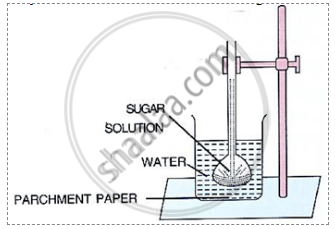
Name any other substance that can be used instead of parchment paper in the above experiment.
Concept: undefined >> undefined
Advertisements
The diagram given below represents an experimental set-up to demonstrate a certain process. Study the same and answer the questions that follow:
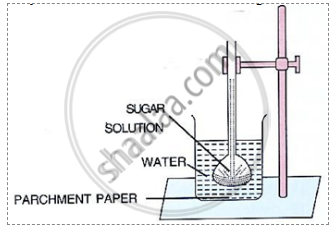
Mention two advantages of the process to the plants.
Concept: undefined >> undefined
Identify the false statements and rewrite them correctly by changing the first or last word only.
Starch produced in a leaf remains stored in it for 2-3 weeks before it is used by other parts of the plant.
Concept: undefined >> undefined
In the flowering plants, food is transported in the form of ______.
Concept: undefined >> undefined
Enumerate the steps involved in testing a green leaf for the presence of starch.
Concept: undefined >> undefined
A higher concentration of ethylene is found in
Concept: undefined >> undefined
The figure given below shows the stages of ripening in a banana. Answer the questions that follow:

- Name the plant hormone responsible for the above changes.
- Mention two characteristic features of this hormone.
Concept: undefined >> undefined
What is a gene? How is it related to heredity?
Concept: undefined >> undefined
Give the significance of mutation.
Concept: undefined >> undefined
What is crossing-over? What are the factors affecting it?
Concept: undefined >> undefined
Mutation alerts the hereditary material. Give reasons.
Concept: undefined >> undefined
Differentiate Between Homozygous shows Heterozygous.
Concept: undefined >> undefined
Differentiate between genotype and phenotype.
Concept: undefined >> undefined
State Mendel’s Law of Dominance.
Concept: undefined >> undefined
- A pure tall plant (TT) is crossed with a pure dwarf plant (tt). Draw Punnett squares to show
- F1, generation
- F2 generation.
- Give the phenotype of F2 generation.
- Give the phenotype and genotypic ratios of the F1 and F2 generations.
Concept: undefined >> undefined
Give the Phenotype of the F2 generation.
Concept: undefined >> undefined
Give the Phenotypic and Genotypic ratio of the F2 and F2 generation.
Concept: undefined >> undefined
Explain the Term Heredity.
Concept: undefined >> undefined
Explain the Term Variation.
Concept: undefined >> undefined
