Please select a subject first
Advertisements
Advertisements
Convert the following:
Bromobenzene to benzoic acid
Concept: undefined >> undefined
Calculate the λ0m for Cl- ion from the data given below:
∧0m MgCl2 = 258.6 Scm2 mol-1 and λ0m Mg2+ = 106 Scm2 mol-1
Concept: undefined >> undefined
Advertisements
Can we construct an electrochemical cell with two half-cells composed of ZnSO4 solution and zinc electrodes? Explain your answer.
Concept: undefined >> undefined
The cell constant of a conductivity cell is 0.146 cm-1. What is the conductivity of 0.01 M solution of an electrolyte at 298 K, if the resistance of the cell is 1000 ohm?
Concept: undefined >> undefined
Draw the structure of the major monohalo product in the following reaction:

Concept: undefined >> undefined
Define “zero order reaction”.
Concept: undefined >> undefined
In a first order reaction x → y, 40% of the given sample of compound remains unreacted in 45 minutes. Calculate rate constant of the reaction.
Concept: undefined >> undefined
The major binding force in diamond is_______________ .
(a) Covalent bond
(b) Ionic bond
(c) Metallic bond
(d) Co-ordinate covalent bond
Concept: undefined >> undefined
What is the covalency of nitrogen in N2O5?
Concept: undefined >> undefined
A reaction is second order in A and first order in B.
(i) Write the differential rate equation.
(ii) How is the rate affected on increasing the concentration of A three times?
(iii) How is the rate affected when the concentrations of both A and B are doubled?
Concept: undefined >> undefined
Give an example each of a molecular solid and an ionic solid.
Concept: undefined >> undefined
For a reaction: 
Rate = k
(i) Write the order and molecularity of this reaction.
(ii) Write the unit of k.
Concept: undefined >> undefined
For the first order thermal decomposition reaction, the following data were obtained:

Time / sec Totalpressure / atm
0 0.30
300 0.50
Calculate the rate constant
(Given: log 2 = 0.301, log3 = 0.4771, log 4 = 0.6021)
Concept: undefined >> undefined
Write two factors that affect the rate of reaction.
Concept: undefined >> undefined
For a reaction A + B ⟶ P, the rate is given by
Rate = k [A] [B]2
How is the rate of reaction affected if the concentration of B is doubled?
Concept: undefined >> undefined
For a reaction A + B ⟶ P, the rate is given by
Rate = k [A] [B]2
What is the overall order of reaction if A is present in large excess?
Concept: undefined >> undefined
For a reaction : 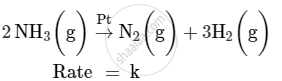
(i) Write the order and molecularity of this reaction.
(ii) Write the unit of k.
Concept: undefined >> undefined
For the hydrolysis of methyl acetate in aqueous solution, the following results were obtained :
| t/s | 0 | 30 | 60 |
| [CH3COOCH3] / mol L–1 | 0.60 | 0.30 | 0.15 |
(i) Show that it follows pseudo first order reaction, as the concentration of water remains constant.
(ii) Calculate the average rate of reaction between the time interval 30 to 60 seconds.
(Given log 2 = 0.3010, log 4 = 0.6021)
Concept: undefined >> undefined
Write the IUPAC name of the given compound:

Concept: undefined >> undefined
Write the names and structures of the monomers of the following polymers: Polyvinyl chloride
Concept: undefined >> undefined
