Advertisements
Advertisements
Consider the LCR circuit shown in figure. Find the net current i and the phase of i. Show that i = v/Z`. Find the impedance Z for this circuit.

Concept: undefined >> undefined
For an LCR circuit driven at frequency ω, the equation reads
`L (di)/(dt) + Ri + q/C = v_i = v_m` sin ωt
- Multiply the equation by i and simplify where possible.
- Interpret each term physically.
- Cast the equation in the form of a conservation of energy statement.
- Integrate the equation over one cycle to find that the phase difference between v and i must be acute.
Concept: undefined >> undefined
Advertisements
One requires 11eV of energy to dissociate a carbon monoxide molecule into carbon and oxygen atoms. The minimum frequency of the appropriate electromagnetic radiation to achieve the dissociation lies in ______.
Concept: undefined >> undefined
The electric field intensity produced by the radiations coming from 100 W bulb at a 3 m distance is E. The electric field intensity produced by the radiations coming from 50 W bulb at the same distance is ______.
Concept: undefined >> undefined
The ratio of contributions made by the electric field and magnetic field components to the intensity of an EM wave is ______.
Concept: undefined >> undefined
Why does microwave oven heats up a food item containing water molecules most efficiently?
Concept: undefined >> undefined
The magnetic field of a beam emerging from a filter facing a floodlight is given by B0 = 12 × 10–8 sin (1.20 × 10⁷z – 3.60 × 10¹⁵t) T. What is the average intensity of the beam?
Concept: undefined >> undefined
Electromagnetic waves with wavelength
- λ1 is used in satellite communication.
- λ2 is used to kill germs in water purifies.
- λ3 is used to detect leakage of oil in underground pipelines.
- λ4 is used to improve visibility in runways during fog and mist conditions.
- Identify and name the part of electromagnetic spectrum to which these radiations belong.
- Arrange these wavelengths in ascending order of their magnitude.
- Write one more application of each.
Concept: undefined >> undefined
What happens to the intensity of light from a bulb if the distance from the bulb is doubled? As a laser beam travels across the length of a room, its intensity essentially remains constant. What geometrical characteristic of LASER beam is responsible for the constant intensity which is missing in the case of light from the bulb?
Concept: undefined >> undefined
Do all the electrons that absorb a photon come out as photoelectrons?
Concept: undefined >> undefined
Consider a metal exposed to light of wavelength 600 nm. The maximum energy of the electron doubles when light of wavelength 400 nm is used. Find the work function in eV.
Concept: undefined >> undefined
Two monochromatic beams A and B of equal intensity I, hit a screen. The number of photons hitting the screen by beam A is twice that by beam B. Then what inference can you make about their frequencies?
Concept: undefined >> undefined
Consider a thin target (10–2 cm square, 10–3 m thickness) of sodium, which produces a photocurrent of 100 µA when a light of intensity 100W/m2 (λ = 660 nm) falls on it. Find the probability that a photoelectron is produced when a photons strikes a sodium atom. [Take density of Na = 0.97 kg/m3].
Concept: undefined >> undefined
Consider a 20 W bulb emitting light of wavelength 5000 Å and shining on a metal surface kept at a distance 2 m. Assume that the metal surface has work function of 2 eV and that each atom on the metal surface can be treated as a circular disk of radius 1.5 Å.
- Estimate no. of photons emitted by the bulb per second. [Assume no other losses]
- Will there be photoelectric emission?
- How much time would be required by the atomic disk to receive energy equal to work function (2 eV)?
- How many photons would atomic disk receive within time duration calculated in (iii) above?
- Can you explain how photoelectric effect was observed instantaneously?
Concept: undefined >> undefined
A 100 m long antenna is mounted on a 500 m tall building. The complex can become a transmission tower for waves with λ.
Concept: undefined >> undefined
A speech signal of 3 kHz is used to modulate a carrier signal of frequency 1 MHz, using amplitude modulation. The frequencies of the sidebands will be ______.
Concept: undefined >> undefined
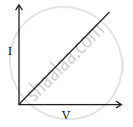
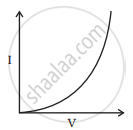
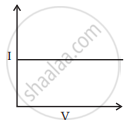
I-V characteristics of four devices are shown in Figures.
 |
 |
 |
|
| (i) | (ii) | (iii) | (iv) |
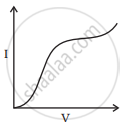
Identify devices that can be used for modulation.
Concept: undefined >> undefined
Show that the first few frequencies of light that is emitted when electrons fall to the nth level from levels higher than n, are approximate harmonics (i.e. in the ratio 1 : 2 : 3...) when n >> 1.
Concept: undefined >> undefined
What is the minimum energy that must be given to a H atom in ground state so that it can emit an Hγ line in Balmer series. If the angular momentum of the system is conserved, what would be the angular momentum of such Hγ photon?
Concept: undefined >> undefined
The first four spectral lines in the Lyman series of a H-atom are λ = 1218 Å, 1028Å, 974.3 Å and 951.4 Å. If instead of Hydrogen, we consider Deuterium, calculate the shift in the wavelength of these lines.
Concept: undefined >> undefined
