Advertisements
Advertisements
A person standing on a platform finds that a train moving with velocity 0.6c takes one second to pass by him. Find (a) the length of the train as seen by the person and (b) the rest length of the train.
Concept: undefined >> undefined
A person travels on a spaceship moving at a speed of 5c/13. (a) Find the time interval calculated by him between the consecutive birthday celebrations of his friend on the earth. (b) Find the time interval calculated by the friend on the earth between the consecutive birthday celebrations of the traveller.
Concept: undefined >> undefined
Advertisements
(a) Calculate the energy released if 238U emits an α-particle. (b) Calculate the energy to be supplied to 238U it two protons and two neutrons are to be emitted one by one. The atomic masses of 238U, 234Th and 4He are 238.0508 u, 234.04363 u and 4.00260 u respectively.
(Use Mass of proton mp = 1.007276 u, Mass of `""_1^1"H"` atom = 1.007825 u, Mass of neutron mn = 1.008665 u, Mass of electron = 0.0005486 u ≈ 511 keV/c2,1 u = 931 MeV/c2.)
Concept: undefined >> undefined
A person travelling by a car moving at 100 km h−1 finds that his wristwatch agrees with the clock on a tower A. By what amount will his wristwatch lag or lead the clock on another tower B, 1000 km (in the earth's frame) from the tower A when the car reaches there?
Concept: undefined >> undefined
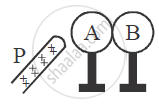
Two metallic spheres A and B kept on insulating stands are in contact with each other. A positively charged rod P is brought near the sphere A as shown in the figure. The two spheres are separated from each other, and the rod P is removed. What will be the nature of charges on spheres A and B?
Concept: undefined >> undefined
A metal sphere is kept on an insulting stands. A negatively charged rod is brought near it, then the sphere is earthed as shown. On removing the earthing, and taking the negatively charged rod away, what will be the nature of charge on the sphere? Give reason for your answer.

Concept: undefined >> undefined
Write the function of receiver in communication system.
Concept: undefined >> undefined
Write the functions of the transducer and repeaters.
Concept: undefined >> undefined
What is the function of a bandpass filter used in a modulator for obtaining AM signal?
Concept: undefined >> undefined
Answer the following question.
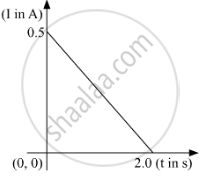
When a conducting loop of resistance 10 Ω and area 10 cm2 is removed from an external magnetic field acting normally, the variation of induced current-I in the loop with time t is as shown in the figure.
Find the
(a) total charge passed through the loop.
(b) change in magnetic flux through the loop
(c) magnitude of the field applied
Concept: undefined >> undefined
Define Current density.
Concept: undefined >> undefined
A 44 mH inductor is connected to 220 V, 50 Hz ac supply. Determine the rms value of the current in the circuit.
Concept: undefined >> undefined
A magnetic field that varies in magnitude from point to point but has a constant direction (east to west) is set up in a chamber. A charged particle enters the chamber and travels undeflected along a straight path with constant speed. What can you say about the initial velocity of the particle?
Concept: undefined >> undefined
A coil of inductance 0.50 H and resistance 100 Ω is connected to a 240 V, 50 Hz ac supply.
(a) What is the maximum current in the coil?
(b) What is the time lag between the voltage maximum and the current maximum?
Concept: undefined >> undefined
Obtain if the circuit is connected to a high-frequency supply (240 V, 10 kHz). Hence, explain the statement that at very high frequency, an inductor in a circuit nearly amounts to an open circuit. How does an inductor behave in a dc circuit after the steady state?
Concept: undefined >> undefined
A 100 µF capacitor in series with a 40 Ω resistance is connected to a 110 V, 60 Hz supply.
(a) What is the maximum current in the circuit?
(b) What is the time lag between the current maximum and the voltage maximum?
Concept: undefined >> undefined
Obtain if the circuit is connected to a 110 V, 12 kHz supply? Hence, explain the statement that a capacitor is a conductor at very high frequencies. Compare this behaviour with that of a capacitor in a dc circuit after the steady state.
Concept: undefined >> undefined
An applied voltage signal consists of a superposition of a dc voltage and an ac voltage of high frequency. The circuit consists of an inductor and a capacitor in series. Show that the dc signal will appear across C and the ac signal across L.
Concept: undefined >> undefined
Alternating current is so called because _______.
Concept: undefined >> undefined
In a circuit containing resistance only, voltage and current are ______.
Concept: undefined >> undefined
