Advertisements
Advertisements
Draw a labelled ray diagram of an astronomical telescope in the near point adjustment position. A giant refracting telescope at an observatory has an objective lens of focal length 15 m and an eyepiece of focal length 1.0 cm. If this telescope is used to view the Moon, find the diameter of the image of the Moon formed by the objective lens. The diameter of the Moon is `3.48 xx 10^6`m, and the radius of the lunar orbit is `3.48 xx 10^8`m.
Concept: undefined >> undefined
Define the term ‘resolving power of a telescope’.
Concept: undefined >> undefined
Advertisements
A capacitor has some dielectric between its plates, and the capacitor is connected to a dc source. The battery is now disconnected and then the dielectric is removed, then ______.
Concept: undefined >> undefined
A small telescope has an objective lens of focal length 140 cm and an eyepiece of focal length 5.0 cm. Find the magnifying power of the telescope for viewing distant objects when
- the telescope is in normal adjustment,
- the final image is formed at the least distance of distinct vision.
Concept: undefined >> undefined
Draw a ray diagram of astronomical telescope for the final image formed at infinity.
Concept: undefined >> undefined
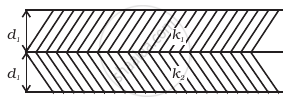
A parallel plate capacitor is made of two dielectric blocks in series. One of the blocks has thickness d1 and dielectric constant k1 and the other has thickness d2 and dielectric constant k2 as shown in figure. This arrangement can be thought as a dielectric slab of thickness d (= d1 + d2) and effective dielectric constant k. The k is ______.
Concept: undefined >> undefined
A capacitor is made of two circular plates of radius R each, separated by a distance d << R. The capacitor is connected to a constant voltage. A thin conducting disc of radius r<<R and thickness t << r is placed at a centre of the bottom plate. Find the minimum voltage required to lift the disc if the mass of the disc is m.
Concept: undefined >> undefined
Read the following paragraph and answer the questions.
| A number of optical devices and instruments have been designed and developed such as periscope, binoculars, microscopes and telescopes utilising the reflecting and refracting properties of mirrors, lenses and prisms. Most of them are in common use. Our knowledge about the formation of images by the mirrors and lenses is the basic requirement for understanding the working of these devices. |
- Why the image formed at infinity is often considered most suitable for viewing. Explain
- In modern microscopes, multicomponent lenses are used for both the objective and the eyepiece. Why?
- Write two points of difference between a compound microscope and an astronomical telescope
OR
Write two distinct advantages of a reflecting type telescope over a refracting type telescope.
Concept: undefined >> undefined
With the help of a ray diagram explain the working of a reflecting telescope.
Concept: undefined >> undefined
Draw a labelled ray diagram showing the image formation by a refracting telescope. Define its magnifying power.
Concept: undefined >> undefined
Draw a ray diagram for the formation of image of an object by an astronomical telescope, in normal adjustment. Obtain the expression for its magnifying power.
Concept: undefined >> undefined
The magnifying power of an astronomical telescope in normal adjustment is 2.9 and the objective and the eyepiece are separated by a distance of 150 cm. Find the focal lengths of the two lenses.
Concept: undefined >> undefined
In an astronomical telescope in normal adjustment, a straight black line of length L is drawn on the objective lens. The eyepiece forms a real image of this line whose length is 𝑙. What is the angular magnification of the telescope?
Concept: undefined >> undefined
Two capacitors of unknown capacitances C1 and C2 are connected first in series and then in parallel across a battery of 100 V. If the energy stored in the two combinations is 0.045 J and 0.25 J respectively, determine the value of C1 and C2. Also calculate the charge on each capacitor in parallel combination.
Concept: undefined >> undefined
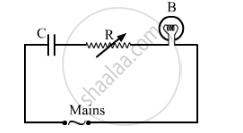
A capacitor 'C', a variable resistor 'R' and a bulb 'B' are connected in series to the ac mains in circuit as shown. The bulb glows with some brightness. How will the glow of the bulb change if (i) a dielectric slab is introduced between the plates of the capacitor, keeping resistance R to be the same; (ii) the resistance R is increased keeping the same capacitance?
Concept: undefined >> undefined
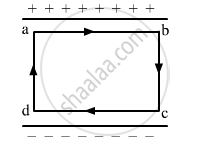
The electric field inside a parallel plate capacitor is E. Find the amount of work done in moving a charge q over a closed loop a b c d a.
Concept: undefined >> undefined
Three capacitors each of capacitance 9 pF are connected in series.
- What is the total capacitance of the combination?
- What is the potential difference across each capacitor if the combination is connected to a 120 V supply?
Concept: undefined >> undefined
Three capacitors of capacitances 2 pF, 3 pF and 4 pF are connected in parallel. Determine the charge on each capacitor if the combination is connected to a 100 V supply.
Concept: undefined >> undefined
An electrical technician requires a capacitance of 2 µF in a circuit across a potential difference of 1 kV. A large number of 1 µF capacitors are available to him each of which can withstand a potential difference of not more than 400 V. Suggest a possible arrangement that requires the minimum number of capacitors.
Concept: undefined >> undefined
A cylindrical capacitor has two co-axial cylinders of length 15 cm and radii 1.5 cm and 1.4 cm. The outer cylinder is earthed and the inner cylinder is given a charge of 3.5 µC. Determine the capacitance of the system and the potential of the inner cylinder. Neglect end effects (i.e., bending of field lines at the ends).
Concept: undefined >> undefined
