Please select a subject first
Advertisements
Advertisements
Establish the following vector inequalities geometrically or otherwise:
- | a+b | ≤ |a| + |b|
- |a + b| ≥ | |a| - |b| |
- |a - b| ≤ |a| + |b|
- |a-b| ≥ | |a| - |b| |
When does the equality sign above apply?
Concept: undefined >> undefined
Two heavy spheres each of mass 100 kg and radius 0.10 m are placed 1.0 m apart on a horizontal table. What is the gravitational force and potential at the mid point of the line joining the centers of the spheres? Is an object placed at that point in equilibrium? If so, is the equilibrium stable or unstable?
Concept: undefined >> undefined
Advertisements
A star 2.5 times the mass of the sun and collapsed to a size of 12 km rotates with a speed of 1.2 rev. per second. (Extremely compact stars of this kind are known as neutron stars. Certain stellar objects called pulsars belong to this category). Will an object placed on its equator remain stuck to its surface due to gravity? (mass of the sun = 2 x 1030 kg).
Concept: undefined >> undefined
Give the magnitude and direction of the net force acting on a drop of rain falling down with a constant speed.
Concept: undefined >> undefined
The driver of a three-wheeler moving with a speed of 36 km/h sees a child standing in the middle of the road and brings his vehicle to rest in 4.0 s just in time to save the child. What is the average retarding force on the vehicle? The mass of the three-wheeler is 400 kg and the mass of the driver is 65 kg.
Concept: undefined >> undefined
If the speed of the stone is increased beyond the maximum permissible value, and the string breaks suddenly, which of the following correctly describes the trajectory of the stone after the string breaks?
Concept: undefined >> undefined
Read each statement below carefully, and state, with reasons, if it is true or false;
During rolling, the force of friction acts in the same direction as the direction of motion of the CM of the body
Concept: undefined >> undefined
Read each statement below carefully, and state, with reasons, if it is true or false;
The instantaneous acceleration of the point of contact during rolling is zero.
Concept: undefined >> undefined
A piece of copper having a rectangular cross-section of 15.2 mm × 19.1 mm is pulled in tension with 44,500 N force, producing only elastic deformation. Calculate the resulting strain?
Concept: undefined >> undefined
A vertical off-shore structure is built to withstand a maximum stress of 109 Pa. Is the structure suitable for putting up on top of an oil well in the ocean? Take the depth of the ocean to be roughly 3 km, and ignore ocean currents.
Concept: undefined >> undefined
What is the pressure inside the drop of mercury of radius 3.00 mm at room temperature? The surface tension of mercury at that temperature (20°C) is 4.65 × 10⁻¹ N m–1. The atmospheric pressure is 1.01 × 10⁵ Pa. Also give the excess pressure inside the drop
Concept: undefined >> undefined
A tank with a square base of area 1.0 m2 is divided by a vertical partition in the middle. The bottom of the partition has a small-hinged door of area 20 cm2. The tank is filled with water in one compartment, and an acid (of relative density 1.7) in the other, both to a height of 4.0 m. compute the force necessary to keep the door close.
Concept: undefined >> undefined
It is known that density ρ of air decreases with height y as `0^(e^(y/y_0))` Where`rho_0` = 1.25 kg m–3 is the density at sea level, and y0 is a constant. This density variation is called the law of atmospheres. Obtain this law assuming that the temperature of atmosphere remains a constant (isothermal conditions). Also, assume that the value of gremains constant
Concept: undefined >> undefined
Explain why Two bodies at different temperatures T1 and T2, if brought in thermal contact, do not necessarily settle to the mean temperature (T1 + T2)/2.
Concept: undefined >> undefined
Explain why Air pressure in a car tyre increases during driving.
Concept: undefined >> undefined
In changing the state of a gas adiabatically from an equilibrium state A to another equilibrium state B, an amount of work equal to 22.3 J is done on the system. If the gas is taken from state A to B via a process in which the net heat absorbed by the system is 9.35 cal, how much is the net work done by the system in the latter case? (Take 1 cal = 4.19 J)
Concept: undefined >> undefined
Two cylinders A and B of equal capacity are connected to each other via a stopcock. A contains a gas at standard temperature and pressure. B is completely evacuated. The entire system is thermally insulated. The stopcock is suddenly opened. Answer the following:
Do the intermediate states of the system (before settling to the final equilibrium state) lie on its P-V-T surface?
Concept: undefined >> undefined
A steam engine delivers 5.4×10⁸ J of work per minute and services 3.6 × 10⁹ J of heat per minute from its boiler. What is the efficiency of the engine? How much heat is wasted per minute?
Concept: undefined >> undefined
The motion of a particle executing simple harmonic motion is described by the displacement function,
x (t) = A cos (ωt + φ).
If the initial (t = 0) position of the particle is 1 cm and its initial velocity is ω cm/s, what are its amplitude and initial phase angle? The angular frequency of the particle is π s–1. If instead of the cosine function, we choose the sine function to describe the SHM: x = B sin (ωt + α), what are the amplitude and initial phase of the particle with the above initial conditions.
Concept: undefined >> undefined
Figures correspond to two circular motions. The radius of the circle, the period of revolution, the initial position, and the sense of revolution (i.e. clockwise or anti-clockwise) are indicated on each figure
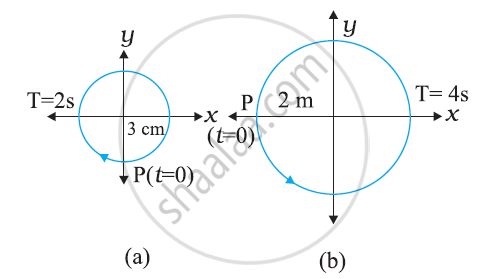
Obtain the corresponding simple harmonic motions of the x-projection of the radius vector of the revolving particle P, in each case.
Concept: undefined >> undefined
