Please select a subject first
Advertisements
Advertisements
Consider a long steel bar under a tensile stress due to forces F acting at the edges along the length of the bar (Figure). Consider a plane making an angle θ with the length. What are the tensile and shearing stresses on this plane

- For what angle is the tensile stress a maximum?
- For what angle is the shearing stress a maximum?
Concept: undefined >> undefined
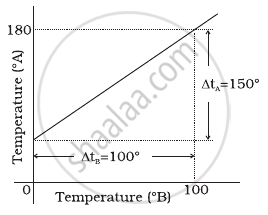
The graph between two temperature scales A and B is shown in figure. Between upper fixed point and lower fixed point there are 150 equal division on scale A and 100 on scale B. The relationship for conversion between the two scales is given by ______.
Concept: undefined >> undefined
Advertisements
The graph between two temperature scales A and B is shown in figure. Between upper fixed point and lower fixed point there are 150 equal division on scale A and 100 on scale B. The relationship for conversion between the two scales is given by ______.
Concept: undefined >> undefined
Calculate the temperature which has same numeral value on celsius and Fahrenheit scale.
Concept: undefined >> undefined
Calculate the temperature which has same numeral value on celsius and Fahrenheit scale.
Concept: undefined >> undefined
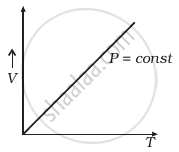
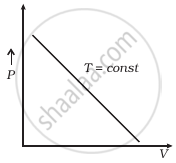
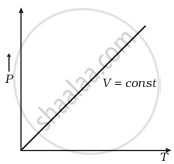
Which of the following diagrams (Figure) depicts ideal gas behaviour?
 (a) |
 (b) |
 (c) |
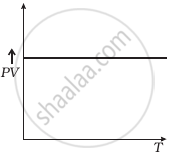 (d) |
Concept: undefined >> undefined
Calculate the number of atoms in 39.4 g gold. Molar mass of gold is 197g mole–1.
Concept: undefined >> undefined
A box of 1.00 m3 is filled with nitrogen at 1.50 atm at 300K. The box has a hole of an area 0.010 mm2. How much time is required for the pressure to reduce by 0.10 atm, if the pressure outside is 1 atm.
Concept: undefined >> undefined
The displacement of a particle is represented by the equation y = sin3ωt. The motion is ______.
Concept: undefined >> undefined
The displacement of a particle varies with time according to the relation y = a sin ωt + b cos ωt.
Concept: undefined >> undefined
Motion of a ball bearing inside a smooth curved bowl, when released from a point slightly above the lower point is ______.
- simple harmonic motion.
- non-periodic motion.
- periodic motion.
- periodic but not S.H.M.
Concept: undefined >> undefined
Displacement vs. time curve for a particle executing S.H.M. is shown in figure. Choose the correct statements.

- Phase of the oscillator is same at t = 0 s and t = 2s.
- Phase of the oscillator is same at t = 2 s and t = 6s.
- Phase of the oscillator is same at t = 1 s and t = 7s.
- Phase of the oscillator is same at t = 1 s and t = 5s.
Concept: undefined >> undefined
What is the ratio of maxmimum acceleration to the maximum velocity of a simple harmonic oscillator?
Concept: undefined >> undefined
The earth has a radius of 6400 km. The inner core of 1000 km radius is solid. Outside it, there is a region from 1000 km to a radius of 3500 km which is in molten state. Then again from 3500 km to 6400 km the earth is solid. Only longitudinal (P) waves can travel inside a liquid. Assume that the P wave has a speed of 8 km s–1 in solid parts and of 5 km s–1 in liquid parts of the earth. An earthquake occurs at some place close to the surface of the earth. Calculate the time after which it will be recorded in a seismometer at a diametrically opposite point on the earth if wave travels along diameter?
Concept: undefined >> undefined
In the given progressive wave y = 5 sin (100 πt – 0.4 πx) where y and x are in m, t is in s. What is the amplitude.
Concept: undefined >> undefined
In the given progressive wave y = 5 sin (100 πt – 0.4 πx) where y and x are in m, t is in s. What is the wavelength.
Concept: undefined >> undefined
In the given progressive wave y = 5 sin (100 πt – 0.4 πx) where y and x are in m, t is in s. What is the frequency.
Concept: undefined >> undefined
In the given progressive wave y = 5 sin (100 πt – 0.4 πx) where y and x are in m, t is in s. What is the wave velocity.
Concept: undefined >> undefined
In the given progressive wave y = 5 sin (100 πt – 0.4 πx) where y and x are in m, t is in s. What is the particle velocity amplitude..
Concept: undefined >> undefined
Given a + b + c + d = 0, state whether the following statement is correct or incorrect:
b + c must lie in the plane of a and d if a and d are not collinear, and in the line of a and d, if they are collinear.
Concept: undefined >> undefined
