Please select a subject first
Advertisements
Advertisements
The half-life of a certain radioactive nucleus is 3.2 days. Calculate (i) decay constant (ii) average life of radioactive nucleus.
Concept: Radioactive Decays
Show that for radioactive decay N(t) = `"N"_"O" "e"^{-λ"t"}`, where symbols have their usual meaning.
Concept: Radioactive Decays
Obtain an expression for the half-lifetime of radioactive material. Hence state the relation between an average life and half life time of radioactive material.
Concept: Radioactive Decays
A radioactive substance decays to (1/10)th of its original value in 56 days. Calculate its decay constant.
Concept: Radioactive Decays
Determine the shortest wavelengths of Balmer and Pasch en series. Given the limit for the Lyman series is 912 Å.
Concept: Atomic Spectra
The disintegration rate of a radio-active sample is 1010 per hour at 20 hours from the start. It reduces to 5 × 10⁹ per hour after 30 hours. Calculate the decay constant.
Concept: Radioactive Decays
State unit and dimensions of Magnetic susceptibility.
Concept: Magnetisation and Magnetic Intensity
What is binding energy of a hydrogen atom?
Concept: Mass Defect and Binding Energy
Calculate the wavelength of the first two lines in the Balmer series of hydrogen atoms.
Concept: Atomic Spectra
The co-efficient of mutual induction between primary and secondary coil is 2H. Calculate induced e.m.f. if current of 4A is cut off in 2.5 x 10⁻⁴ seconds
Concept: Inductance >> Mutual Inductance
Electric field intensity in free space at a distance ‘r’ outside the charged conducting sphere of radius ‘R’ in terms of surface charge density ‘ a ’ is............................
(a)`sigma / in_0[R/r]^2`
(b)`in_0/sigma[R/r]^2`
(c)`R/r[sigma/in_0]^2`
(d)`R/sigma[r/in_0]^2`
Concept: Introduction to Electromagnetic Induction
A solenoid 3.142m long and 5.0 cm in diameter has two layers of windings of 500 turns each and carries a current of 5A. Calculate the magnetic induction at its centre along the axis.
Concept: Inductance and Capacitance
The magnetic flux through a loop varies according to the relation Φ = 8t2 + 6t + C, where ‘C’ is constant, 'Φ' is in milliweber and 't' is in second. What is the magnitude of induced e.m.f. in the loop at t = 2 seconds.
Concept: Introduction to Electromagnetic Induction
Two metal spheres having charge densities 5μC/m2 and -2μC/m2 with radii 2mm and 1mm respectively are kept in a hypothetical closed surface. Calculate total normal electric induction over the closed surface.
Concept: Inductance and Capacitance
Obtain an expression for e.m.f. induced in a coil rotating with uniform angular velocity in a uniform magnetic field. Show graphically the variation of e.m.f. with time (t).
Resistance of a potentiometer wire is 0.1Ω/cm. A cell of e.m.f 1.5V is balanced at 300 cm on this potentiometer wire. Calculate the current and balancing length for another cell of e.m.f. 1.4V on the same potentiometer wire.
Concept: Coil Rotating in Uniform Magnetic Induction
Discuss the composition of two S.H.M.s along the same path having same period. Find the resultant amplitude and intial phase.
Concept: LC Oscillations
Obtain an expression for average power dissipated in a purely resistive A.C. circult.
Concept: Power in AC Circuit
If the radius of a sphere is doubled without changing the charge on it, then electric flux originating from the sphere is ______.
Concept: Inductance >> Mutual Inductance
A coil of 100 turns, each of area 0.02m2 is kept in a uniform field of induction 3.5 x10⁻⁵ T. If the coil rotates with a speed of 6000 r.p.m. about an axis in the plane of the coil and perpendicular to the magnetic induction, calculate peak value of e.m.f. induced in the coil.
Concept: Coil Rotating in Uniform Magnetic Induction
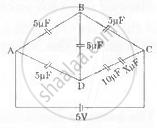
Six capacitors of capacities 5, 5. 5, 5, 10 and X μ F are connected as shown in the network in the diagram.
Find :
- The value of X if the network is balanced, and
- The resultant capacitance between A and C.
Concept: Inductance and Capacitance
