Advertisements
Advertisements
Briefly explain the following terms: Photophosphorylation
Concept: Concept of Photosynthesis
the exact location of the Thylakoids
Concept: Concept of Photosynthesis
The diagram below shows two test-tubes A and B. Test-tube A contains a green water plant. Test-tube B contains both a green water plant and a snail. Both testtubes are kept in sunlight. Answer the questions that follow:

(i) Name the physiological process that releases the bubbles of oxygen.
(ii) Explain the physiological process as mentioned above in Q2 (a)(i).
(iii) What is the purpose of keeping a snail in test-tube ‘B’?
(iv) Why does test-tube ‘B’ have more bubbles of oxygen?
(v) Given an example of a water plant that can be used in the above process.
(vi) Write the overall chemical equation for the above process.
Concept: Concept of Photosynthesis
Name the following:
The process of conversion of ADP into ATP during photosynthesis.
Concept: Concept of Photosynthesis
State the main function of the Lenticels
Concept: Process of Photosynthesis
Identify the odd one in each set : Transpiration, Photosynthesis, Phagocytosis, Guttation
Concept: Concept of Photosynthesis
The figure given below represents an experimental setup with a weighing machine to demonstrate a particular process in plants. The experimental setup was placed in bright sunlight. Study the diagram and answer the following questions:

(i) Name the process intended for study.
(ii) Define the above mentioned process.
(iii) When the weight of the test tube (A & B) is taken before and after the experiment, what is observed? Give reasons to justify your observation in A & B.
(iv) What is the purpose of keeping the test tube B in the experimental setup?
Concept: Concept of Photosynthesis
A potted plant was taken in order to prove a factor necessary for photosynthesis. The potted plant was kept in the dark for 24 hours. One of the leaves was covered with black paper in the centre.The potted plant was then placed in sunlight for a few hours.
- What aspect of photosynthesis was being tested?
- Why was the plant placed in the dark before beginning the experiment?
- During the starch test why was the leaf
- boiled in water
- boiled in methylated spirit
- Write a balanced chemical equation to represent the process of photosynthesis.
- Draw a neat diagram of a chloroplast and label its parts.
Concept: Concept of Photosynthesis
Give one example of An aquatic plant used in the laboratory to demonstrate O2 liberation during photosynthesis
Concept: Concept of Photosynthesis
Expand the following biological abbreviations: ATP
Concept: Concept of Photosynthesis
Complete the following paragraph by filling in the blank (1) to (5) with appropriate words:
To test a leaf for starch, the leaf is boiled in water to (1) _________. It is then boiled in Methylated spirit to (2) ________. The leaf is dipped in warm water to soften it. It is placed in a petri dish, and (3) _____ solution is added. The region of the leaf which contains starch, turns (4) ________and the region while does not contain starch, turns (5) __________.
Concept: Concept of Photosynthesis
A potted plant with variegated leaves was taken in order to prove a factor necessary for photosynthesis. The potted plant was kept in the dark for 24 hours and then placed in bright sunlight for a few hours. Observe the diagrams and answer the questions:

- What aspect of photosynthesis is being tested in the above diagram?
- Represent the process of photosynthesis in the form of a balanced equation.
- Why was the plant kept in the dark before beginning the experiment?
- What will be the result of the starch test performed on Leaf ‘A’ shown in the diagram? Give an example of a plant with variegated leaves
- Draw a neat labelled diagram of a chloroplast.
Concept: Chlorophyll: The Vital Plant Pigment
Differentiate between the following pairs on the basis of what is indicated in the brackets.
Leaf and Liver [form in which glucose is stored]
Concept: Concept of Photosynthesis
Give biological explanations for Plants growing in fertilized soil are often found to wilt if the soil is not adequately watered.
Concept: Concept of Photosynthesis
Give suitable biological reasons for the following statement :
All life on Earth is supported by Photosynthesis.
Concept: Concept of Photosynthesis
Expand the following biological abbreviations :
ATP
Concept: Concept of Photosynthesis
Given below is an experimental setup to demonstrate a particular tropic movement in germinating seeds. Study the diagram and answer the questions that follow:
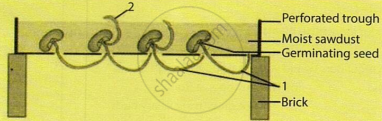
- Label the parts 1 and 2.
- Name the tropic movement shown by part 1.
- Part 1 is affected by two stimuli. Name them. Which one of the two is stronger?
- What is thigmotropism? Give one example.
- What is meant by 'Positive' and 'Negative' tropic movements in plants?
Concept: Concept of Photosynthesis
Given below is an experiment setup to demonstrate a particualr tropic movement in germinating seeds. Study the diagram and answer the questions that follow :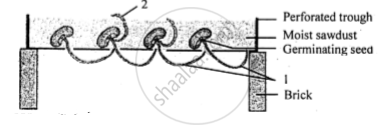
(ii) Name the tropic movement shown by part 1.
Concept: Concept of Photosynthesis
Given below is an experiment setup to demonstrate a particualr tropic movement in germinating seeds. Study the diagram and answer the questions that follow :
Part 1 is affected by two stimuli. Name them. Which one of the two is stronger?
Part 1 is affected by two stimuli. Name them. Which one of the two is stronger?
Concept: Concept of Photosynthesis
Given below is an experiment setup to demonstrate a particualr tropic movement in germinating seeds. Study the diagram and answer the questions that follow :
What is Thigmotropism? Give one example.
Concept: Concept of Photosynthesis
