Advertisements
Advertisements
प्रश्न
Give suitable biological reasons for the following statement :
All life on Earth is supported by Photosynthesis.
Advertisements
उत्तर
Photosynthesis is ultimately the source of energy and food for all living beings i.e. directly for plants and indirectly for animals.
APPEARS IN
संबंधित प्रश्न
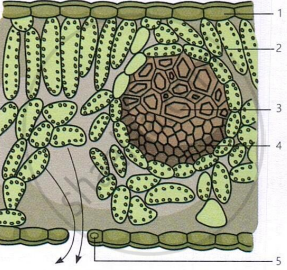
Fig. represents the vertical section of a leaf.
- Name the parts labelled 1 to 5.
- What do the two arrows (dotted and solid) indicate in the daytime and at night?
- Could you add one more arrow in the figure? If yes, what for?
A plant is kept in a dark cupboard for 48 hours before conducting any experiment on photosynthesis in order to
Give technical term:
What does ATP abbreviate for?
Complete the following sentence with appropriate word:
AIIP stands for ____________.
Complete the following sentence with appropriate word:
A dark reaction is a __________ reaction.
Choose the correct option.
The net result of photo-oxidation of water is release of ______.
Choose the correct option.
The sequential order in electron transport from PSII to PSI of photosynthesis is ______.
State whether true or false. If false, correct the statement.
Plants lose water when the stomata on leaves are closed.
Plants may inhale carbon dioxide for photosynthesis but need ______ for their living.
Study the diagram given below and fill in the blanks with suitable words:
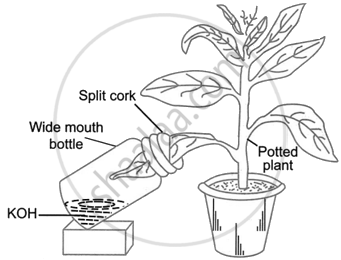
In order to prove that carbon dioxide is necessary for
(a) ______, a potted plant is placed in dark for 48 hours to (b) ______ the leaves. A part of a leaf is inserted into a conical flask containing potassium hydroxide solution. This is to absorb (c) ______ from the flask. The plant is then placed in sunlight for a few hours. The experimental leaf is tested for starch. The part of the leaf that was inside the conical flask turns (d) ______, whereas the part of the left outside turns (e) ______ in colour.
