Advertisements
Advertisements
In a Geiger-Marsden experiment, calculate the distance of closest approach to the nucleus of Z = 75, when a α-particle of 5 MeV energy impinges on it before it comes momentarily to rest and reverses its direction.
How will the distance of closest approach be affected when the kinetic energy of the α-particle is doubles?
Concept: Alpha-particle Scattering and Rutherford’s Nuclear Model of Atom
The ground state energy of hydrogen atom is −13.6 eV. If an electron make a transition from an energy level −0.85 eV to −1.51 eV, calculate the wavelength of the spectral line emitted. To which series of hydrogen spectrum does this wavelength belong?
Concept: Hydrogen Spectrum
Write the expression for Bohr’s radius in hydrogen atom ?
Concept: Bohr’s Model for Hydrogen Atom
The energy levels of an atom are as shown below. Which of them will result in the transition of a photon of wavelength 275 nm?
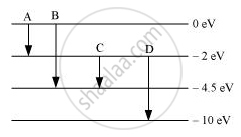
Concept: Energy Levels
Which transition corresponds to emission of radiation of maximum wavelength?
Concept: Energy Levels
Plot a graph showing the variation of de Broglie wavelength (X) associated with a charged a particle of mass m, versus `1/sqrtV` where V is the potential difference through which the particle is accelerated. How does this graph give us information regarding the magnitude of the charge of the particle?
Concept: De Broglie’s Explanation of Bohr’s Second Postulate of Quantisation
Answer the following question.
A charged particle q is moving in the presence of a magnetic field B which is inclined to an angle 30° with the direction of the motion of the particle. Draw the trajectory followed by the particle in the presence of the field and explain how the particle describes this path.
Concept: Alpha-particle Scattering and Rutherford’s Nuclear Model of Atom
Answer the following question.
Explain briefly how Rutherford scattering of α-particle by a target nucleus can provide information on the size of the nucleus.
Concept: Alpha-particle Scattering and Rutherford’s Nuclear Model of Atom
When the electron orbiting in hydrogen atom in its ground state moves to the third excited state, show how the de Broglie wavelength associated with it would be affected.
Concept: Bohr’s Model for Hydrogen Atom
Consider two different hydrogen atoms. The electron in each atom is in an excited state. Is it possible for the electrons to have different energies but same orbital angular momentum according to the Bohr model? Justify your answer.
Concept: Bohr’s Model for Hydrogen Atom
Derive an expression for the frequency of radiation emitted when a hydrogen atom de-excites from level n to level (n – 1). Also show that for large values of n, this frequency equals to classical frequency of revolution of an electron.
Concept: Bohr’s Model for Hydrogen Atom
How long can an electric lamp of 100 W be kept glowing by fusion of 2 kg of deuterium? Take the fusion reaction as
\[\ce{^2_1H + ^2_1H -> ^3_2He + n + 3.27 MeV}\]
Concept: Introduction of Atoms
The radius of the innermost electron orbit of a hydrogen atom is 5.3 × 10⁻¹¹m. The radius of the n = 3 orbit is ______.
Concept: Bohr’s Model for Hydrogen Atom
What is the nuclear radius of 125Fe, if that of 27Al is 3.6 fermi?
Concept: Alpha-particle Scattering and Rutherford’s Nuclear Model of Atom
The short wavelength limit for the Lyman series of the hydrogen spectrum is 913.4 Å. Calculate the short wavelength limit for the Balmer series of the hydrogen spectrum.
Concept: Hydrogen Spectrum
The ground state energy of hydrogen atoms is -13.6 eV. The photon emitted during the transition of electron from n = 3 to n = 1 unknown work function. The photoelectrons are emitted from the material with a maximum kinetic energy of 9 eV. Calculate the threshold wavelength of the material used.
Concept: Bohr’s Model for Hydrogen Atom
How will the energy of a hydrogen atom change if n increases from 1 to ∞?
Concept: Bohr’s Model for Hydrogen Atom
An electron in a hydrogen atom makes transitions from orbits of higher energies to orbits of lower energies.
- When will such transitions result in (a) Lyman (b) Balmer series?
- Find the ratio of the longest wavelength in the Lyman series to the shortest wavelength in the Balmer series.
Concept: Hydrogen Spectrum
The energy of hydrogen atom in an orbit is −1.51 eV. What are the kinetic and potential energies of the electron in this orbit?
Concept: Alpha-particle Scattering and Rutherford’s Nuclear Model of Atom
The electron in a hydrogen atom is typically found at a distance of about 5.3 × 10⁻¹¹ m from the nucleus which has a diameter of about 1.0 × 10⁻¹⁵ m. Assuming the hydrogen atom to be a sphere of radius 5.3 × 10⁻¹¹ m, what fraction of its volume is occupied by the nucleus?
Concept: Alpha-particle Scattering and Rutherford’s Nuclear Model of Atom
