Advertisements
Advertisements
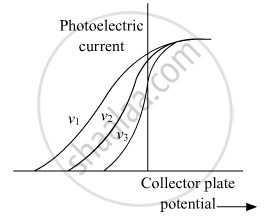
On the basis of the graphs shown in the figure, answer the following questions :
(a) Which physical parameter is kept constant for the three curves?
(b) Which is the highest frequency among v1, v2, and v3?
Concept: Experimental Study of Photoelectric Effect
Use Einstein's photoelectric equation to show how from this graph,
(i) Threshold frequency, and
(ii) Planck's constant can be determined.
Concept: Einstein’s Photoelectric Equation: Energy Quantum of Radiation
The work function of aluminum is 4⋅2 eV. If two photons each of energy 2⋅5 eV are incident on its surface, will the emission of electrons take place? Justify your answer.
Concept: Electron Emission
Define the terms "stopping potential' and 'threshold frequency' in relation to the photoelectric effect. How does one determine these physical quantities using Einstein's equation?
Concept: Experimental Study of Photoelectric Effect
Choose the correct answer from given options
Photons of frequency v are incident on the surface of two metals A and B of threshold frequency 3/4 v and 2/3 v, respectively. The ratio of maximum kinetic energy of electrons emitted from A to that from B is
Concept: Einstein’s Photoelectric Equation: Energy Quantum of Radiation
In the case of a photo electric effect experiment, explain the following facts, giving reasons.
The wave theory of light could not explain the existence of the threshold frequency.
Concept: Photoelectric Effect and Wave Theory of Light
In the case of photoelectric effect experiment, explain the following facts, giving reasons.
The photoelectric current increases with increase of intensity of incident light.
Concept: Experimental Study of Photoelectric Effect
Define the term: stopping potential in the photoelectric effect.
Concept: Experimental Study of Photoelectric Effect
Explain how does (i) photoelectric current and (ii) kinetic energy of the photoelectrons emitted in a photocell vary if the frequency of incident radiation is doubled, but keeping the intensity same?
Show the graphical variation in the above two cases.
Concept: Experimental Study of Photoelectric Effect
Light of wavelength 2000 Å falls on a metal surface of work function 4.2 eV.
What is the kinetic energy (in eV) of the fastest electrons emitted from the surface?
Concept: de-Broglie Relation
Light of wavelength 2000 Å falls on a metal surface of work function 4.2 eV.
What will be the change in the energy of the emitted electrons if the intensity of light with same wavelength is doubled?
Concept: de-Broglie Relation
Light of wavelength 2000 Å falls on a metal surface of work function 4.2 eV.
If the same light falls on another surface of work function 6.5 eV, what will be the energy of emitted electrons?
Concept: de-Broglie Relation
The work function for a metal surface is 4.14 eV. The threshold wavelength for this metal surface is ______.
Concept: Experimental Study of Photoelectric Effect
Radiation of frequency 1015 Hz is incident on three photosensitive surfaces A, B and C. Following observations are recorded:
Surface A: no photoemission occurs
Surface B: photoemission occurs but the photoelectrons have zero kinetic energy.
Surface C: photo emission occurs and photoelectrons have some kinetic energy.
Using Einstein’s photo-electric equation, explain the three observations.
Concept: Einstein’s Photoelectric Equation: Energy Quantum of Radiation
The graph shows the variation of photocurrent for a photosensitive metal
- What does X and A on the horizontal axis represent?
- Draw this graph for three different values of frequencies of incident radiation ʋ1, ʋ2 and ʋ3 (ʋ3 > ʋ2 > ʋ1) for the same intensity.
- Draw this graph for three different values of intensities of incident radiation I1, I2 and I3 (I3 > I2 > I1) having the same frequency.
Concept: Experimental Study of Photoelectric Effect
(i) A ray of light incident on face AB of an equilateral glass prism, shows minimum deviation of 30°. Calculate the speed of light through the prism.

(ii) Find the angle of incidence at face AB so that the emergent ray grazes along the face AC.
Concept: Einstein’s Equation - Particle Nature of Light
An alpha particle is accelerated through a potential difference of 100 V. Calculate:
- The speed acquired by the alpha particle, and
- The de-Broglie wavelength is associated with it.
(Take mass of alpha particle = 6.4 × 10⁻²⁷ kg)
Concept: Wave Nature of Matter
Give an example each of a metal from which photoelectric emission takes place when irradiated by
- UV light
- visible light.
Concept: Electron Emission
The work function of a metal is 4.50 eV. Find the frequency of light to be used to eject electrons from the metal surface with a maximum kinetic energy of 6.06 × 10⁻¹⁹ J.
Concept: de-Broglie Relation
- Calculate the frequency of a photon of energy 6.5 × 10⁻¹⁹ J.
- Can this photon cause the emission of an electron from the surface of Cs of work function 2.14 eV? If yes, what will be the maximum kinetic energy of the photoelectron?
Concept: Einstein’s Equation - Particle Nature of Light
