Advertisements
Advertisements
A proton and an α-particle are accelerated through the same potential difference. Which one of the two has less kinetic energy? Justify your answer.
Concept: de-Broglie Relation
State two important properties of photon which are used to write Einstein’s photoelectric equation.
Concept: Einstein’s Equation - Particle Nature of Light
Define (i) stopping potential and (ii) threshold frequency, using Einstein’s equation and drawing necessary plot between relevant quantities.
Concept: Einstein’s Equation - Particle Nature of Light
Light of intensity ‘I’ and frequency ‘v’ is incident on a photosensitive surface and causes photoelectric emission. What will be the effect on anode current when (i) the intensity of light is gradually increased. In each case, all other factors remain the same. Explain, giving justification in each case.
Concept: Photoelectric Effect - Hertz’s Observations
Light of intensity ‘I’ and frequency ‘v’ is incident on a photosensitive surface and causes photoelectric emission. What will be the effect on anode current when (ii) the frequency of incident radiation is increased. In each case, all other factors remain the same. Explain, giving justification in each case.
Concept: Photoelectric Effect - Hertz’s Observations
Light of intensity ‘I’ and frequency ‘v’ is incident on a photosensitive surface and causes photoelectric emission. What will be the effect on anode current when the anode potential is increased? In each case, all other factors remain the same. Explain, giving justification in each case.
Concept: Photoelectric Effect - Hertz’s Observations
A proton and a deuteron are accelerated through the same accelerating potential. Which one of the two has the greater value of de-Broglie wavelength associated with it, and Give reasons to justify your answer.
Concept: de-Broglie Relation
A proton and a deuteron are accelerated through the same accelerating potential. Which one of the two has less momentum?
Give reasons to justify your answer.
Concept: Einstein’s Equation - Particle Nature of Light
Write its S.I. unit of (intensity of radiation)
Concept: Einstein’s Equation - Particle Nature of Light
Show that the wavelength of electromagnetic radiation is equal to the de Broglie wavelength of its quantum (photon).
Concept: Wave Nature of Matter
The following graph shows the variation of photocurrent for a photosensitive metal :
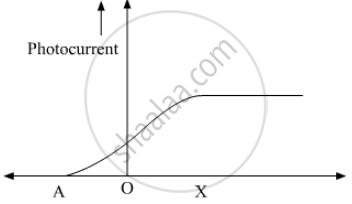
(a) Identify the variable X on the horizontal axis.
(b) What does the point A on the horizontal axis represent?
(c) Draw this graph for three different values of frequencies of incident radiation v1, v2 and v3 (v1 > v2 > v3) for same intensity.
(d) Draw this graph for three different values of intensities of incident radiation I1, I2 and I3 (I1 > I2 > I3) having same frequency.
Concept: Experimental Study of Photoelectric Effect
The work function of the following metals is given : Na 2.75 ev, K = 2.3 eV, Mo = 4.17 eV and Ni = 5.15 eV. Which of these metals will not cause photoelectric emission for radiation of wavelength 3300 Å from a laser source placed 1 m away from these metals? What happens if the laser source is brought nearer and placed 50 cm away?
Concept: Electron Emission
A electron of mass me revolves around a nucleus of charge +Ze. Show that it behaves like a tiny magnetic dipole. Hence prove that the magnetic moment associated wit it is expressed as `vecμ =−e/(2 m_e)vecL `, where `vec L` is the orbital angular momentum of the electron. Give the significance of negative sign.
Concept: Wave Nature of Matter
An α-particle and a proton are accelerated through the same potential difference. Find the ratio of their de Broglie wavelength.
Concept: de-Broglie Relation
Radiation of frequency 1015 Hz is incident on two photosensitive surface P and Q. There is no photoemission from surface P. Photoemission occurs from surface Q but photoelectrons have zero kinetic energy. Explain these observations and find the value of work function for surface Q.
Concept: Einstein’s Equation - Particle Nature of Light
A photosensitive surface emits photoelectrons when red light falls on it. Will the surface emit photoelectrons when blue light is incident on it? Give reason.
Concept: Photoelectric Effect - Hertz’s Observations
Draw a plot showing the variation of photoelectric current with collector potential for different frequencies but same intensity of incident radiation ?
Concept: Photoelectric Effect - Hertz’s Observations
Use Einstein's photoelectric equation to explain the observations from this graph ?
Concept: Photoelectric Effect - Hertz’s Observations
What change will you observe if intensity of incident radiation is changed but the frequency remains the same?
Concept: Photoelectric Effect - Hertz’s Observations
Use de-Broglie's hypothesis to write the relation for the nth radius of Bohr orbit in terms of Bohr's quantization condition of orbital angular momentum ?
Concept: de-Broglie Relation
