Advertisements
Advertisements
Predict the direction of induced current in metal rings 1 and 2 when current I in the wire is steadily decreasing?
Concept: Lenz’s Law and Conservation of Energy
A plot of magnetic flux (Φ) versus current (I) is shown in the figure for two inductors A and Β. Which of the two has larger value of self inductance?
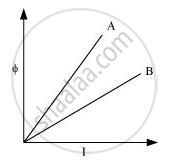
Concept: Inductance >> Self Inductance
Show diagrammatically how an alternating emf is generated by a loop of wire rotating in a magnetic field. Write the expression for the instantaneous value of the emf induced in the rotating loop.
Concept: Introduction to Electromagnetic Induction
Define self inductance. Write its S.I. units.
Concept: Inductance >> Self Inductance
Derive an expression for self inductance of a long solenoid of length l, cross-sectional area A having N number of turns.
Concept: Inductance >> Self Inductance
Explain, with the help of a suitable example, how we can show that Lenz's law is a consequence of the principle of conservation of energy.
Concept: Lenz’s Law and Conservation of Energy
Answer the following question.
When a conducting loop of resistance 10 Ω and area 10 cm2 is removed from an external magnetic field acting normally, the variation of induced current-I in the loop with time t is as shown in the figure.
Find the
(a) total charge passed through the loop.
(b) change in magnetic flux through the loop
(c) magnitude of the field applied
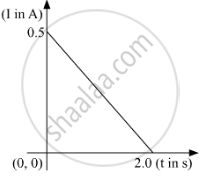
Concept: Magnetic Flux
A rectangular, a square, a circular and an elliptical loop, all in the (x - y) plane, are moving out of a uniform magnetic field with a constant velocity `vecv = vhati`. The magnetic field is directed along the negative z-axis direction. The induced emf, during the passage of these loops, out of the field region, will not remain constant for ______.
Concept: Introduction to Electromagnetic Induction
A current of 1A flows through a coil when it is connected across a DC battery of 100V. If the DC battery is replaced by an AC source of 100 V and angular frequency of 100 rad s-1, the current reduces to 0.5 A. Find
- the impedance of the circuit.
- self-inductance of coil.
- Phase difference between the voltage and the current.
Concept: Inductance >> Self Inductance
In a coil of resistance 100 Ω a current is induced by changing the magnetic flux through it. The variation of current with time is shown in the figure. The magnitude of change in flux through the coil is ______.

Concept: Magnetic Flux
Two circular loops, one of small radius r and the other of larger radius R, such that R >> r, are placed coaxially with centres coinciding. Obtain the mutual inductance of the arrangement.
Concept: Inductance >> Mutual Inductance
Draw a labeled diagram of a step-down transformer.
Concept: Transformers
In a series LCR circuit connected to an a.c. source of voltage v = vmsinωt, use phasor diagram to derive an expression for the current in the circuit. Hence, obtain the expression for the power dissipated in the circuit. Show that power dissipated at resonance is maximum
Concept: AC Voltage Applied to a Series LCR Circuit
In a series LCR circuit, VL = VC ≠ VR. What is the value of power factor?
Concept: AC Voltage Applied to a Series LCR Circuit
Why does current in a steady state not flow in a capacitor connected across a battery? However momentary current does flow during charging or discharging of the capacitor. Explain.
Concept: AC Voltage Applied to a Series LCR Circuit
State the principle of the step-down transformer and its working.
Concept: Transformers
Express the turn ratio in terms of voltages.
Concept: Transformers
Find the ratio of primary and secondary currents in terms of turn ratio in an ideal transformer.
Concept: Transformers
How much current is drawn by the primary of a transformer connected to 220 V supply when it delivers power to a 110 V − 550 W refrigerator?
Concept: Transformers
A source of ac voltage v = v0 sin ωt, is connected across a pure inductor of inductance L. Derive the expressions for the instantaneous current in the circuit. Show that average power dissipated in the circuit is zero.
Concept: AC Voltage Applied to a Series LCR Circuit
