Advertisements
Advertisements
Answer the following question.
2 g of silver chloride is taken in a china dish and the china dish is placed in sunlight for some time. What will be your observation in this case? Write the chemical reaction involved in the form of a balanced chemical equation. Identify the type of chemical reaction.
Concept: Types of Chemical Reactions > Decomposition Reaction
Answer the following question.
What is observed when 2 mL of dilute hydrochloric acid is added to 1 g of sodium carbonate taken in a clean and dry test tube? Write a chemical equation for the reaction involved.
Concept: Chemical Equations
In a double displacement reaction such as the reaction between sodium sulphate solution and barium chloride solution:
- exchange of atoms takes place
- exchange of ions takes place
- a precipitate is produced
- an insoluble salt is produced
The correct option is:
Concept: Types of Chemical Reactions > Double Displacement Reaction
When aqueous solutions of potassium iodide and lead nitrate are mixed an insoluble substance separates out. The chemical equation for the reaction involved is:
Concept: Chemical Equations
What is observed when silver chloride is exposed to sunlight? Give the type of reaction involved.
Concept: Types of Chemical Reactions > Decomposition Reaction
Hard water required for an experiment is not available in a school laboratory. However, following salts are available in the laboratory. Select the salts which may be dissolved in water to make it hard for the experiment.
|
(1) |
Calcium Sulphate |
(2) |
Sodium Sulphate |
|
(3) |
Calcium Chloride |
(4) |
Potassium Sulphate |
|
(5) |
Sodium Hydrogen Carbonate |
(6) |
Magnesium Chloride |
(A) 1, 2 and 4
(B) 1, 3 and 6
(C) 3, 5 and 6
(D) 2, 4 and 5
Concept: Salts
A metal 'M' on reacting with dilute acid liberates a gas 'G'. The same metal also liberates gas 'G' when reacts with a base.
- Write the name of gas 'G'.
- How will you test the presence of this gas?
- Write chemical equations for the reactions of the metal with (1) an acid and (2) a base.
Concept: Acids
Assertion (A): Reaction of Quicklime with water is an exothermic reaction.
Reason (R): Quicklime reacts vigorously with water releasing a large amount of heat.
Concept: Bleaching Powder
Name the salt formed when sulphuric acid is added to sodium hydroxide and write its pH.
Concept: Salts
Write the importance of ciliary muscles in the human eye. Name the defect of vision that arises due to gradual weakening of the ciliary muscles. What types of lenses are required by the person suffering from this defect to see the objects clearly?
Akshay, sitting in the last row in his class, could not see clearly the words write on the blackboard. When the teacher noticed it, he announced if any student sitting in the front row could volunteer to exchange his seat with Akshay. Salman immediately agreed to exchange his seat with Akshay. He could now see the words written on the blackboard clearly. The teacher thought it fit to send the message to Akshay’s parents advising them to get his eyesight checked.
In the context of the above event, answer the following questions:-
(a) Which defect of vision is Akshay suffering from? Which type of lens is used to correct this defect?
(b) State the values displayed by the teacher and Salman.
(c) In your opinion, in what way can Akshay express his gratitude towards the teacher and Salman?
Concept: Defects of Vision and Their Corrections > Myopia
A student traces the path of a ray of light through a triangular glass prism for different values of angle of incidence. On analyzing the ray diagrams, which one of the following conclusions is he likely to draw?
(A) The emergent ray is parallel to the incident ray.
(B) The emergent ray bends at an angle to the direction of the incident ray.
(C) The emergent ray and the refracted ray are at right angles to each other.
(D) The emergent ray is perpendicular to the incident ray.
Concept: Dispersion of Light Through a Prism
A narrow beam PQ of white light is passing through a glass prism ABC as shown in the diagram.

Trace it on your answer sheet and show the path of the emergent beam as observed on the screen DE.
(i) Write the name and cause of the phenomenon observed.
(ii) Where else in nature is this phenomenon observed?
(iii) Based on this observation, state the conclusion which can be drawn about the constituents of white light.
Concept: Dispersion of Light Through a Prism
Do you know that the corneal-impairment can be cured by replacing the defective cornea with the cornea of the donated eye? How and why should we organise groups to motivate the community members to donate their eyes after death?
Concept: Defects of Vision and Their Corrections > Myopia
In the following diagram, the path of a ray of light passing through a glass prism is shown:
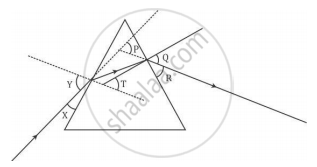
In this diagram the angle of incidence, the angle of emergence and the angle of deviation respectively are (select the correct option):
(A) X, R and T
(B) Y, Q and T
(C) X, Q and P
(D) Y, Q and P
Concept: Dispersion of Light Through a Prism
Study the following diagrams in which the path of a ray of light passing through a glass prism as traced by four students P, Q, R and S is shown:

The student who has traced the path correctly is
(A) P
(B) Q
(C) R
(D) S
Concept: Dispersion of Light Through a Prism
Millions of people in the developing countries of the world are suffering from corneal blindness. These persons can be cured by replacing the defective cornea with the cornea of a donated eye. A charitable society of your city has organised a campaign in your neighbourhood in order to create awareness about this fact. If you are asked to participate in this mission, how would you contribute in this noble cause?
(i) State the objective of organising such campaigns.
(ii) List two arguments which you would give to motivate the people to donate their eyes after death.
(iii) List two values which are developed in the persons who actively participate and contribute in such programmes.
Concept: Defects of Vision and Their Corrections > Myopia
Study the following figure in which a student has marked the angle of incidence (∠i), angle of refraction (∠r), angle of emergence (∠e), angle of prism (∠A) and the angle of deviation (∠D). The correctly marked angles are
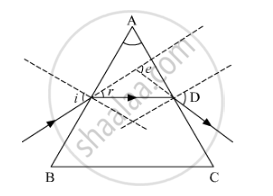
(a) ∠A and ∠i
(b) ∠A, ∠i and ∠r
(c) ∠A, ∠i, ∠e and ∠D
(d) ∠A, ∠i, ∠r and ∠D
Concept: Dispersion of Light Through a Prism
A student is unable to see clearly the words written on the blackboard placed at a distance of approximately 4 m from him. Name the defect of vision the boy is suffering from. Explain the method of correcting this defect.
Draw ray diagram for the:-
(i) defect of vision and also
(ii) for its correction.
Concept: Defects of Vision and Their Corrections > Myopia
After tracing the path of a ray of light through a glass prism a student marked the angle of incidence (∠i), angle of refraction (∠r) angle of emergence (∠e) and the angle of deviation (∠D) as shown in the diagram. The correctly marked angles are :

(A) ∠i and ∠r
(B) ∠i and ∠e
(C) ∠i, ∠e and ∠D
(D) ∠i, ∠r and ∠e
Concept: Dispersion of Light Through a Prism
List three common refractive defects of vision. Suggest the way of correcting these defects.
Concept: Defects of Vision and Their Corrections > Myopia
