- Hypermetropia is a condition in which distant objects are seen clearly, but nearby objects appear blurred.
- The near point shifts beyond 25 cm, making close-up tasks like reading difficult.
- The image of nearby objects forms behind the retina.
- Causes include reduced curvature of the lens or cornea and shortening of the eyeball.
- It is corrected using a convex lens of positive power, which converges light rays to focus the image on the retina.
Definitions [54]
Define Regular reflection.
The phenomenon due to which a parallel beam of light traveling through a certain medium, on striking some polished surface, bounces off from it, as a parallel beam, in some other direction, is called regular reflection.
Definition: Reflection of Light
The phenomenon of bouncing back of light rays in the same medium on striking a surface is called reflection of light.
Define the term Principle axis.
The principal axis is the straight line passing through the pole and the centre of curvature.
Define reflection.
The bouncing of light by any smooth or polished surface is called.
Definition: Pole
The geometric centre of a spherical mirror is called its pole.
Definition: Normal
For a spherical mirror, the normal at the point of incidence is along the radius, that is, the line joining the centre of curvature of the mirror to the point of incidence, called the normal.
Definition: Principal Axis
The line joining the pole and the centre of curvature of the spherical mirror is called the principal axis.
Definition: Focal Length
The distance of the principal focus from the pole is called the focal length (f).
Definition: Object Distance
In a spherical mirror, the distance of the object from its pole is called the object distance (u).
Definition: Image Distance
The distance of the image from the pole of the mirror is called the image distance (v).
Definition: Normal
A normal is an imaginary line drawn perpendicular to the boundary at the point of incidence.
Definition: Refracted Ray
The ray that enters the second medium after crossing the boundary is called the refracted ray.
Definition: Refraction of Light
When travelling obliquely from one medium to another, the direction of propagation of light in the second medium changes. This phenomenon is known as refraction of light.
OR
Light changes its direction when going from one transparent medium to another transparent medium. This is called the refraction of light.
OR
The bending of the light ray from its path in passing from one medium to the other medium is called 'refraction' of light.
OR
When a ray of light impinges on a polished, smooth, shiny surface, the rebounding of light within the same medium is called reflection of light.
Definition: Refraction
The change in the direction of the path of light when it passes from one transparent medium to another transparent medium is called refraction. The refraction of light is essentially a surface phenomenon.
or
When light passes from one transparent medium to another, its speed and direction change. This is called refraction.
Define the following terms used in the study of reflection of light by drawing a labelled ray-diagram:
- Incident ray
- Point of incidence
- Normal
- Reflected ray
- Angle of incidence
- Angle of reflection
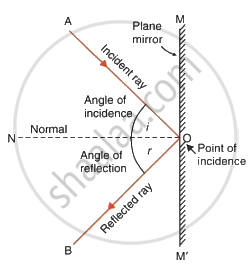
- Incident ray: The ray of light which falls on the mirror surface is called the incident ray.
- Point of incidence: The point at which the incident ray falls on the mirror is called the point of incidence.
- Normal: The normal is a line at right angles to the mirror surface at the point of incidence.
- Reflected ray: The ray of light which is sent back by the mirror is called the reflected ray.
- Angle of incidence: The angle of incidence is the angle made by the incident ray with the normal at the point of incidence.
- Angle of reflection: The angle of reflection is the angle made by the reflected ray with the normal at the point of incidence.
Define the principal focus of a concave mirror.
Light rays that are parallel to the principal axis of a concave mirror converge at a specific point on its principal axis after reflecting from the mirror. This point is known as the principal focus of the concave mirror.
Definition: Refracted Light
Refracted light is the part of light enters into the other medium and travels in a straight path but in a direction different from its initial direction and is called the refracted light.
Define critical angle for a given medium.
When a ray of light propagates from a denser medium to a rarer medium, the angle of incidence for which the angle of refraction is 90° is called the critical angle.
Definition: Critical Angle
The critical angle is the angle of incidence in the denser medium for which the angle of refraction in the rarer medium is 90 degrees.
Definition: Total Internal Reflection
Total internal reflection is the complete reflection of light back into an optically denser medium when light travels from a denser medium to a rarer medium and the angle of incidence exceeds the critical angle.
Definition: Spherical Aberration (Lens)
The aberration caused by the spherical shape of the lens, where light rays at the edges focus at a different point than those near the centre, leading to a blurred image, is called spherical aberration.
Definition: Chromatic Aberration
The aberration that occurs due to the lens refracting different wavelengths of light at different angles, resulting in an image consisting of different colours without a single focussed image, is called chromatic aberration.
Define the term ‘focal length of a mirror’.
When rays of light parallel to the principal axis of a mirror are incident on it, the rays after reflection either converge at a point or appear to diverge from a point. The distance of that point from the pole of the mirror is known as the focal length of the mirror.
Definition: Principal Focus
The point on the principal axis where rays parallel to the principal axis actually meet after refraction, or appear to diverge after refraction, is called the principal focus.
Definition: Magnification
The ratio of the height of the image to the height of the object is called magnification.
Definition: Lens
A transparent refracting medium bounded by two surfaces, of which at least one is spherical, is called a lens.
Definition: Principal Axis
The straight line passing through the optical centre and the centres of curvature of the lens surfaces is called the principal axis.
Definition: Optic Centre
The point near the centre of a thin lens through which a ray of light passes without appreciable deviation is called the optical centre.
Definition: Focal Length
The distance between the optical centre and the principal focus is called the focal length.
Definition: Power of a Lens
The deviation of the incident light rays produced by a lens on refraction through it, is a measure of its power.
or
The power of a lens is defined as the reciprocal of its focal length. It is represented by the letter P.
OR
The power (P) of a thin lens is equal to the reciprocal of its focal length (f) measured in metres.
Define the power of a lens.
Power of a lens is defined as the ability of a lens to bend the rays of light. It is given by the reciprocal of focal length in metre.
The power of a lens is a measure of the deviation produced by it in the path of rays refracted through it.
Definition: Unit of Power
The SI unit of power of a lens is the dioptre.
One dioptre is the power of a lens whose focal length is 1 metre.
1D = 1m−1
Define angular dispersion.
The angular separation between the two extreme colours (violet and red) in the spectrum (which is obtained by passing a beam of white light through a prism) is known as angular dispersion.
Definition: Angular Magnification or Magnifying Power
Angular magnification or magnifying power of an optical instrument is defined as the ratio of the visual angle made by the image formed by that optical instrument (β) to the visual angle subtended by the object when kept at the least distance of distinct vision (α).
Definition: Least Distance of Distinct Vision
For a normal, unaided human eye, D = 25 cm. If an object is brought closer than this, we cannot see it clearly. The minimum distance from the eye at which an object can be seen clearly is called the least distance of distinct vision.
OR
Due to the limitation of focusing the eye lens, it is not possible to take an object closer than a certain distance. This distance is called the least distance of distinct vision.
Definition: Simple Microscope
An optical instrument that uses a single convex lens to magnify small objects is called a simple microscope.
Definition: Compound Microscope
An optical instrument that uses objective and eye piece lenses to magnify tiny objects in detail is called a compound microscope.
Define the term ‘resolving power of a telescope’.
The resolving power of an astronomical telescope is defined as the reciprocal of the smallest angular separation between two point objects whose images can just be resolved by the telescope.
R.P = `(1.22 lambda)/D`
Resolving power is the ability of the telescope to distinguish clearly between two points whose angular separation is less than the smallest angle that the observer’s eye can resolve.
Definition: Telescope
An optical instrument that uses objective and eye piece lenses to magnify distant terrestrial or celestial objects is called a telescope.
Define a wavefront.
Wavefront is defined as the locus of all the points in space that reach a particular distance by a propagating wave at the same instant.
A wave front is defined as a surface of constant phase.
Definition: Wavefront
A wavefront is a surface of constant phase.
Definition: Spherical Wave
If a point source emits waves uniformly in all directions, the locus of points which have the same amplitude and vibrate in the same phase is a sphere. This is known as a spherical wave.
Definition: Plane Wave
At a large distance from the source, a small portion of the spherical wave can be considered as a plane. This is known as a plane wave.
Definition: Wave Interference
The phenomenon that occurs when two waves meet while travelling along the same medium is called wave interference.
Definition: Interference of Light
The phenomenon of redistribution of energy on account of superposition of light waves from two coherent sources is called interference of light.
Definition: Constructive Interference
The points of maximum intensity in the regions of superposition of waves are said to be in constructive interference.
Definition: Destructive Interference
The points of minimum intensity in the regions of superposition of waves are said to be in destructive interference.
Definition: Fringe
A fringe is a bright or dark band formed on the screen due to constructive or destructive interference.
Definition: Interference of Light
Interference is the phenomenon in which light intensity is modified due to the superposition of two or more light waves.
Definition: Fringe Width
Fringe width is the distance between two consecutive bright fringes or two consecutive dark fringes.
Definition: Single Slit Diffraction
When light passes through a single narrow slit, it spreads out and produces a pattern of alternating bright and dark bands on a screen. This spreading of light is called diffraction.
Definition: Electric Polarisation
Electric Polarisation is the phenomenon in which an external electric field induces or aligns molecular dipoles within a dielectric, producing equal and opposite bound surface charges on its faces.
Definition: Dielectric Constant (K)
Dielectric Constant (K) is the ratio of the applied field to the net field inside the dielectric, indicating how much the material reduces the electric field.
Definition: Dielectric Strength
Dielectric Strength is the maximum electric field a dielectric can withstand without electrical breakdown (i.e., before it starts conducting).
Formulae [24]
Formula: Number of Images in Inclined Mirrors
n = \[\frac {360°}{θ}\]
- If n is even → N = n − 1
- If n is odd → N = n (object not on bisector); N = n − 1 (object on bisector)
- If n is a fraction → N = integral part of n
Formula: Mirror Formula
\[\frac {1}{v}\] + \[\frac {1}{u}\] = \[\frac {1}{f}\]
Formula: Magnification
Magnification (m) = \[\frac{\text{Height of the image (}h'\text{)}}{\text{Height of the object (}h\text{)}}\] = \[\frac {h'}{h}\]
Magnification in terms of object and image distances:
Magnification (m) = \[\frac {h'}{h}\] = -\[\frac {v}{u}\]
Formula: Critical Angle
For light travelling from medium 1 to medium 2, where medium 1 is denser than medium 2:
sin C = \[\frac {n_1}{n_2}\]
where:
- C = critical angle
- n1 = refractive index of the denser medium
- n2 = refractive index of rarer medium
For a denser medium to air:
sin C = \[\frac {1}{μ}\]
where μ is the refractive index of the denser medium with respect to air.
Formula: Refractive Index
n = \[\frac {\text {sin i}}{\text {sin r}}\] = \[\frac {c}{v}\] = \[\frac {\text {Real depth}}{\text {Apparent depth}}\]
Formula: Apparent Depth (Glass Slab)
d = t - \[\frac {t}{μ}\] = t\[\left(1-\frac{1}{\mu}\right)\]
Formula: Refraction at a Spherical Surface
For refraction at a spherical surface, the relation is:
\[\frac{n_2}{v}-\frac{n_1}{u}=\frac{n_2-n_1}{R}\]
Formula: Magnification
\[m=\frac{h_i}{h_o}=\frac{v}{u}\]
Where:
- m = magnification.
- hi = height of image.
- ho = height of object.
- v = image distance.
- u = object distance.
Formula: Thin Lens Formula
\[\frac{1}{v}-\frac{1}{u}=\frac{1}{f}\]
Where:
- u = object distance.
- v = image distance.
- f = focal length of the lens.
Formula: Lens Maker’s Formula
\[\frac{1}{f}=(\mu-1)\left(\frac{1}{R_1}-\frac{1}{R_2}\right)\]
Where:
- f = focal length of the lens.
- μ = refractive index of the material of the lens with respect to air.
- R1 = radius of curvature of the first surface.
- R2 = radius of curvature of the second surface.
Formula: Power of a Lens
Power of lens (in D) = \[\frac{1}{\text{focal length (in metre)}}\]
or
P = \[\frac {1}{f}\]
or
P = \[\frac {1}{f (m)}\]
Power of a Lens in a Medium:
P = (n2 - n1)\[\left(\frac{1}{R_{1}}-\frac{1}{R_{2}}\right)\] = \[\frac {n_1}{f}\]
Formula: Magnifying Power of Simple Microscope
- MMax = 1 + \[\frac {D}{f}\]
- MMin = \[\frac {D}{f}\]
Formula: Magnifying Power of Compound Microscopе
M = mo × Me
Formula: Magnifying Power of Telescope
- \[\mathrm{M_{D.D.V}=\frac{f_{o}}{f_{e}}\left(1+\frac{f_{e}}{D}\right)}\]
- M = \[\frac{\mathrm{f}_{0}}{\mathrm{f}_{0}}\]
Formula: Resultant Amplitude
When two waves of amplitudes a1 and a2 interfere at a point where phase difference is ϕ, the resultant amplitude is:
\[A^2=a_1^2+a_2^2+2a_1a_2\cos\phi\]
Formula: Resultant Intensity
I = I1 + I2 + 2\[\sqrt {I_1I_2}\] ⋅ cos ϕ
When I1 = I2 = I0:
I = \[2I_0(1+\cos\phi)=4I_0\cos^2\left(\frac{\phi}{2}\right)\]
Formula: Ratio of Maximum to Minimum Intensity
\[\frac{I_{\max}}{I_{\min}}=\left(\frac{a_1+a_2}{a_1-a_2}\right)^2=\left(\frac{\sqrt{I_1}+\sqrt{I_2}}{\sqrt{I_1}-\sqrt{I_2}}\right)^2\]
Formula: Fringe Width (β)
\[\beta=\frac{\lambda D}{d}\]
Formula: Angular fringe width (α)
\[\alpha=\frac{\beta}{D}=\frac{\lambda}{d}\]
Formula: Distance between n-th bright and m-th dark
\[x_n-x_m=\left[n-\frac{(2m-1)}{2}\right]\beta\]
Formula: Position of m-th dark fringe
\[\begin{array} {cc} & x_m=\frac{(2m-1)\lambda D}{2d} \end{array}\]
Formula: Position of n-th bright fringe
\[\begin{array} {c}x_n=\frac{n\lambda D}{d}=n\beta \end{array}\]
Formula: Dielectric Constant
K = \[\frac {E_0}{E}\]
K = \[\frac {\sigma}{\sigma-\sigma_i}\]
where σ = surface charge density on plates, σi = induced (bound) charge density.
Formula: Dielectric Strength
Eds = \[\frac {V_{max}}{d}\]
SI unit: V/m
Theorems and Laws [5]
Law: Laws of Reflection
- The angle of incidence ∠i = angle of reflection ∠r.
- The incident ray, reflected ray, and normal lie in one plane; both rays are on either side of the normal.
Law: Laws of Reflection
- The angle of reflection is equal to the angle of incidence.
- The angle of reflection is the angle between the reflected ray and the normal to the reflecting surface or mirror.
- The angle of incidence is the angle between the incident ray and the normal.
- The incident ray, reflected ray, and the normal to the reflecting surface at the point of incidence lie in the same plane.
Important: These laws are valid at each point on any reflecting surface, whether plane or curved.
Law: Laws of Refraction
The laws of refraction are fundamental for board examinations and objective tests.
First law
The incident ray, the refracted ray, and the normal at the point of incidence all lie in the same plane.
Second law
For a given pair of media, the ratio of the sine of the angle of incidence to the sine of the angle of refraction remains constant.
\[\frac {\text {sin i}}{\text {sin r}}\] = constant
This constant is called the refractive index of the second medium with respect to the first medium.
Law: Young's Double Slit Experiment
Thomas Young first demonstrated the phenomenon of interference of light with the help of a slit, using a monochromatic source and two slits S1 and S2, producing alternating bright fringes (constructive interference) and dark fringes (destructive interference) on a screen.
Law: Brewster's Law
Statement:
When unpolarised light is incident at polarising angle iB on an interface separating air from a medium of refractive index μ, then the reflected light is plane polarised (perpendicular to the plane of incidence), provided:
μ = tan iB
Additional condition at polarising angle:
iB + r = \[\frac {π}{2}\]
i.e., the reflected plane polarised light is at right angles to the refracted light.
OR
Statement:
- When the angle of incidence equals the polarising angle (θB), the reflected and refracted rays are perpendicular to each other.
- "The refractive index of a medium is equal to the tangent of the polarising angle θB."
μ = tan θp
From Brewster's law: \[\mu=\frac{\sin\theta_p}{\sin r}=\frac{\sin\theta_p}{\sin(90°-\theta_p)}=\frac{\sin\theta_p}{\cos\theta_p}=\tan\theta_p\]
Key Points
Key Points: Reflection of Light
- Reflection occurs when light bounces off a smooth surface like a mirror, following fixed laws.
- Plane mirrors always form virtual, erect, and same-sized images that are laterally inverted.
- Curved surfaces (like a spoon) act as spherical mirrors, changing the image size and orientation depending on the object's position.
Key Points: Reflection of Light by Spherical Mirrors
- The laws of reflection apply to both plane and curved reflecting surfaces.
- In spherical mirrors, the normal is taken at the point of incidence.
- The normal is along the radius joining the centre of curvature to the point of incidence.
- The geometric centre of a spherical mirror is called the pole.
- The line joining the pole and the centre of curvature is the principal axis.
Key Points: Refraction by a Lens
- A lens forms images by refraction at its two spherical surfaces.
- A transparent refracting medium bounded by two surfaces, of which at least one is spherical, is called a lens.
- The new Cartesian sign convention is used in lens problems.
- The focal length of a convex lens is positive, and the focal length of a concave lens is negative.
- The lens formula is: \[\frac {1}{v}−\frac {1}{u}=\frac {1}{f}\]
- The lens maker’s formula is: \[\frac {1}{f}\] = (μ − 1)(\[\frac {1}{R_1}−\frac {1}{R_2}\])
- Magnification is given by: m = \[\frac {h_i}{h_o}\] = \[\frac {v}{u}\]
- A ray through the optical centre passes without appreciable deviation.
- A lens disappears in a liquid if the refractive index of the liquid is the same as that of the lens.
Key Points: Thin Lenses and Their Combination
Lens Formula:
\[\frac{1}{v}-\frac{1}{u}=\frac{1}{f}\]
Magnification:
\[m=\frac{h_i}{h_o}=\frac{v}{u}=\frac{f}{f+u}=\frac{f-v}{f}\]
Combination of Thin Lenses in Contact:
- Effective focal length: \[\frac{1}{F}=\frac{1}{f_1}+\frac{1}{f_2}+\frac{1}{f_3}+...\]
- Total power: P = P1 + P2 + P3 + ...
- When one lens is concave and other convex: \[F=\frac{f_1f_2}{f_2-f_1}\]
For Separated Lenses (distance d apart):
\[\frac{1}{F}=\frac{1}{f_1}+\frac{1}{f_2}-\frac{d}{f_1f_2}\]
Key Points: Applications of Scattering of Light
- Red colour of the Sun at sunrise and sunset is due to maximum scattering of blue light and least scattering of red light in the atmosphere.
- The blue colour of the sky is due to the greater scattering of blue (or violet) light by air molecules because of its short wavelength.
- The black colour of the sky in the absence of atmosphere occurs because there is no scattering of sunlight.
- Red light is used for danger signals because it has the longest wavelength and is scattered the least, so it can be seen from a far distance.
Key Points: Myopia
- Myopia is a vision defect in which distant objects appear blurry, while near objects are seen clearly.
- This occurs because the image of distant objects forms on the retina.
- The far point is not at infinity but is shifted closer to the eye.
- Causes include increased curvature of the cornea/lens or elongation of the eyeball.
- Corrected using a concave lens of negative power, which diverges light rays to focus the image on the retina.
Key Points: Hypermetropia
Key Points: Concept of Wave Optics
- Wave optics studies the wave nature of light.
- Newton supported the corpuscular theory of light.
- Huygens proposed the wave theory in 1678.
- Young's 1801 interference experiment supported the wave model.
- Maxwell explained light as an electromagnetic wave.
- Geometrical optics treats light as rays.
- Wave optics includes Huygens' principle, interference, diffraction, and polarisation.
Concepts [39]
- Reflection of Light
- Reflection of Light by Spherical Mirrors
- Ray Optics - Mirror Formula
- Refraction of Light
- Total Internal Reflection
- Refraction at a Spherical Surface and Lenses
- Refraction at a Spherical Surfaces
- Refraction by a Lens
- Thin Lenses and Their Combination
- Thin Lens Formula
- Lens Maker's Formula
- Magnification
- Power of a Lens
- Refraction Through a Prism
- Dispersion of White Light by a Prism : Angular Dispersion
- Applications of Scattering of Light
- Introduction to Optical Instruments
- Simple Microscope or a Reading Glass
- Compound Microscope
- Telescope
- Optical Instruments: the Eye
- Defects of Vision and Their Corrections > Myopia
- Defects of Vision and Their Corrections > Hypermetropia
- Introduction to Wave Optics
- Huygens Principle
- Reflection and Refraction of Plane Wave at a Plane Surface Using Wave Fronts
- Proof of Laws of Reflection and Refraction Using Huygens' Principle
- Interference
- Interference of Light Waves and Young’s Experiment
- No Interference by Two Independent Light-Sources : Coherent Sources
- Fraunhofer's Diffraction Due to a Single-slit
- Width of Central Maximum
- Resolving Power of Microscope and Astronomical Telescope
- Seeing the Single Slit Diffraction Pattern
- The Single Slit
- The Validity of Ray Optics
- Electric Polarisation of Dielectrics
- Plane Polarised Light
- Brewster's Law
