Definitions [2]
The centroid of a triangle is the point of intersection of its medians
The slope m of a line is m = tanθ
where θ is the inclination of the line with the positive x-axis.
Formulae [5]
The distance between P(x1, y1) and Q(x2, y2) is
\[\sqrt{(x_2-x_1)^2+(y_2-y_1)^2}\]
The distance of a point P(x, y) from the origin is
\[\sqrt{x^2+y^2}\]
\[P\left(\frac{m_1x_2+m_2x_1}{m_1+m_2},\frac{m_1y_2+m_2y_1}{m_1+m_2}\right)\]
\[M\left(\frac{x_1+x_2}{2},\frac{y_1+y_2}{2}\right)\]
The point of concurrence (centroid) divides the median in the ratio 2:1.
\[G\left(\frac{x_1+x_2+x_3}{3},\frac{y_1+y_2+y_3}{3}\right)\]
\[m=\frac{y_2-y_1}{x_2-x_1}\]
Theorems and Laws [7]
If the point (x, y) is equidistant from the points (a + b, b – a) and (a – b, a + b), prove that bx = ay.
Let P(x, y), Q(a + b, b – a) and R (a – b, a + b) be the given points. Then
PQ = PR ...(Given)
⇒ `sqrt({x - (a + b)}^2 + {y - (b - a)}^2) = sqrt({x - (a - b)}^2 + {y - (a + b)}^2`
⇒ `{x - (a + b)}^2 + {y - (b - a)}^2 = {x - (a - b)}^2 + {y - (a + b)}^2`
⇒ x2 – 2x(a + b) + (a + b)2 + y2 – 2y(b – a) + (b – a)2 = x2 + (a – b)2 – 2x(a – b) + y2 – 2(a + b) + (a + b)2
⇒ –2x(a + b) – 2y(b – a) = –2x(a – b) – 2y(a + b)
⇒ ax + bx + by – ay = ax – bx + ay + by
⇒ 2bx = 2ay
⇒ bx = ay
If a ≠ b ≠ 0, prove that the points (a, a2), (b, b2) (0, 0) will not be collinear.
Let A(a, a2), B(b, b2) and C(0, 0) be the coordinates of the given points.
We know that the area of triangle having vertices (x1, y1), (x2, y2) and (x3, y3) is ∣∣`1/2`[x1(y2−y3)+x2(y3−y1)+x3(y1−y2)]∣∣ square units.
So,
Area of ∆ABC
`= |1/2|a(b^2 - 0) + b(0 - a^2) + 0(a^2 - b^2)||`
`=|1/2(ab^2 - a^2b)|`
`= 1/2|ab(b -a)|`
`!= 0 (∵ a!= b != 0)`
Since the area of the triangle formed by the points (a, a2), (b, b2) and (0, 0) is not zero, so the given points are not collinear.
If the point P(x, y) is equidistant from the points A (5, 1) and B (1, 5), prove that x = y.
The distance d between two points `(x_1,y_1)` and `(x_2,y_2)` is given by the formula
`d = sqrt((x_1 - x_2)^2 + (y_1 - y_2)^2)`
The three given points are P(x, y), A(5, 1) and B(1, 5).
Now let us find the distance between ‘P’ and ‘A’.
`PA = sqrt((x - 5)^2 + (y - 1)^2)`
Now, let us find the distance between ‘P’ and ‘B’.
`PB = sqrt((x - 1)^2 + (y - 5)^2)`
It is given that both these distances are equal. So, let us equate both the above equations,
PA = PB
`sqrt((x - 5)^2 + (y -1)^2) = sqrt((x - 1)^2 + (y - 5)^2)`
Squaring on both sides of the equation we get,
`(x - 5)^2 + (y - 1)^2 = (x - 1)^2 + (y - 5)^2`
`=> x^2 + 25 - 10x + y^2 + 1 - 2y = x^2 + 1 - 2x + y^2 + 25 - 10y`
`=> 26 - 10x - 2y = 26 - 10y - 2x`
`=> 10y - 2y = 10x - 2x`
`=> 8y = 8x`
`=> y = x`
Hence we have proved that x = y.
Let `A(bara)` and `B(barb)` be any two points in the space and `R(barr)` be the third point on the line AB dividing the segment AB externally in the ratio m : n, then prove that `barr = (mbarb - nbara)/(m - n)`.
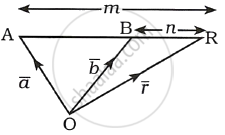
As the point R divides the line segment AB externally, we have either A-B-R or R-A-B.
Assume that A-B-R and `bar(AR) : bar(BR)` = m : n
∴ `(AR)/(BR) = m/n` so n(AR) = m(BR)
As `n(bar(AR))` and `m(bar(BR))` have same magnitude and direction,
∴ `n(bar(AR)) = m(bar(BR))`
∴ `n(barr - bara) = m(barr - barb)`
∴ `nbarr - nbara = mbarr - mbarb`
∴ `mbarr - nbarr = mbarb - nbara`
∴ `(m - n)barr = mbarb - nbara`
∴ `barr = (mbarb - nbara)/(m - n)`
Hence proved.
Let `A(bara)` and `B(barb)` are any two points in the space and `R(barr)` be a point on the line segment AB dividing it internally in the ratio m : n, then prove that `barr = (mbarb + nbara)/(m + n)`.
R is a point on the line segment AB(A – R – B) and `bar(AR)` and `bar(RB)` are in the same direction.
Point R divides AB internally in the ratio m : n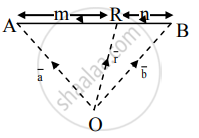
∴ `(AR)/(RB) = m/n`
∴ n(AR) = m(RB)
As `n(bar(AR))` and `m(bar(RB))` have same direction and magnitude,
`n(bar(AR)) = m(bar(RB))`
∴ `n(bar(OR) - bar(OA)) = m(bar(OB) - bar(OR))`
∴ `n(vecr - veca) = m(vecb - vecr)`
∴ `nvecr - nveca = mvecb - mvecr`
∴ `mvecr + nvecr = mvecb + nveca`
∴ `(m + n)vecr = mvecb + nveca`
∴ `vecr = (mvecb + nveca)/(m + n)`
By vector method prove that the medians of a triangle are concurrent.

Let A, B and C be vertices of a triangle.
Let D, E and F be the mid-points of the sides BC, AC and AB respectively.
Let `bara, barb, barc, bard, bare` and `barf` be position vectors of points A, B, C, D, E and F respectively.
Therefore, by mid-point formula,
∴ `bard = (barb + barc)/2, bare = (bara + barc)/2` and `barf = (bara + barb)/2`
∴ `2bard = barb + barc, 2bare = bara + barc` and `2barf = bara + barb`
∴ `2bard + bara = bara + barb + barc`, similarly `2bare + barb = 2barf + barc = bara + barb + barc`
∴ `(2bard + bara)/3 = (2bare + barb)/3 = (2barf + barc)/3 = (bara + barb + barc)/3 = barg` ...(Say)
Then we have `barg = (bara + barb + barc)/3 = ((2)bard + (1)bara)/(2 + 1) = ((2)bare + (1)barb)/(2 + 1) = ((2)barf + (1)barc)/(2 + 1)`
If G is the point whose position vector is `barg`, then from the above equation it is clear that the point G lies on the medians AD, BE, CF and it divides each of the medians AD, BE, CF internally in the ratio 2 : 1.
Therefore, three medians are concurrent.
If D, E, F are the midpoints of the sides BC, CA, AB of a triangle ABC, prove that `bar(AD) + bar(BE) + bar(CF) = bar0`.
Let `bara, barb, barc, bard, bare, barf` be the position vectors of the points A, B, C, D, E, F respectively.
Since D, E, F are the midpoints of BC, CA, AB respectively, by the midpoint formula
`bard = (barb + barc)/2, bare = (barc + bara)/2, barf = (bara + barb)/2`
∴ `bar(AD) + bar(BE) + bar(CF) = (bard - bara) + (bare - barb) + (barf - barc)`
= `((barb + barc)/2 - bara) + ((barc + bara)/2 - barb) + ((bara + barb)/2 - barc)`
= `1/2barb + 1/2barc - bara + 1/2barc + 1/2bara - barb + 1/2bara + 1/2barb - barc`
= `1/2(barb + barc - 2bara + bar c + bara - 2barb + bara + barb - 2barc)`
= `(bara + barb + barc) - (bara + barb + barc) = bar0`.
Key Points
Nature of Slope
-
m > 0 → rising line
-
m < 0 → falling line
-
m = 0 → horizontal line
-
m = ∞→ vertical line
Parallel Lines
Two lines are parallel ⇔ , their slopes are equal, m1 = m2
Perpendicular Lines
Two lines are perpendicular ⇔
Collinearity of Three Points
Points A, B, and C are collinear
Method 1: Distance method
AB + BC = AC
Method 2: Slope method
Slope of AB = Slope of BC
Important Questions [14]
- Show that points A(–1, –1), B(0, 1), C(1, 3) are collinear.
- Determine whether the points are collinear. A(1, −3), B(2, −5), C(−4, 7)
- Determine whether the points are collinear. P(–2, 3), Q(1, 2), R(4, 1)
- From the Given Number Line, Find D(A, B):
- Show that the points (2, 0), (–2, 0), and (0, 2) are the vertices of a triangle. Also, a state with the reason for the type of triangle.
- Find the distance between the points O(0, 0) and P(3, 4).
- Find the Co-ordinates of the Centroid of the δ Pqr, Whose Vertices Are P(3, –5), Q(4, 3) and R(11, –4)
- Draw Seg Ab of Length 9.7 Cm. Take a Point P on It Such that A-p-b, Ap = 3.5 Cm. Construct a Line Mn Sag Ab Through Point P.
- Write Down the Equation of a Line Whose Slope is 3/2 and Which Passes Through Point P, Where P Divides the Line Segment AB Joining A(-2, 6) and B(3, -4) in the Ratio 2 : 3.
- ΔRST ~ ΔUAY, In ΔRST, RS = 6 cm, ∠S = 50°, ST = 7.5 cm. The corresponding sides of ΔRST and ΔUAY are in the ratio 5 : 4. Construct ΔUAY.
- Construct the Circumcircle and Incircle of an Equilateral Triangle Abc with Side 6 Cm and Centre O. Find the Ratio of Radii of Circumcircle and Incircle.
- Construct the Circumcircle and Incircle of an Equilateral ∆Xyz with Side 6.5 Cm and Centre O. Find the Ratio of the Radii of Incircle and Circumcircle.
- ∆PQR ~ ∆LTR. In ∆PQR, PQ = 4.2 cm, QR = 5.4 cm, PR = 4.8 cm. Construct ∆PQR and ∆LTR, such that PQLTPQLT=34.
- Δ Amt ∼ δAhe. in δ Amt, Ma = 6.3 Cm, ∠Mat = 120°, at = 4.9 Cm, M a H a = 7 5 . Construct δ Ahe.
