- The word “gene” was coined by geneticist Wilhelm Johannsen in 1909 to simply describe what parents passed to their offspring. The detailed structure of DNA associated with genes was discovered much later.
- Genes are specific sequences of nucleotides on a chromosome, that encode particular proteins which are expressed in the form of some particular feature of the body.
- GENES are the specific parts (DNA segments) of a chromosome which determine the hereditary characteristics.
Definitions [36]
Definition: Mendelism
Mendelism refers to the principles of inheritance proposed by Gregor Mendel based on his experiments with pea plants. These principles explain that traits are inherited in a predictable manner through discrete hereditary units.
Definition: Genes
Definition: Genome
GENOME is the full complement of DNA (including all genes and the intergenic regions) of an organism.
Define the following term:
Gene
Genes are specific sequences of nucleotides on a chromosome that encode particular proteins which are expressed in the form of some particular feature of the body. They are the units of heredity which are transferred from parents to offspring and are responsible for some specific characteristics of the offspring.
Definition: Genetics
Genetics is the study of heredity i.e. transmission of body features (both similarities and differences) from parents to offspring and the laws relating to such transmission.
Definition: Heredity
Heredity (heirship or inheritance) is the transmission of genetically based characters from parents to their offsprings.
Definition: Sister Chromatids
Two identical chromatids that are joined by a centromere are called sister chromatids which eventually get separated during anaphase.
Define the following term:
Chromosome
The nucleus contains most of the cell's DNA, which is organised into discrete units called chromosomes.
Define the following term:
Chromatid
After duplication, a chromosome has two identical sections. A chromosome is formed during cell division by the union of two chromatids.
Define Aneuploidy.
Aneuploidy is the addition or deletion of one or two chromosomes in a diploid chromosomal pair.
Aneuploidy refers to the chromosomal variation due to a loss or a gain of one or more chromosomes deviating from the normal genome number for that species due to nondisjunction of the homologous chromosome.
Definition: Chromosomes
The nucleus contains most of the cell's DNA which is organized into discrete units called chromosomes.
or
Chromosomes are highly coiled, ribbon-like structures formed by the condensation of chromatin fibres during cell division.
Definition: Chromatin
Each chromosome contains one long DNA molecule associated with many proteins. This complex of DNA and proteins is called the chromatin.
Definition: Chromatid
One vertical half of a duplicated chromosome is called a chromatid.
Definition: Homologous Chromosomes
A pair of corresponding chromosomes of the same shape and size, one obtained from each parent.
Definition: Centromere
Each chromosome in its condensed form as visible during the start of cell division, consists of two sister chromatids joined at some point along the length. This point of attachment is called centromere, and it appears as a small constricted region.
Definition: Sex Chromosomes
Sex chromosomes (also called allosomes) are the kind of chromosomes that determine the sex of an organism. Every human has only 1 pair of sex chromosomes.
Definition: Autosomes
Autosomes are the kind of chromosomes which determine general body features like complexion, height, seed colour, etc. Humans have 22 pairs of autosomes.
Definition: Sex determination
The biological mechanism by which the sex (male or female) of an individual is established based on genetic or chromosomal factors, is called sex determination.
Definition: Alleles
Every gene has two alternative forms for a character producing different effects. These alternative forms are called the alleles.
Definition: Dominant Allele
The kind of allele which expresses itself regardless of the presence of another allele/s for a given gene. e.g., The dominant allele for height in garden pea is tall.
Definition: Recessive Allele
The kind of allele whose expression is suppressed in presence of a dominant allele for a given gene. A recessive allele can only express itself in presence of the same recessive allele. e.g. The recessive allele for height in garden pea is dwarf.
Definition: Phenotype
The expressed shown character is called phenotype (phene: to show).
or
The observable characteristics which are genetically controlled.
Definition: Genotype
The genetic constitutions (pertaining to the kinds of genes possessed) are called genotype.
or
The set of genes present in the cells of an organism.
Definition: Sex-Linked Inheritance
Sex-linked inheritance is the appearance of a trait which is due to the presence of an allele exclusively either on the X chromosome or on the Y chromosome.
Definition: Criss-Cross Inheritance
Inheritance of X-linked genes, as in colour blindness and haemophilia is also called 'criss-cross inheritance'.
Definition: Haemophilia
Definition: Colour Blindness
Definition: Dominant Trait
The trait expressed in a heterozygous condition is called dominant.
Definition: Alleles
Alternative forms of the same gene controlling a pair of contrasting traits are called alleles.
Definition: Homozygous
An organism having identical alleles for a character, such as TT or tt, is called homozygous.
Definition: Heterozygous
An organism having unlike alleles for a character, such as Tt, is called heterozygous.
Definition: Recessive Trait
The trait that remains unexpressed in a heterozygous condition but appears in homozygous form is called recessive.
Definition: Monohybrid Experiments
Mendel's first experiments were with the varieties of garden pea that differed in only one visible character. These are known as monohybrid experiments.
Definition: Dihybrid Cross
- Mendel investigated not only those crosses in which the parent differed in a single pair of characters but also others in which the parent differed in two pairs. Such a cross, which involves two pairs of contrasting characters simultaneously, is called a dihybrid cross.
- A genetic cross involving two pairs of contrasting characters simultaneously is called a dihybrid cross.
Definition: Punnett Square
A Punnett square is a graphical diagram developed by Reginald C. Punnett to represent genetic crosses. It is used to predict all possible genotypes and their probabilities in the offspring by arranging the gametes of parents along the top row and left column and showing their combinations in a square format.
Definition: Mutation
Mutation is a sudden change in one or more genes, or in the number or in the structure of chromosomes.
or
Mutation is a phenomenon which results in an alteration of DNA sequences and consequently results in changes in the genotype and the phenotype of an organism.
Theorems and Laws [4]
Explain the law of dominance using a monohybrid cross.
The law of dominance states that when a pair of alleles or allelomorphs are combined in an F1 hybrid, only one of them expresses itself, hiding the expression of the other. A monohybrid cross was used to investigate the simultaneous inheritance of a single pair of Mendelian components. A monohybrid cross is one that considers only different versions of a single character. The feature that occurred in the F1 generation was referred to as dominant, whereas the trait that did not appear in the F1 population was known as recessive.

Thus, when a pair of alleles come together in an F1 hybrid, only one of them expresses itself, hiding the expression of the other entirely. In the above example, in the Tt - F1 hybrid (tall), only ‘T’ expresses itself as dominant, while ‘t’ remains hidden as recessive. This instance illustrates and indicates the law of dominance.
Laws: Law of Dominance
The law of dominance states that, out of a pair of allelomorphic characters, one is dominant and the other recessive.
- In a pair of contrasting traits, only one trait is expressed - this is the dominant trait.
- The trait that remains unexpressed is called recessive.
- The recessive trait can express itself only when both alleles are recessive (homozygous recessive).
Or
When two homozygous individuals with one or more sets of contrasting characters are crossed, the alleles (characters) that appear in F₁ are dominant, and those which do not appear in F₁ are recessive.
Laws: Law of Segregation
The law of segregation states that when a pair of alleles is brought together in the hybrid (F1), they remain together in the hybrid without blending but separate completely and pure during gamete formation.
- Each pair of alleles separates during gamete formation, with one going into each gamete.
- No blending occurs; alleles remain pure and distinct.
- Gametes fuse randomly during fertilisation to form a zygote.
or
When a hybrid (F₁) forms gametes, the alleles segregate from each other and enter different gametes.
Laws: Law of Independent Assortment
Mendel’s Law of Independent Assortment states that, when two pairs of independent alleles are brought together in the hybrid F1 they show independent dominant effects. In the formation of gametes, the law of segregation operates, but the factors assort themselves independently at random and freely.
- When two pairs of traits are considered, alleles of each trait assort independently during gamete formation.
- The inheritance of one trait does not affect the inheritance of the other.
- This law is clearly demonstrated in the F₁ generation of a dihybrid cross.
or
When a hybrid possessing two (or more) pairs of contrasting factors (alleles) forms gametes, the factors in each pair segregate independently of the other pair.
Key Points
Key Points: Gregor Johann Mendel – Father of Genetics
- Gregor Johann Mendel (1822–1884), an Austrian monk, is known as the Father of Genetics for his pioneering work on heredity.
- He studied science and mathematics at the University of Vienna, which helped him apply a quantitative approach to biological problems.
- Mendel conducted systematic hybridization experiments on garden pea (Pisum sativum) from 1856 to 1863.
- From these experiments, he formulated the fundamental Laws of Inheritance, explaining how traits are transmitted across generations.
- Although his work was ignored during his lifetime, it was rediscovered in 1900, leading to widespread recognition and the foundation of modern genetics.
Key Points: Heredity and Variation
- Genetics is the study of inheritance and variation in living organisms.
- Inheritance is the passing of traits from parents to offspring.
- Variation refers to differences between offspring and their parents.
- Early humans knew that sexual reproduction causes variation (around 8000–1000 B.C.).
- Humans used selective breeding to develop desirable traits (e.g., Sahiwal cows).
Key Points: Chromosomes
- Chromosomes are thread-like (filamentous) structures present in the nucleus, made of DNA and proteins, and carry genetic information (genes). They were first observed by Walther Flemming (1882).
- During cell division, chromatin condenses to form visible chromosomes, ensuring equal distribution of genetic material to daughter cells.
- Each chromosome consists of two sister chromatids joined at a centromere, which has a kinetochore for attachment to spindle fibres.
- Important parts include telomeres (protect chromosome ends), chromonemata (coiled DNA fibres), and satellites (small segments).
- Chromosome number is constant for each species and is best observed at the metaphase stage of cell division.
- Ploidy refers to the number of chromosome sets: euploidy (exact multiples like haploid, diploid, polyploid) and aneuploidy (abnormal numbers like monosomy and trisomy).
- Chromosomes play a key role in heredity, gene expression, and maintaining genetic stability across generations.
Key Points: Autosomes and Sex Chromosomes
- Chromosomes are classified into autosomes and sex chromosomes.
- In diploid organisms, the material presents autosomes as 2n − 2 and sex chromosomes as 2.
- Humans have 22 pairs of autosomes and 1 pair of sex chromosomes.
- XX = female and XY = male in humans.
- Heterogametic sex produces two kinds of gametes.
- Homogametic sex produces one kind of gamete.
- XO, XY, and WZ are major systems of sex determination discussed here.
Key Points: Sex Determination
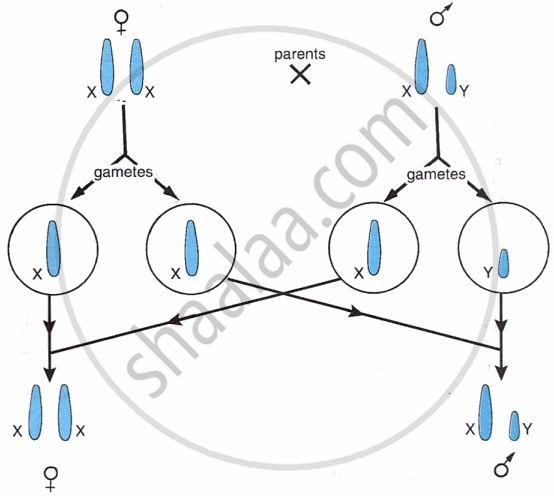
- Sex determination is decided at fertilisation when sperm meets the egg.
- Females have XX chromosomes, while males have XY chromosomes.
- The mother always provides an X chromosome, while the father provides either X or Y.
- X + X results in a girl, and X + Y results in a boy.
- The father’s sperm determines the sex of the child, and the chances of a boy or a girl are equal.
Key Points: Sex Determination
- Sex determination: It is the mechanism by which an organism develops into a male or a female based on genetic factors.
- Types of organisms: Organisms may be bisexual (hermaphrodite), having both sex organs, or unisexual (dioecious), like humans, with separate sexes.
- Discovery: Henking (1891) discovered the X-body, later identified as the X chromosome involved in sex determination.
- XX–XY system: Females are XX (homogametic) and males are XY (heterogametic), seen in humans and Drosophila.
- ZW–ZZ system: Females are ZW (heterogametic) and males are ZZ (homogametic), seen in birds and some reptiles.
- Haplodiploidy: In honeybees, unfertilized eggs develop into haploid males and fertilised eggs into diploid females.
Key Points: Sex Determination in Humans
Key Points: Genes and Alleles
- Alleles are alternative forms of a gene.
- One allele is dominant, the other is recessive.
- Dominant allele expresses even if single (e.g., tall pea = "T").
- Recessive allele expresses only if both are recessive (e.g., dwarf = "tt").
- Homozygous = same alleles (AA/aa); Heterozygous = different alleles (Aa).
Key Points: Sex-linked Inheritance in Human Beings
- Human somatic cells possess 23 pairs of chromosomes, comprising 22 pairs of autosomes and one pair of sex chromosomes (XX in females and XY in males).
- The male gamete determines the sex of the offspring, as males produce two different types of gametes (X or Y) while females produce only one type (X).
- Sex-linked inheritance in humans follows the exact same pattern observed in Drosophila, with haemophilia and colour blindness being major examples of these traits.
Determination of sex by Y-chromosome in human beings:
Key Points: Haemophilia
- Haemophilia is an X‑linked recessive hereditary disorder in which blood fails to clot normally, causing prolonged bleeding even after minor injuries.
- It occurs due to deficiency of clotting factors VIII or IX, controlled by a recessive gene (Xʰ) on the X chromosome.
- Males (XʰY) are more commonly affected; females are affected only when both X chromosomes carry the recessive gene (XʰXʰ); otherwise, they are carriers (XᴴXʰ).
- Haemophilia shows criss‑cross inheritance, where the gene passes from an affected father to a carrier daughter and then to a haemophilic grandson.
- A haemophilic male × normal female produces carrier daughters, while a carrier female × normal male can produce 50% haemophilic sons.
Key Points: Colour Blindness
- Colour blindness is an X-linked recessive disorder.
- It mainly affects the ability to distinguish red and green colours.
- It is caused by a defect associated with the retina / cone cells.
- Males are more commonly affected than females.
- Females may act as carriers.
- It follows criss-cross inheritance.
- A colour-blind father can pass the gene to his daughter, who may pass it to her son.
Key Points: Mendel's Experiments on Inheritance
- Gregor Mendel is known as the Father of Genetics; he worked on pea plants (1856–1863).
- He used true-breeding pea plants and studied inheritance using cross-pollination experiments.
- Mendel selected 7 pairs of contrasting traits (e.g., tall/dwarf, round/wrinkled, yellow/green).
- He introduced the concepts of dominant and recessive traits.
- His experiments had a large sample size and statistical analysis, making the results reliable.
- Mendel’s work formed the basic laws of inheritance, explaining how traits pass from parents to offspring.
- His findings were confirmed by repeated experiments across generations.
Key Points: Monohybrid Cross
| Parameter | Monohybrid Cross |
|---|---|
| Meaning | Cross involving 1 pair of contrasting characters |
| Example | TT × tt (Tall × Dwarf) |
| Phenotypic Ratio | 3:1 (Tall: Dwarf) |
| Genotypic Ratio | 1: 2: 1 |
| Conclusion | Tallness is dominant; dwarfness is recessive |
Key Points: Dihybrid Cross
| Parameter | Dihybrid Cross |
|---|---|
| Meaning | Cross involving 2 pairs of contrasting characters |
| Example | TTRR × ttrr (Tall Round × Dwarf Wrinkled) |
| Phenotypic Ratio | 9 : 3 : 3 : 1 (Tall Round : Tall Wrinkled : Dwarf Round : Dwarf Wrinkled) |
| Genotypic Ratio | 1 : 2 : 1 : 2 : 4 : 2 : 1 : 2 : 1 |
| Conclusion | Tall/dwarf and round/wrinkled traits are independently inherited |
Key Points: Reasons for Mendel's Success
- The garden pea (Pisum sativum) was an excellent experimental choice due to its easily recognisable, naturally contrasting physical traits.
- Focusing on the inheritance of just one specific character at a time prevented complex and confusing outcomes.
- Conducting experiments on a massive scale provided a high degree of credibility and reliability to the collected data.
- Meticulous, quantitative records were maintained for every cross and the exact number of resulting progeny.
- Applying statistical methods and mathematical logic allowed for an accurate and objective analysis of the biological results.
- Unwanted pollination was strictly prevented by carefully utilising emasculation and bagging techniques.
- Starting all experiments exclusively with true-breeding (pure-line) plants ensured a perfectly accurate foundation for the studies.
Key Points: The Law of Independent Assortment
- Mendel proposed the Law of Independent Assortment based on dihybrid crosses; it states that segregation of one pair of characters is independent of the other pair.
- In dihybrid crosses, the F₂ phenotypic ratio is 9:3:3:1, derived as a combination of 3 yellow:1 green with 3 round:1 wrinkled.
- During meiosis in F₁ (RrYy), each gene pair segregates independently, producing 4 types of gametes - RY, Ry, rY, ry, each with a frequency of 25%.
- A Punnett square of F₁ × F₁ produces 16 combinations, giving 9 different genotypes and 4 different phenotypes in F₂.
- F₂ phenotypic distribution - 4 genotypes give Round yellow, 2 genotypes give Round green, 2 genotypes give Wrinkled yellow, 1 genotype gives Wrinkled green (rryy).
- The genotypic ratio at the F₂ stage is 1:2:1:2:4:2:1:2:1, while the phenotypic ratio is 9:3:3:1.
Key Points: Punnett Square
- Punnett Square was developed by British geneticist Reginald C. Punnett; it is a diagram used to show all possible genotypes of offspring in a genetic cross.
- In a Monohybrid Cross, Tall (TT) × Dwarf (tt) gives F₁ plants that are all Tt (tall) because T (tall) is dominant over t (dwarf).
- When F₁ (Tt) is self-pollinated, the F₂ offspring are TT, Tt, Tt, and tt, giving a phenotypic ratio of 3:1 (tall: dwarf) and a genotypic ratio of 1:2:1 (TT:Tt:tt).
- TT and Tt plants are phenotypically identical (both tall) but genotypically different because the T allele dominates over the t allele.
- A test cross involves crossing an organism with a dominant but unknown genotype with a homozygous recessive (tt) parent to determine its genotype.
- If all offspring are tall, the unknown parent is TT (homozygous dominant); if half are tall and half are dwarfs, the unknown parent is Tt (heterozygous).
- The ratio 1/4 TT: 2/4 Tt: 1/4 tt can also be expressed using the binomial expansion (aT + bt)² formula.
Key Points: Applications and Beyond Mendel's Laws
Practical Applications
- Predicts Outcomes: Helps predict new trait combinations and frequencies in hybrid offspring.
- Breeding Utility: An essential foundation for plant and animal breeders.
- Crop Improvement: Enables the creation of new, desirable plant varieties through hybridization.
Post-Mendelian Genetics
- Terminology: Mendel’s discrete "factors" are what we now call genes.
- Limitations: Mendel’s original principles are broadly true but cannot explain every pattern of inheritance.
- Extensions: Later genetic complexities were resolved by modifying and extending Mendel's original framework.
Key Points: Mutations
- A mutation is a sudden heritable change in DNA sequences that leads to changes in the genotype and phenotype of an organism.
- Loss of DNA segment = deletion; gain of DNA segment = insertion/duplication; both cause chromosomal aberrations, commonly seen in cancer cells.
- Frame-shift mutation - caused by loss or gain of a DNA segment; Point mutation - change in a single base pair (e.g., sickle cell anaemia).
- Physical mutagens that cause mutation include UV radiation, X-rays, alpha, beta and gamma rays; Chemical mutagens include mustard gas, phenol and formalin.
- Mutation is an important source of genetic variation in organisms, alongside recombination.
Important Questions [14]
- Synthesis phase in the cell cycle is called so, because of the synthesis of more ______.
- State the exact location of the Centromere
- Chromosomes get aligned at the center of the cell during ______.
- Name the Following : the Number of Chromosomes Present in a Nerve Cell of a Human Being.
- Choose the odd one out and name the category to which it belongs. Centrosome, Cell wall, Cell membrane, Large Vacuole.
- Give an appropriate biological or technical term for the following: The condition in which a pair of chromosomes carry similar alleles of a particular character.
- Expand the Following Biological Abbreviations : Dna
- Duplicated chromosomes are joined at a point termed ______.
- A male gorilla has 48 chromosomes in each of its body cells. How many chromosomes will each of the sperms have?
- The sex chromosome in a human ovum is ______.
- Choose the Correct Answer from the Four Options Given Below : in a Human Male, a Sperm Will Contain :
- A zygote which has Y chromosome inherited from the father will develop into a ______.
- A pure breeding red flower variety of pea plant (RR) is crossed with a pure breeding white flower variety of pea plant (rr). Draw a Punnett square to find out the Phenotypic and Genotypic ratio
- Given below is a schematic representation of the inheritance of the shape of the seeds of garden peas. Answer the questions that follow: Which is the dominant and recessive allele of the trait?
Concepts [26]
- Gregor Johann Mendel – Father of Genetics
- Genes and Genetic
- Heredity and Variation
- Inheritance in Humans
- Chromosomes - The Carriers of Heredity
- Autosomes and Sex Chromosomes
- Sex Determination
- Sex Determination in Humans
- Genes and their Alleles
- Genotype and Phenotype
- Inheritance of Traits
- Sex-Linked Inheritance in Human Beings
- Haemophilia
- Colour blindness
- Mendel's Experiments on Inheritance
- Monohybrid Cross
- Dihybrid Cross
- Reasons for Mendel's Success
- Comparison of Behaviour of Mendel's Factors and Chromosomes
- Mendel's Laws > The Law of Dominance
- Mendel's Laws > The Law of Segregation (Law of Purity of Gametes)
- Mendel's Laws > The Law of Independent Assortment
- Punnett Square
- Exceptions to Mendel's Laws
- Applications and Beyond Mendel's Laws
- Mutations
