Definitions [19]
Scalar: Those quantities which have magnitude but no direction are called scalar quantities or scalars. e.g. length, mass, volume, temperature, work, etc.
Vector: Those quantities which have magnitude as well as direction are called vector quantities or vectors. e.g. force, displacement, velocity, etc.
Representation A vector is represented as a or bold letter (a).
The magnitude of vector \[\vec{AB}\] is the length of the directed line segment AB. It is written as \[|\vec{AB}|\], \[|\vec{a}|\], or simply a. The magnitude of a vector is never negative because it represents length.
A vector is a quantity that has magnitude as well as direction. Geometrically, a vector is represented by a directed line segment such as \[\vec{AB}\], where A is the initial point and B is the terminal point.
A vector quantity is a physical quantity that has magnitude as well as direction.
A scalar quantity is a physical quantity that has magnitude only.
In three-dimensional geometry, the vector drawn from the origin O(0, 0, 0) to a point P(x, y, z) is called the position vector of the point P. It is written as \[\vec{OP}\]. If point P(x, y, z) is given, then the magnitude of its position vector is:
a and b are two non-collinear vectors. A vector r is coplanar with a and b if and only if there exists a unique scalar λ₁ and λ₂ such that r = λ₁a + λ₂b
Three vectors a₁i + a₂j + a₃k, b₁i + b₂j + b₃k and c₁i + c₂j + c₃k are coplanar, if \[\begin{vmatrix} a_{1} & a_{2} & a_{3} \\ b_{1} & b_{2} & b_{3} \\ c_{1} & c_{2} & c_{3} \end{vmatrix}=0.\]
Four points with position vectors a = a₁i + a₂j + a₃k, b = b₁i + b₂j + b₃k, c = c₁i + c₂j + c₃k and d = d₁i + d₂j + d₃k will be coplanar iff
\[\begin{vmatrix} a_1 & a_2 & a_3 & 1 \\ b_1 & b_2 & b_3 & 1 \\ c_1 & c_2 & c_3 & 1 \\ d_1 & d_2 & d_3 & 1 \end{vmatrix}=0.\]
Two vectors a and b are collinear if there exists a scalar λ such that a = λb.
Three points A(a), B(b) and C(c) are collinear iff ∃ non-zero scalars x, y, z such that xa + yb + zc = 0, where x + y + z = 0.
Three points A(a), B(b) and C(c) are collinear if AB × BC = 0 i.e. a × b + b × c + c × a = 0.
In general, if a₁, a₂, …, aₙ are n vectors and t₁, t₂, …, tₙ are n scalars, then linear combination of vectors a₁, a₂, …, aₙ is t₁a₁ + t₂a₂ + … + tₙaₙ.
-
For 2 vectors:
\[\overline{\mathbf{r}}=x\overline{\mathbf{a}}+y\overline{\mathbf{b}}\] -
For 3 vectors:
\[\mathbf{\overline{r}}=x\mathbf{\overline{a}}+y\mathbf{\overline{b}}+\mathbf{z}\mathbf{\overline{c}}\]
If P(x, y, z) is a point, then its position vector is
This is called the component form of a vector.
General Component Form:
If \[ \vec{a} = a_{1}\hat{i} + a_{2}\hat{j} + a_{3}\hat{k}, \]
then \[ a_{1}, a_{2}, a_{3} \] are called the components of \[ \vec{a}. \]
If \[P_1(x_1, y_1, z_1)\] and \[P_2(x_2, y_2, z_2)\] are two points in space, then the vector joining \[P_1\] to \[P_2\] is the vector \[\vec{P_1P_2}\]
representing the displacement from \[P_1\] (initial point) to \[P_2\] (terminal point).
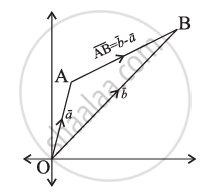
If \[ \overrightarrow{OA} = \vec{a} \] and \[ \overrightarrow{OB} = \vec{b}, \] then the vector joining \[ A \] to \[ B \] is
\[ \overrightarrow{AB} = \vec{b} - \vec{a} \]
Magnitude of vector:
Projection is the part of one vector in the direction of another vector.
Scalar projection of \[\vec{a}\] on \[\vec{b}\]
Vector projection of \[\vec{a}\] on \[\vec{b}\]
If \[\vec{a}\] and \[\vec{b}\] are two vectors and \[\theta\] is the angle between them, then their scalar product is given by:
If α, β and γ are the direction angles of a vector, then the cosines of these angles, i.e.
l = cosα, m = cosβ, n = cosγ
are called the direction cosines of the vector.
If \[ P(x,y,z) \] is a point and \[ \vec{OP} \] is its position vector, then
\[ r = |\vec{OP}| = \sqrt{x^{2} + y^{2} + z^{2}} \]
and
\[ \boxed{\,\cos\alpha = \frac{x}{r}, \qquad \cos\beta = \frac{y}{r}, \qquad \cos\gamma = \frac{z}{r}\,} \]
If l, m, n are direction cosines of a line and if a, b, c are real numbers such that \[\frac{\mathrm{a}}{l}=\frac{\mathrm{b}}{\mathrm{m}}=\frac{\mathrm{c}}{\mathrm{n}}=\lambda,\] then a, b, c are called direction ratios of that line.
\[ \boxed{\,\frac{a}{\sqrt{a^{2} + b^{2} + c^{2}}}, \qquad \frac{b}{\sqrt{a^{2} + b^{2} + c^{2}}}, \qquad \frac{c}{\sqrt{a^{2} + b^{2} + c^{2}}}\,} \]
The angles made by a vector with the positive directions of the X-axis, Y-axis and Z-axis are called direction angles of the vector, denoted by α, β, and γ.
\[ l = \cos\alpha, \quad m = \cos\beta, \quad n = \cos\gamma, \]
\[ \boxed{\,\cos^{2}\alpha + \cos^{2}\beta + \cos^{2}\gamma = 1\,} \]
The vector product of two non-null and non-parallel vectors a and b is expressed as:
a × b = |a||b| sinθ n̂ = ab sinθ n̂
The unit vector n̂ along a × b is given by:
\[\hat{\mathbf{n}}=\frac{\mathbf{a}\times\mathbf{b}}{|\mathbf{a}\times\mathbf{b}|}\]
The scalar triple product of three vectors a, b, and c is defined as
(a × b) · c = |a| |b| |c| sinθ cosφ,
where θ is the angle between a and b, and φ is the angle between a × b and c. It is also defined as [a b c].
For vectors \[\overline{a}\], \[\overline{b}\] and \[\overline{c}\] in the space, we define the vector triple product as
\[\overset{-}{\operatorname*{\operatorname*{a}}}\times\left(\overset{-}{\operatorname*{\operatorname*{b}}}\times\overset{-}{\operatorname*{\operatorname*{c}}}\right)=\left(\overset{-}{\operatorname*{\operatorname*{a}}}\cdot\overset{-}{\operatorname*{\operatorname*{c}}}\right)\overline{b}-\left(\overset{-}{\operatorname*{\operatorname*{a}}}\cdot\overline{b}\right)\overline{c}\]
Formulae [7]
Magnitude of Vector: \[\mid r\mid=\sqrt{x^{2}+y^{2}}\]
\[\theta=\tan^{-1}\left(\frac{y}{x}\right)\]
\[\mathbf{\overline{r}}=\mathbf{\frac{m\overline{b}+n\overline{a}}{m+n}}\]
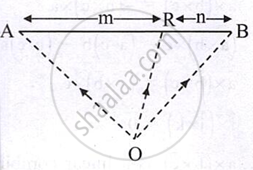
\[\overline{\mathrm{r}}=\frac{\mathrm{m\overline{b}-n\overline{a}}}{\mathrm{m-n}}\]
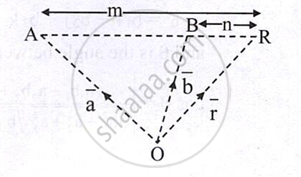
If R (r̄) is the mid-point of the line segment joining the points A (ā) and B (b̄), then
\[\overline{\mathbf{r}}=\frac{\overline{\mathbf{a}}+\overline{\mathbf{b}}}{2}\]
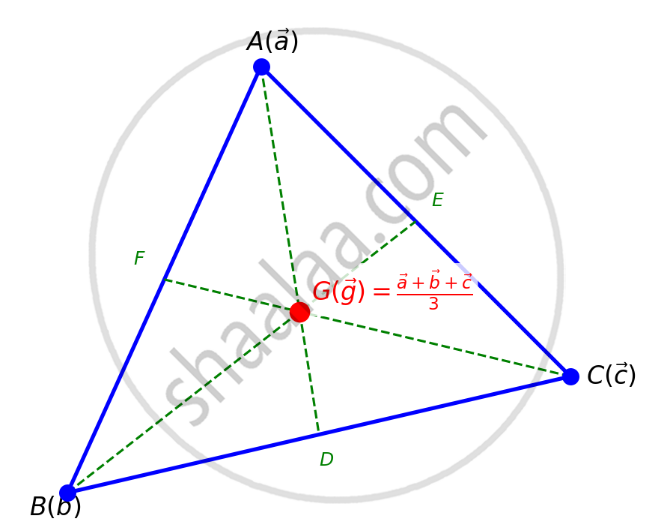
Centroid of Triangle:
\[\mathbf{\overline{g}}=\frac{\mathbf{\overline{a}}+\mathbf{\overline{b}}+\mathbf{\overline{c}}}{3}\]
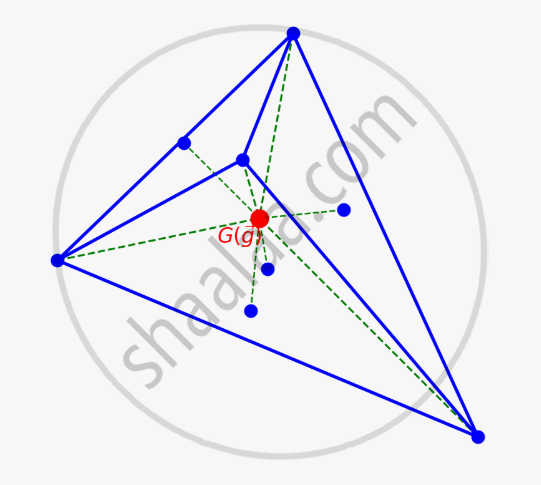
Centroid of Tetrahedron:
\[\overline{\mathbf{g}}=\frac{\overline{\mathbf{a}}+\overline{\mathbf{b}}+\overline{\mathbf{c}}+\overline{\mathbf{d}}}{4}\]
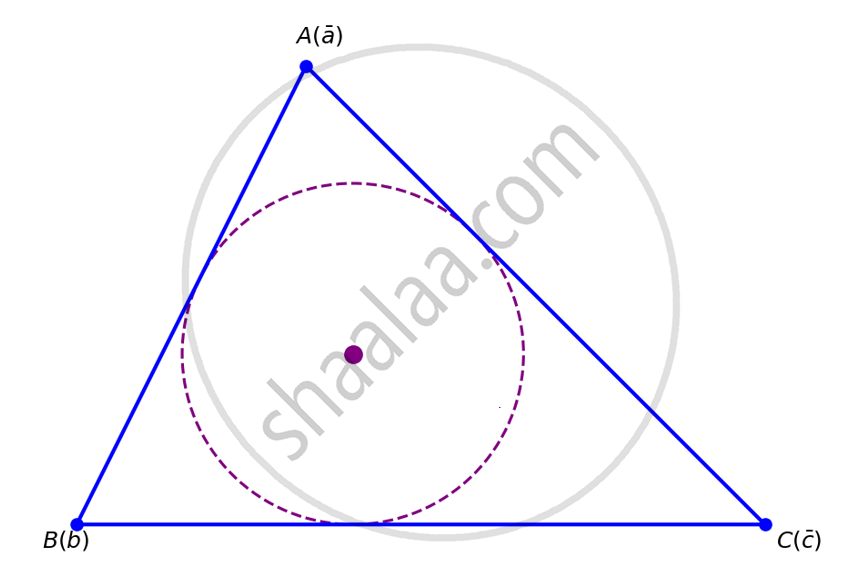
Incentre of Triangle:
\[\overline{\mathrm{h}}=\frac{\left|\overline{\mathrm{AB}}\right|\overline{\mathrm{c}}+\left|\overline{\mathrm{BC}}\right|\overline{\mathrm{a}}+\left|\overline{\mathrm{AC}}\right|\overline{\mathrm{b}}}{\left|\overline{\mathrm{AB}}\right|+\left|\overline{\mathrm{BC}}\right|+\left|\overline{\mathrm{AC}}\right|}\]
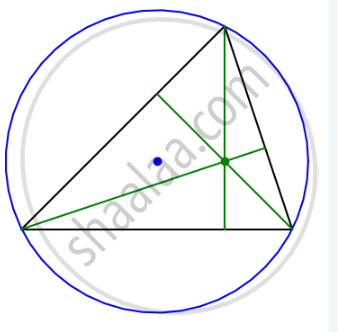
Orthocentre of Triangle:
\[\overline{\mathrm{p}}=\frac{\tan A\left(\overline{\mathrm{a}}\right)+\tan B\left(\overline{\mathrm{b}}\right)+\tan C\left(\overline{\mathrm{c}}\right)}{\tan A+\tan B+\tan C}\]
\[\sin\theta=\frac{\left|\overline{a}\times\overline{b}\right|}{\left|\overline{a}\right|\left|\overline{b}\right|}\]
Parallelepiped: Volume = [a b c]
Tetrahedron: \[\frac{1}{6}\] [a b c]
Theorems and Laws [2]
Using properties of scalar triple product, prove that `[(bara + barb, barb + barc, barc + bara)] = 2[(bara, barb, barc)]`.
L.H.S = `[(bara + barb, barb + barc, barc + bara)]`
= `(bara + barb) . [(barb + barc) xx (barc + bara)]`
= `(bara + barb) . [barb xx barc + barb xx bara + barc xx barc + barc xx bara]`
= `(bara + barb) . [barb xx barc + barb xx bara + barc xx bara] ...[∵ barc xx barc = bar0]`
= `bara . [(barb xx barc) + (barb xx bara) + (barc xx bara)] + barb . [(barb xx barc) + (barb xx bara) + (barc xx bara)]`
= `bara . (barb xx barc) + bara . (barb xx bara) + bara . (barc xx bara) + barb . (barb xx barc) + barb(barb xx bara) + barb(barc xx bara)`
= `[bara barb barc] + [bara barb bara] + [bara barc bara] + [barb barb barc] + [barb barb bara] + [barb barc bara]`
= `[bara barb barc] + 0 + 0 + 0 + 0 + [bara barb barc]`
= `2[bara barb barc]`
= R.H.S
Prove by vector method, that the angle subtended on semicircle is a right angle.
Let seg AB be a diameter of a circle with centre C and P be any point on the circle other than A and B.
Then ∠APB is an angle subtended on a semicircle.
Let `bar"AC" = bar"CB" = bar"a"` and `bar"CP" = bar"r"`
Then `|bar"a"| = |bar"r"|` ....(1)

`bar"AP" = bar"AC" + bar"CP"`
= `bar"a" + bar"r"`
= `bar"r" + bar"a"`
`bar"BP" = bar"BC" + bar"CP"`
= `- bar"CB" + bar"CP"`
= `- bar"a" + bar"r"`
∴ `bar"AP".bar"BP" = (bar"r" + bar"a").(bar"r" - bar"a")`
= `bar"r".bar"r" - bar"r".bar"a" + bar"a".bar"r" - bar"a".bar"a"`
= `|bar"r"|^2 - |bar"a"|^2`
= 0 ....`(∵ bar"r".bar"a" = bar"a".bar"r")`
∴ `bar"AP" ⊥ bar"BP"`
∴ ∠APB is a right angle.
Hence, the angle subtended on a semicircle is the right angle.
Consider the circle with the centre at O and AB is the diameter.
Let `bar(OA) = bar a, bar(OB) = bar b, bar(OC) = bar c`

∴ `|bar a| =|bar b| = |bar c| = r` ...(1)
and `bar a = -bar b` ...(2)
Consider:
`bar (AC) * bar (BC) = (bar c - bar a) * (bar c - bar b)`
= `(bar c - bar a) * (bar c + bar a)` ...[From (2)]
= `|bar c|^2 - |bar a|^2`
= r2 − r2 ...[From (1)]
= 0
∴ `bar(AC) * bar(BC) = 0`
∴ `bar(AC)` is perpendicular to `bar(BC)`
∴ ∠ACB = 90°
∴ Angle subtended on semi-circle is a right angle.
Key Points
| Type | Simple Meaning |
|---|---|
| Zero vector (0) | Zero magnitude, no direction |
| Unit vector | Magnitude = 1, shows direction only |
| Position vector (r) | Shows the position of a point from the origin |
| Equal vectors | Same magnitude and same direction |
| Negative vector | Same magnitude, opposite direction |
| Co-initial vectors | Start from the same point |
| Co-terminus vectors | End at the same point |
| Localised vector | Fixed at one position (cannot move) |
| Free vector | Can be moved parallel anywhere |
| Coplanar vectors | Lie in the same plane |
-
Scalars have only magnitude.
-
Vectors have magnitude and direction.
-
Vectors are represented by directed line segments.
-
\[\vec{AB}\] represents a vector from A to B.
-
Magnitude of a vector is its length and is always non-negative.
-
\[\vec{OP}\] is the position vector of point \[P(x, y, z)\].
-
\[|\vec{OP}| = \sqrt{x^2 + y^2 + z^2}\].
Coordinates on Axes
-
X-axis → (x,0,0)(x, 0, 0)(x,0,0)
-
Y-axis → (0,y,0)(0, y, 0)(0,y,0)
-
Z-axis → (0,0,z)(0, 0, z)(0,0,z)
Coordinates on Planes
-
XY-plane → (x,y,0)(x, y, 0)(x,y,0)
-
YZ-plane → (0,y,z)(0, y, z)(0,y,z)
-
ZX-plane → (x,0,z)(x, 0, z)(x,0,z)
Distance from Coordinate Planes
-
From XY-plane → ∣z∣
-
From YZ-plane → ∣x∣
-
From ZX-plane → ∣y∣
Distance from Origin
\[\sqrt{x^{2}+y^{2}+z^{2}}\]
Distance Between Two Points
\[d=\sqrt{(x_{2}-x_{1})^{2}+(y_{2}-y_{1})^{2}+(z_{2}-z_{1})^{2}}\]
Octants:
| Octants | I | II | III | IV | V | VI | VII | VIII |
|---|---|---|---|---|---|---|---|---|
| Coordinates | OXYZ | OX′YZ | OX′Y′Z | OXY′Z | OXYZ′ | OX′YZ′ | OX′Y′Z′ | OXY′Z′ |
| x | + | − | − | + | + | − | − | + |
| y | + | + | − | − | + | + | − | − |
| z | + | + | + | + | − | − | − | − |
-
Initial point: starting point of vector; terminal point: ending point.
-
Vector joining \[P_1(x_1, y_1, z_1)\] to \[P_2(x_2, y_2, z_2)\]:
\[\vec{P_1P_2} = (x_2 - x_1)\hat{i} + (y_2 - y_1)\hat{j} + (z_2 - z_1)\hat{k}\] -
Order matters: \[\vec{P_1P_2} = -\vec{P_2P_1}\]
-
Magnitude equals distance between points:
\[|\vec{P_1P_2}| = \sqrt{(x_2 - x_1)^2 + (y_2 - y_1)^2 + (z_2 - z_1)^2}\]
- Section formula gives the position vector of a point dividing a line segment in a given ratio.
-
For internal division, use \(\dfrac{m\vec{b}+n\vec{a}}{m+n}\).
-
For external division, use \(\dfrac{m\vec{b}-n\vec{a}}{m-n}\).
-
Midpoint is the special case when the ratio is \(1:1\).
-
Centroid formulas are natural extensions of the same averaging idea.
- The dot product of two vectors is a scalar quantity.
- The dot product uses the cosine of the angle between the vectors.
\[ \vec{a} \cdot \vec{b} = |\vec{a}||\vec{b}| \cos\theta \] - The dot product is useful in finding the angle between two vectors and projection.
- For two non-zero vectors, \[ \vec{a} \cdot \vec{b} = 0 \] indicates that the vectors are perpendicular.
-
Direction angles are the angles a line makes with the positive coordinate axes.
-
Direction cosines are \[\cos \alpha\], \[\cos \beta\], and \[\cos \gamma\].
-
If direction cosines are (l, m, n), then \[l^2 + m^2 + n^2 = 1\].
-
Direction ratios are any numbers proportional to direction cosines.
-
If direction ratios are (a, b, c), then corresponding direction cosines are:
-
For points \[A(x_1, y_1, z_1)\], \[B(x_2, y_2, z_2)\], direction ratios of AB are \[(x_2 - x_1, y_2 - y_1, z_2 - z_1)\].
-
Angle between two lines can be found using either direction cosines or direction ratios.
1. Determinant form:
If \[\overline{\mathrm{a}}=\mathrm{a}_{1}\hat{\mathrm{i}}+\mathrm{a}_{2}\hat{\mathrm{j}}+\mathrm{a}_{3}\hat{\mathrm{k}}\] and \[\overline{\mathrm{b}}=\mathrm{b}_1\hat{\mathrm{i}}+\mathrm{b}_2\hat{\mathrm{j}}+\mathrm{b}_3\hat{\mathrm{k}}\], then
\[\overline{\mathrm{a}}\times\overline{\mathrm{b}}= \begin{vmatrix} \hat{\mathrm{i}} & \hat{\mathrm{j}} & \hat{\mathrm{k}} \\ \mathbf{a}_1 & \mathbf{a}_2 & \mathbf{a}_3 \\ \mathbf{b}_1 & \mathbf{b}_2 & \mathbf{b}_3 \end{vmatrix}\]
2. Condition for zero cross product:
a × b = 0 ⇒ vectors are parallel (or one is zero)
Concepts [15]
- Vector Algebra: Representation and Types
- Basic Concepts of Vector Algebra
- Collinearity and Coplanarity of Vectors
- Vectors in Coordinate Geometry
- Three Dimensional (3-D) Coordinate System
- Components of Vector in Algebra
- Position Vector of a Point P(X, Y, Z) in Space
- Component Form of a Position Vector
- Vector Joining Two Points in Algebra
- Section Formula in Vector Algebra
- Product of Two Vectors > Scalar (Dot) Product
- Direction Ratios, Direction Cosine & Direction Angles in Vector
- Vector Product of two vectors in Algebra (Cross Product)
- Scalar Triple Product
- Vector Triple Product
