Science (English Medium)
Academic Year: 2019-2020
Date & Time: 14th March 2020, 10:30 am
Duration: 3h
Advertisements
General Instructions:
Read the following instructions very carefully and strictly follow them:
- Question paper comprises five sections – A, B, C, D and E.
- There are 27 questions in the question paper. All questions are compulsory.
- Section A – Questions no. 1 to 5 are multiple choice questions, carrying 1 mark each.
- Section B – Questions no. 6 to 12 are short-answer questions type-I, carrying 2 marks each.
- Section C – Questions no. 13 to 21 are short-answer questions type-II, carrying 3 marks each.
- Section D – Questions no. 22 to 24 are short-answer questions type-III, carrying 3 marks each.
- Section E – Questions no. 25 to 27 are long-answer questions, carrying 5 marks each.
- Answers should be brief and to the point.
- There is no overall choice in the question paper. However, an internal choice has been provided in two questions of 1 mark, one question of 2 marks, two questions of 3 marks and three questions of 5 marks. Only one of the choices in such questions have to be attempted.
- The diagrams drawn should be neat, proportionate and properly labelled, wherever necessary.
- In addition to this, separate instructions are given with each section and question, wherever necessary.
Introduction of an alien DNA into a plant host cell is achieved by making them ______.
Competent with bivalent ions
Using microinjections
Using gene gun
Using lysozymes and chitinase
Chapter:
One of the ex situ conservation methods for endangered species is ______.
Biosphere reserves
National parks
Cryopreservation
Wildlife sanctuaries
Chapter:
Ozone gas is continuously formed in the stratosphere by ______.
Action of UV rays on nascent oxygen
Reaction of oxygen with water vapour
Action of UV rays on molecular oxygen
Action of UV rays on water vapour
Chapter:
Intense lactation in mothers acts as a natural contraceptive due to the ______.
Suppression of gonadotropins
Hypersecretion of gonadotropins
Suppression of gametic transport
Suppression of fertilization
Chapter:
The principle of vaccination is based on the property of ______.
Specificity
Diversity
Memory
Discrimination between ‘self’ and ‘non-self’
Chapter:
Opioids act as ______.
Depressants
Pain killers
Euphoria providers
Stimulants
Chapter:
Nematode specific genes were introduced into the tobacco host plant by using the vector ______.
Plasmid
Bacteriophage
pBR 322
Agrobacterium
Chapter:
Spirulina is a rich source of proteins. Mention the two ways by which large scale culturing of these microbes is possible.
Chapter:
How does EcoRI specifically act on DNA molecule? Explain.
Chapter:
Explain the cause responsible in a human to have sex chromosomes as ‘XXY’ instead of ‘XX’ or ‘XY’.
Chapter:
List any two ways such individuals are different from the normal being.
Chapter:
Name and explain the technique that can be used in developing improved crop varieties in plants bearing female flowers only.
Chapter:
When are the non-flowering plants said to be homothallic and monoecious; and heterothallic and dioecious? Give an example of each.
Chapter:
Mention the kind of interaction mycorrhizae exhibit. How is Glomus in mycorrhizal association beneficial to the plants?
Chapter:
Given below is the segment of a DNA strand. Write its complementary strand and the RNA strand that can be transcribed from the DNA molecule formed.
5' TAC CGT GAC GTC 3'
Chapter:
Name the type of Ecological Pyramid that can exist as upright as well as inverted. Explain how does it happen.
Chapter:
‘‘Cotton bollworms enjoy feeding on cotton plants, but get killed when feed on Bt cotton plant.’’ Justify the statement.
Chapter:
Advertisements
How is gene therapy carried out to treat the patients suffering from ADA deficiency disease?
Chapter:
State the possibility of a permanent cure of ADA deficiency disease.
Chapter:
Differentiate between Intrauterine insemination and Intrauterine transfer.
Chapter:
Mention one positive application of amniocentesis.
Chapter:
Mention one negative application of amniocentesis.
Chapter:
Explain the solutions found by Ahmed Khan, a Bengaluru based plastic sack manufacturer, after realising the problems created by plastic wastes.
Chapter:
Mention the chemical nature of an antibody and name the type of cells they are produced by.
Chapter:
Write the difference between active and passive immune responses on the basis of antibodies.
Chapter:
Name the cells that act as HIV factory in humans when infected by HIV. Explain the events that occur in these infected cells.
Chapter:
Why is the collection of white winged moths and dark winged moths made in England between 1850 – 1920 considered a good example of natural selection?
Chapter:
‘‘Evolution is based on chance events in nature and chance mutations in organisms.’’ Justify the statement.
Chapter:
Compare the mechanism of sex determination in humans with that of honey bees, with respect to chromosome number.
How is the gamete formation comparable in the above two cases?
Chapter:
Differentiate between the pattern of inheritance in humans of the blood diseases, haemophilia and thalassemia.
Chapter:
Identify i, ii, iii, iv, v and vi in the following table:
| No. | Organism | Bioactive molecules | Use |
| 1 | Monascus purpureus | i | ii |
| 2 | iii | iv | Antibiotic |
| 3 | v | Cyclosporin A | vi |
Chapter:
Write the scientific name of methanogen bacteria. Where are these bacteria generally found? Explain their role in biogas production.
Chapter:
Advertisements
Given below is the diagram representing the observations made for separating DNA fragments by Gel electrophoresis technique. Observe the illustration and answer the questions that follow:
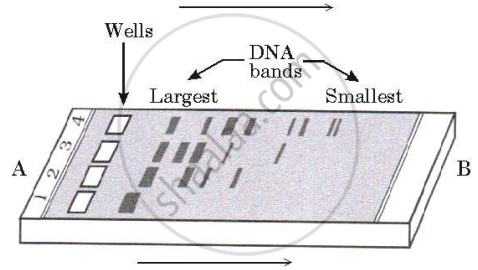
- Why are the DNA fragments seen to be moving in the direction A → B?
- Write the medium used on which DNA fragments separate.
- Mention how the separated DNA fragments can be visualised for further technical use.
Chapter:
Study the transverse section of human ovary given below and answer the questions that follow:
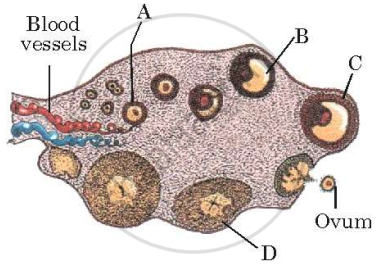
- Name the hormone that helps in the growth of A → B → C.
- Name the hormone secreted by A and B.
- State the role of the hormone produced by D.
Chapter:
Indiscriminate use of chemicals, pesticides and weedicides by humans are polluting our water bodies, which in turn are harming the living organisms. Study the flow chart and answer the questions based on it.

- Why does the concentration of DDT seem to be considerably high in the top consumer?
- How would the organisms at the highest level be affected?
- Name the phenomenon observed.
Chapter:
According to ecologists, tropical regions in the world account for greater biological diversity. Justify.
Chapter:
Why is habitat loss considered as the cause of biodiversity loss? Explain with the help of an example.
Chapter:
Why is alien species invasion considered as the cause of biodiversity loss? Explain with the help of an example.
Chapter:
Differentiate between primary and secondary succession.
Chapter:
Give an example of a pioneer species in Xerarch succession respectively.
Chapter:
Give an example of a pioneer species in Hydrarch succession respectively.
Chapter:
Name and write two characteristics of the type of DNA that forms the basis of DNA fingerprinting technique.
Chapter:
Explain different steps involved in DNA Fingerprinting.
Chapter:
Write a note on applications of DNA fingerprinting.
Chapter:
Explain the role of different genes in a lac operon, when in a ‘Switched On’ state.
Chapter:
Draw a diagram of the mature embryo sac of an angiospermic ovule and label any four parts in it.
Chapter: [1] Sexual Reproduction in Flowering Plants
Why does endosperm development precede embryo development in angiosperm seeds?
Chapter: [1] Sexual Reproduction in Flowering Plants
Number of chromosomes in an onion plant cell is 16. Name the cells of the embryo sac having 16 and 24 chromosomes formed after fertilisation.
Chapter:
Describe the events that occur after fertilisation of an ovum till implantation in a human female.
Chapter:
Other Solutions
Submit Question Paper
Help us maintain new question papers on Shaalaa.com, so we can continue to help studentsonly jpg, png and pdf files
CBSE previous year question papers Class 12 Biology with solutions 2019 - 2020
Previous year Question paper for CBSE Class 12 -2020 is solved by experts. Solved question papers gives you the chance to check yourself after your mock test.
By referring the question paper Solutions for Biology, you can scale your preparation level and work on your weak areas. It will also help the candidates in developing the time-management skills. Practice makes perfect, and there is no better way to practice than to attempt previous year question paper solutions of CBSE Class 12.
How CBSE Class 12 Question Paper solutions Help Students ?
• Question paper solutions for Biology will helps students to prepare for exam.
• Question paper with answer will boost students confidence in exam time and also give you an idea About the important questions and topics to be prepared for the board exam.
• For finding solution of question papers no need to refer so multiple sources like textbook or guides.
