Advertisements
Advertisements
प्रश्न
Write chemical reactions to convert –COOH group of acetic acid into the following.
C2H5OH
Advertisements
उत्तर
\[\ce{\underset{\text{Acetic acid}}{CH3 - COOH} + LiAlH4 ⇌[dry][ether] \underset{\text{Ethanol}}{CH3CH2OH}}\]
APPEARS IN
संबंधित प्रश्न
Answer in brief.
Formic acid is stronger than acetic acid. Explain.
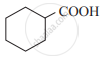
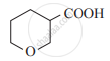
Arrange the following carboxylic acids with increasing order of their acidic strength and justify your answer.
1) 
2) 
3) 
Correct order of acid strength for
- acetic acid
- fluoroacetic acid
- 4-Nitrobenzoic acid
- 4-Methyl benzoic acid is ______.
Write the reducing agent which CANNOT reduce –COOH group.
What is the action of following on proponal?
Hydrazine
Write the preparation reactions for acid amide from the following.
Carboxylic acid
Write the preparation reactions for acid amide from the following.
Acid chloride
Write reactions for the following conversions.
Propanone to Propane
Write reactions for the following conversions.
4-Nitrobenzoic acid to Nitrobenzene
Write chemical reactions to convert –COOH group of acetic acid into the following.
CH4
Explain the acidic nature of carboxylic acids.
Which of following elements does not form amide when reacted with ammonia?
What amount of dinitrogen contains 3.6 × 10¹⁸ molecules?
The oxidation number of B in NaBH4 is ____________.
Which of the following aromatic acids has less acidic strength than benzoic acid?
Write structure of adipic acid.
Which oxide of nitrogen is obtained on heating ammonium nitrate at 250°C?
Excess of ammonia with sodium hypochloride solution in the presence of glue or gelatine gives ______.
The number of bonding pairs and lone pairs of electrons present in the central atom of ammonia molecular are respectively.
Which of the following can reduce?
\[\ce{RCOOH -> RCH2OH}\]
Draw structures 01 conjugate bases of monochloroacetic acid and dichloroacetic acid. Which one is more stabilized by -I effect?
How sodium bicarbonate test is used to distinguish between carboxylic acid and phenol?
How will you prepare Acetic anhydride from acetic acid?
Identify the product ‘B’ in the following sequence of reactions.
\[\ce{\underset{}{Methylpropanoate} ->[Δ][dil. NaOH] \underset{\underset{}{}}{A}->[H+][Conc. HCl] \underset{\underset{}{}}{B}}\]
Which of the following represents the correct order of the acidity in the given compounds?
