हिंदी

Work in Pain and Complete the Table of the Supernatural Theories and Logical Explanations as Presented in 'The Mystery of Bermuda Triangle'. - English - Communicative

Advertisements
Advertisements

प्रश्न

Work in pain and complete the table of the supernatural theories and logical explanations as presented in 'The Mystery of Bermuda Triangle'. 

संक्षेप में उत्तर
सारिणी
Advertisements

उत्तर
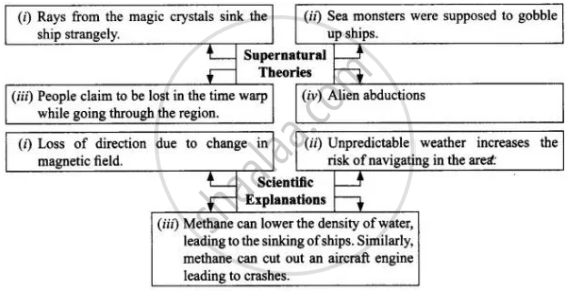
shaalaa.com
Writing and Grammar
  क्या इस प्रश्न या उत्तर में कोई त्रुटि है?
अध्याय 5.1: Bermuda Triangle - Exercise [पृष्ठ ८८]

APPEARS IN

सीबीएसई English Communicative - Main Course Book Interact in English [English] Class 9
अध्याय 5.1 Bermuda Triangle
Exercise | Q 5 | पृष्ठ ८८

संबंधित प्रश्न

On the basis of your understanding of the poem, answer the following questions
by ticking the correct choice.

 The message of the poem is that the life of a brook is ___________.


The brook appears to be a symbol for life. Pick out examples of parallelism
between life and the brook from the poem.


Answer the following question briefly.

The poet says “I took the one less travelled by, And that has made all the difference.” What is ‘the difference’ that the poet mentions?


On the basis of your reading of the poem, complete the following table.

Stages in the life of the poet Activities Consequences
Youth eating toffees
____________
 ____________
Adulthood ____________ gazing at the dentist in despair.

Answer the following question.

Give an appropriate proverb that conveys the message that this poem carries.


Answer the following question briefly.

Why does Jeanne want to buy a villa?


Select words from the box to describe the characters in the play as revealed by the following lines. You may take the words from the box given on the next page.

Lines from the play Speaker Quality revealed
One hundred thousand francs if necessary and that’s only twice what it cost me.   greedy
If you don’t want the house, tell me so at once and we ’ll say no more about it.    
No! I am very fond of your family, but not quite so fond as that Gaston  
Quite so. I have, but you haven’t.    
I have never cared such a damned little about anybody’s opinion.    
On the principle of people who like children and haven’t any can always go and live near a school.    
The garden is not very large, but you see, it is surrounded by other gardens. Juliette  
I will be philanthropic and let you have it for two hundred thousand.    
I have been thinking a lot about your Papa and Mamma. You see, I am really unselfish.   clever

NCERT Solutions for Class 9 English Literature Chapter 13 Villa for Sale 1


Answer the following question briefly.

Do you think the Bishop was right in selling the salt-cellars? Why/ Why not?


Answer the following question briefly.

Do you think the punishment given to the convict was justified? Why/ Why not?
Why is the convict eager to reach Paris?


Comparing Quantities
Study the following graph depicting major exports from Medland in the
current year.


Write a short report on major exports from Medland this year compared with the last year.  Use words from the box above. Divide your report into two paragraphs as indicated: 

Medland’s Export Trends

 On the whole, Medland exported slightly less this year than the last year. Concerning foodstuffs,
_________________________________________________________________
As regards non-edible goods,_____________________________________________


Read through the poem and quickly make a note of any thoughts that come to you, while you are reading it.

Dispute 
A man and a tiger once had a dispute, 
Which was reckoned greater, the man or the brute. 
The tiger discoursed on his side at some length, 
And greatly enlarged on his courage and strength, 
Said the man, 'Don't be prating; look yonder, I pray, 
At that sculpture of marble: now what will you say? 
The tiger is vanquished; but as for the man, 
He is striding upon him: deny if you can.' 
'But pray,' said the tiger, 'Who sculptured that stone? 
'One of us,' said the man. 'I must candidly own.' 
'But when we are sculptors,' the other replied, 
'You will then on the man see the tiger astride.' 
                                              Anonymous 


Working in groups of four, write a dialogue between 
• A tiger behind bars and a man 
• A man in a cage and a tiger. 


Look at the following pictures/diagrams. Fill in the blanks with an appropriate sentence/phrase, using suitable future time reference. The first one has been done for you as an example:


Before you listen for the second time, discuss the following with your partner.

  1. Why are there two presenters?
  2. What is the presenter’s role?
  3. What is the presenter’s style? Do you like their style? Why / Why not?
  4. Why do the presenters outline some of the contents right at the start of the programme?

Review of passives
Look back on the exercises in this Unit. Discuss why the passive is used in each of these different circumstances.
Can you think of any other times when it is best to use the passive?


Given below is a list or other expressions. Decide what each expression means, by writing D for 'difference' or S for 'similarity' against each. Try to add more expressions to your list and make use of them in writing your article in Question 6. 

Expressions  D or s 
X is different from Y in that _______  
X and Y are alike in that ______  
X and Y have _____ in common.   
Whereas X _________ , Y _____________  
Compared to X, Y ________  
X ____ In contrast, Y ____  
X _____ However, Y _____  
X and Y both  

Here are the stories of the two boys. One student reads the story of Shravan Kumar and the second student reads the story of Narendra Kumar. After reading the story, each student completes bis or her half of the table in Question 3. 

SHRAVAN KUMAR 

His day begins when most other people's day ends. Thirteen-year old Shravan Kumar works in a tea shop on Delhi's Bahadur Shah Zafar Marg, where several newspaper offices are situated. His work begins around seven in the evening when he starts preparing samosas, coffee and tea. He carries them to several offices, does the dishes, and goes around collecting his money well into the night. Around six in the morning, when all the newspapers are despatched for distribution and the press employees return home, he prepares his food, takes a bath and goes to bed.

Shravan is an orphan who crune to Delhi from his village in search of work. His father kept a shop, but was tricked out of it by a deceitful uncle. Despair drove him to alcohol and grunbling, and he died of a stroke soon after. 

Shravan worked in a tea shop in his village for a while. "When I first began washing other people's cups and glasses", he recalls, "I used to feel very bad, I would cry." 
Shravan moved to the more lucrative environs of Delhi, where his elder brother Shatrughan had preceded him. Ajob in a shop selling ice was his first taste of big city life. His mother crune to visit him in Delhi, but she fell ill and died soon after. "That was two or three years ago. I don't remember exactly when," the little boy says. Soon, Shravan lost his first job. His employer still owes him Rs 500. 

Following a brief spell of unemployment and a short spell as an assistant at a car park, he joined the tea shop where he is presently employed. The ruthlessness and loneliness of the world has left him shattered. "I think I run all alone in this world," he says despondently. 

Of the Rs 300 that he earns every month, he deposits Rs 200 in the bank. His bank balance stands at Rs 2000, he says proudly. Survival is his immediate aim but there is a larger objective towards which Shravan is working. He intends to retrieve the land that was mortgaged by his father. Already Shravan and Shatrughan have paid back the loan of Rs 8000 - only the interest remains to be paid. 

Shravan was a dedicated lotte:ry buyer at one time; until he realized that it was adding nothing to his income. The cinema remains a favourite form of entertainment - he even wakes up early to see the noon show. "I have no friends here. Who keeps awake late at night and sleeps during the day? I miss my village. There, I used to play gully danda and marbles and I had a lot of friends. When I went to the village last year, I met them. They are still studying and playing games. I want to join them, but it is a question of survival for me." 

Sharvan's mother wanted him to own a big shop - "like the one his father had owned," he says wistfully. He dreams of fulfilling her wish. He dreams of getting back their mortgaged land, and returning to the village for good, "I like being in my village. I like the films and the glitter of Delhi, but I prefer the greene:ry, the trees, and the fields of my village." Maybe the grit and intelligence he has shown, alone and friendless, in facing a hostile world, will also win for him his heart's desire. 

NARENDRA KUMAR 

Narendra Kumar, a thirteen year old Kendriya Vidyalaya student, was interviewed by The Illustrated Weekly of India. Read what he says about himself. 

Interviewer : Hello, Narendra! 
Narendra : Hello! 
Interviewer : Congratulations! Narendra. I saw your photograph in the newspaper last week, when you won the Soviet Land Nehru Award for drawing and painting. Our readers are anxious to know more about you. 
Narendra : Thank you, Sir. I think I was just lucky to get the award. The competition is held every year in my school and a large number of students take part in it. 
Interviewer : That's good, very good. It's evident that your school encourages students to take part in various activities. 
Narendra : Oh yes. Our teachers -especially my Art teacher, Mr. V. Sinha - gives us a lot of encouragement. My parents have encouraged me a lot, too. 
Interviewer : When did you start painting? 
Narendra : When I was three, I was attending the Shishu Vihar Nursery School. My teacher gave me a picture of a big kite one day. The picture was beautiful and that very day I asked my father to buy me some crayons and drawing paper... Soon my room was full of crayons and paper! I kept drawing whenever I found time. I now have a mini art room of my own at home! 
Interviewer : That's great, really great! Do you want to become an artist when you grow up? 
Narendra : No. Drawing and painting are just hobbies, which give me a great deal of pleasure. I want to become a police officer when I grow up. That's the only thing I've ever wanted to be. 
Interviewer : Is that because your father is a police officer? 
Narendra : Yes, maybe. I've been watching my father and other policemen for a very long time. I suppose I want to be like him! 
Interviewer : Do you feel you have the qualities that a good police officer needs? 
Narendra : Yes, I think so. A good police officer needs to be physically fit and mentally alert. I'm trying my best to grow into a healthy young man. I'm a member of the local sports club. I play tennis in the evenings and I also swim regularly. 
Interviewer : How do you find time for all these activities? 
Narendra : Well, I suppose I'm busy the whole day. Immediately after school I like to paint or play. I study before dinner and usually get to bed at about 10 o'clock. 
Interviewer : Thank you, Narendra. It's been good talking to you. We wish you success. 
Narendra : It's been a pleasure


What do the following phrases mean? 
• We are the children 
• There's a choice we're making. 
We're saving our own lives ... 
• Well, send them your heart 
So they know that someone cares ... 
• Change can only come 
When we stand together 
As one ... 


Prepositions of Location
Picture Dictation
Work in pairs - Student A and Student B. Student A only (picture given below) - . Keep the picture secret from Student B. Describe exactly what you see to Student B, who must draw the picture from the information given. At the end, compare the two pictures. Draw your picture in the box below.


e.g.
In the middle there’s a small house. Behind the house there are two hills. Several birds are flying over the house…


Think of a person in your class, and use adjective + prepositions to describe him/her in about two or three sentences. Don't give a name.

(a) e.g. She’s good at Maths.
She’s keen on hiking.

Show your description to your partner. Let her or him guess who it is.
(b) The following diagram explains the use of some of these prepositions.

Destination Position Destination Position Reference
to •X at •X away from x ⇒

away from x •

Referring to a
on (to) on off off Referring to a
line or surface.
into in out of out of Referring to an
enclosed area

Notice the following peculiarities in the use of Prepositions.
1) at relates to a small extent of space or time while in relates to a wider extent.
2) with relates to the instrument used for doing something.
by relates to the doer
e.g. (1) This poem was composed~me
(2) I wrote with a Shaffer's pen.
3) between, among: between is used when there are two things or persons or
ideas, among is used for more than two.
e.g. ( 1) The property was divided between the twins.
(2) The gossip spread among the villagers.
4) beside, besides : beside means by the side of, besides means in addition to
e.g. (1) Ram sat beside his grandmother.
(2) Besides music, he is interested in painting.
5) in and within : in denotes at the close of some future period, within denotes
sometime short of the close
e.g. (1) The project will be implemented in a week's time.(= at the close)
(2) The plan will be sanctioned within a fort night(= less than)


Share
Notifications

Englishहिंदीमराठी


      Forgot password?
Use app×