Advertisements
Advertisements
प्रश्न
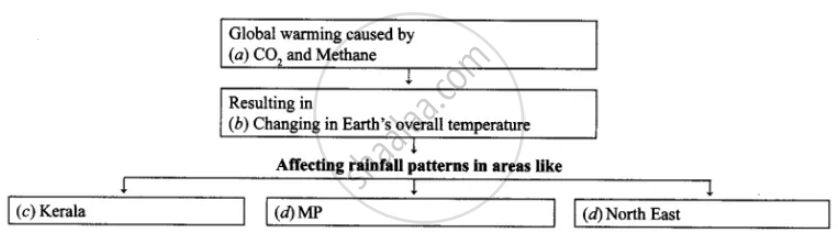
Read the following article on Global Warming and complete the Dow chart given below.
Global Warming is caused by the accumulation of Green house Gases - CO2, and methane in the atmosphere, resulting in the rise of Earth's over all surface temperature. India, a low latitude country, would face much of the misery due to climatic changes. Rainfall pattern is expected to undergo a major change in areas like Kerala, MP and North East.
Himalayan glaciers are melting. This could prove catastrophic for those living downstream in the plains.
Due to global warming heat is trapped in the atmosphere causing the ice to melt. Rising sea levels would inundate many of the coastal cities. Extreme weather conditions such as heavy rainfall is expected to occur soon resulting in loss of life and property.

Advertisements
उत्तर
APPEARS IN
संबंधित प्रश्न
Have you ever been on a trip to any place in India, where you didn’t know the language spoken locally? How did you feel? How did you manage to communicate?
Here is a list of a few things. Can you tell how long each of them can live /exist?
(a) a dog
(b) an elephant
(c) a tree
(d) a human being
(e) a star
(f) a mountain
(g) a river
Answer the following questions: ‘
I wind about, and in and out’. What kind of a picture does this line create in your mind?
(a) Listen to a recording of the poem.
(b) What choice did the poet have to make?
(c) Did he regret his choice? Why/why not?
Answer the following question.
Why is the rain divine?
Answer the following question.
The Poem invokes beautiful imagery which is built around 'sigh of the sea', 'laughter of
the field' and 'tears of heaven'. Explain the three expressions in the context of rain.
Answer the following question.
Explain the ending of the song.
Read the following extract and answer the questions that follow by choosing the
correct options.
Monseigneur, the Bishop is a ... a-hem!
(a) Why does Persome not complete the sentence?
(i) she used to stammer while speaking.
(ii) she was about to praise the Bishop.
(iii) she did not wish to criticise the Bishop in front of Marie.
(iv) she had a habit of passing such remarks.
(b) Why is she angry with the Bishop?
(i) the Bishop has sold the salt-cellars.
(ii) the Bishop has gone to visit Mere Gringoire.
(iii) he showed extra concern for Marie.
(iv) she disliked the Bishop.
The convict is the product of the society he had lived in, both, in terms of the
suffering that led him to steal a loaf of bread, as well as the painful sentence he
received as a punishment for his "crime". He was imprisoned for stealing money
to buy food for his sick wife. This filled him with despair, hopelessness,
bitterness and anger at the injustice of it all.
Conduct a debate in the class (in groups) on the following topic. Instructions for
conducting a debate and use of appropriate language are given in the unit “Children” of
the Main Course Book.
'Criminals are wicked and deserve punishment'
Imagine that you are one of the boys, and that the map on the next page is of the island on which you have landed. Your most urgent task is to decide where to live. Work in groups of four; decide where to set up camp, and the materials you will use. Be prepared to justify your choices to the rest of the class.
Now, work individually, and with the help of the information in the box below, write six appropriate sentences.
| H | P | R | |
| Mrs Sharma | fever | Palatial house | brother-in-law living with them |
| Shyam | Sound health | Personal computer | dog |
Edit the following narrative by choosing the appropriate word from the options given at the end of the paragraph.
(a) Wander along the streets of New York City, my daughters and (b) me stop at shoe stores wherever we (c) happens to be. This is their choice. These women, who as little (d) girl, teetered around the house (e) balances like cranes in my mother’s high heels. I (f) sits on the bench and wait while they try on shoe (g) on shoe readjusting their positions in (h) a mirror, eyes downcast considering their feet.
“So?” one of them (i) will ask me. “What do you think of these?” “I love them,” I say about (j) all pairs.
| (a) (i) wandered (ii) wandering (iii) were wandering (iv) was wandering |
| (b) (i) they (ii) I (iii) we (iv) us |
| (c) (i) happen (ii) happened (iii) are happening (iv) are happened |
| (d) (i) girls (ii) woman (iii) boys (iv) people |
| (e) (i) are balancing (ii) is balancing (iii) balanced (iv) balance |
| (f) (i) sit (ii) am sitting (iii) sat (iv) was sitting |
| (g) (i) after (ii) before (iii) in (iv) by |
| (h) (i) that (ii) the (iii) their (iv) x |
| (i) (i) is asking (ii) asks (iii) are asking (iv) asked |
| (j) (i) every (ii) few (iii) some (iv) a |
Look at the numbers on the map, and match them with the names given in the box below.

Choose a suitable word from the options given and complete the story from Tunisia.
A weary traveller stopped at a Bedouin’s tent and asked for shelter for the night. Without (a)_______ delay, the man killed (b) _______chicken and handed it to (c)_______ wife for (d)___________ guest’s supper. As the woman stirred the meat in (e) _______ copper cooking pot, she smelled the rich steam and could not resist tasting (f)________ of the meat and soup, to see if it was soft and tasty. But mouthful followed mouthful, and there wasn’t (g)__________chicken left but for the neck piece, which she gave to her little son to nibble. The boy found it so tasty that he whined, “Give me (h)_______ more chicken, mother!” The woman slapped the little boy and scolded him: “It’s a shameful habit (i)______ father taught you, enough of it, I tell you!” On the (j) _______ side of the wooden hanging which screened the woman’s part of the tent from the rest, the traveller overheard them. “What habit has (k)______ father taught (l) _______ child?” he asked curiously. “Oh,” said the woman, “whenever a guest arrives at (m)_______ tent, he cuts off his ears and roasts them over the fire for (n)______ son to eat.” Making not a sound, the traveller picked up (o)_______ shoes and ran.
| (a) (i) no any (ii) little (iii) any (iv) no |
| (b) (i) a few (ii) some (iii) few (iv) a |
| (c) (i) his (ii) her (iii) their (iv) there |
| (d) (i) the (ii) a (iii) theirs (iv) their |
| (e) (i) her (ii) hers (iii) the (iv) an |
| (f) (i) some (ii) few (iii) a few (iv) more |
| (g) (i) any (ii) some (iii) a few (iv) few |
| (h) (i) little (ii) a little (iii) a few (iv) some |
| (i) (i) hers (ii) yours (iii) their (iv) his |
| (j) (i) another (ii) another (iii) other (iv) one |
| (k) (i) hers (ii) her (iii) him (iv) his |
| (l) (i) a (ii) an (iii) the (iv) x |
| (m) (i) x (ii) our (iii) ours (iv) their |
| (n) (i) their (ii) his (iii) him (iv) our |
| (o) (i) her (ii) his (iii) our (iv) x |
Look at the following pictures/diagrams. Fill in the blanks with an appropriate sentence/phrase, using suitable future time reference. The first one has been done for you as an example:


What comes next
Connectors are indicators or markers of what comes next in a text.
Look at these extracts from longer texts. Decide which marker/connector could be used in the blanks to indicate what comes next. e.g.
There are many good players in the cricket team: for instance, Tendulkar and Dhoni.
- There are two main types of elephant in the world: ___________ , the Indian and the African.
- He is good at swimming, tennis and hockey. ___________, he has also represented the school in cricket.
- Many environmentalists strongly object to the mill being built at Srutipur, ___________ the unemployed are very happy at the proposal.
- Her performance in the Olympics did not match our expectations. ___________, she hasn’t improved much in the recent past.
- In the field of research the computer, has proved immensely useful. ___________, it has become an indispensable tool for all kinds of scientific endeavour
- The import of petrol has been banned in the Midlands. ___________, the price of it has gone up.
Each sentence has four words underlined. Select the one underlined word that is incorrect and write it in the box as shown.
- Machu Picchu is the pre-Columbian Inca site located 2430 mts above sea-level. [ The]
- It was situated on a mountain ridge in Peru. [_____]
- Machu Picchu was declared an UNESCO world heritage site in 1983.[_____]
- Before it was not plundered by the Spanish it is an important cultural site. [_____]
- This Peruvian historic sanctuary is considered a sacred place. [_____]
Based on the information on your completed scorecard, write a short report for the Danapur local newspaper about the Annual Athletic Meet of the school. Remember 'CODER'. Some further advice ...
• Give an interesting heading
• By line (who has written the report)
• Answer the 'WH' questions - Who? Why? When? Where?
• Overall result
• Aim of the Meet
Group the prepositions in the box below to indicate their use as prepositions of place (P), movement (M) or time (T). There may be more than one category for each.
| between ________ along ________ since ________ up ________ among ________ in front of ________ after ________ |
past ________ on ________ behind ________ round ________ for ________ across ________ through ________ |
before ________ until ________ beside ________ out of ________ at ________ under ________ during ________ |
Your school is playing a football / hockey match with the neighbouring school. You are the official commentator for the match. Give a running commentary on the last few breathtaking minutes of the match.
OR
In groups of four, give a running commentary of the whole match. Each student must become the commentator at some point of time. (Your commentary should not be for more than three minutes)
