Advertisements
Advertisements
प्रश्न
What items of food did Golu take before leaving his home for the Limpopo river?
Advertisements
उत्तर
He took a hundred sugarcanes, fifty dozen bananas, and twenty-five melons.
संबंधित प्रश्न
Discuss in pair and answer question below in a short paragraph (30 − 40 words.
What did Harris say after the bag was shut and strapped? Why do you think he waited
till then to ask?
Thinking about the Text
Answer these question.
This is your big surprise.”
(i) Where has this been said in the play?
(ii) What is the surprise?
Look at these words:
...peace comes dropping slow
Dropping from the veils of the morning to where the cricket sings
What do these words mean to you? What do you think “comes dropping slow...from the veils of the morning”? What does “to where the cricket sings” mean?
Parents alone are responsible for inculcating a good sense of dental hygiene amongst children. Do you agree/disagree? Discuss with your partner.
Read the comic strip based on. H.G. Wells' novells.


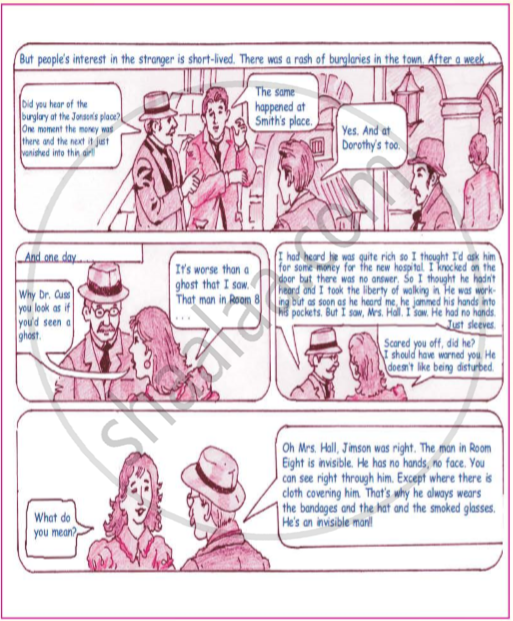
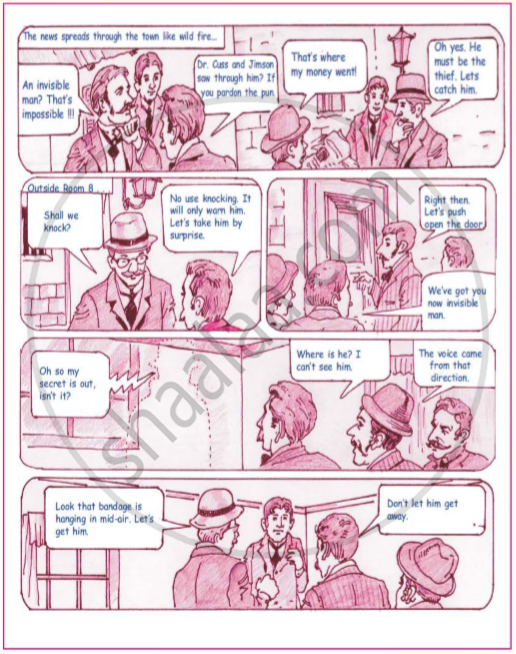
Answer the questions by ticking the correct option.
(a) The strange-looking man wanted ....
(i) the best room at the inn.
(ii} a room with a fire and a good lock.
(iii} a room with a good view.
(iv) a room where he could work quietly.
(b) Jimson was suspicious of the stranger because ...
(i} he did not answer Jimson's questions.
(ii} he did not want to talk about the weather.
(iii} he kept his back turned towards Jimson at all times.
(iv) he shouted atJimson when he entered his room.
(c) The people of the town gossiped about the stranger as ...
(i} he did not go out or talk to anyone in the town.
(ii} he had met with an accident and his face was bandaged.
(iii} he was new to the town and behaved rudely.
(iv) he stayed in his room and did not show his face to anyone.
(d) 'There was a rush of burglaries in the town. This means that ________
(i} there were many robberies in the town.
(ii) a few people in the town had seen a rob her.
(iii} the burglaries in the town were done in a rush.
(iv) the burglar was a rash and careless man.
(e) Although Jimson and Dr Cuss are suspicious of the strange guest, Mrs Hall tolerates him because ....
(i} she is not superstitious or ignorant.
(ii) she is sorry for the stranger who is bandaged.
(iii} the stranger is paying her a good amount of money for the room.
(iv} the stranger is polite and kind to Mrs Hall at all times.
(f) The stranger who was staying at the inn can be described as being ....
(I} violent
(ii} upright
(iii} dishonest
(iv) sensible
Dr. Wood, the capable general practitioner, has been requested to solve this case. He gathers information about the murder from the inmates or the house. The information is presented in two parts.
Parts A: Background story by Arthur Conan Doyle
Parts B: Conversation between Dr. Wood and Cecil Barker
Part A
Background Story
The village of Birlstone is a small and very ancient cluster of half-timbered cottages on the northern border of the county of Sussex. For centuries it had remained unchanged but its picturesque appearance has attracted well-to-do residents. A number of small shops have come into being to meet the wants of the increased population.
About half a mile from the town, standing in an old park famous for its huge beech trees, was the ancient Manor House, with its many gables and its small diamond paned windows. The only approach to the house was over a drawbridge, the chains and windlass of which had been rusted and broken. The family consisted of only two individuals - John Douglas and his wife. Douglas was cheery and genial to all and had acquired great popularity among the villagers. He appeared to have plenty of money. Thus, it came about that John Douglas had, within five years, won himself quite a reputation in Birlstone. His wife was a beautiful woman, tall, dark and slender, younger than her husband; a disparity which seemed in no way to mar the contentment of their family life. It was remarked sometimes, that the confidence between the two did not appear to be complete. There were signs sometimes of some nerve strain upon the part of Mrs. Douglas.
Cecil Barker, was a frequent and welcome visitor at Manor House, Barker was an easy going, free handed gentleman.
It was on Jan 6th at 11:45 that the alarm reached the small local police station that John Douglas had been murdered. Dr. Wood seemed to be unnerved and troubled.
Part B
Conversation between Dr. Wood and Cecil Barker
Dr. Wood : We will touch nothing until my superiors arrive. {He spoke in a hushed voice, stating at the dreadful head)
C.Barker : Nothing has been touched untilnow.
Dr. Wood : When did this happen?
C.Barker : It was just half-past eleven. I was sitting by the fire in my bedroom when I heard the gun shot. In thirty seconds I was in the room.
Dr. Wood : Wasthedooropen?
C.Barker : Yes, it was open. Poor Douglas was lying as you see him.
Dr. Wood : Did you see anyone?
C. Barker : No, I heard Mrs. Douglas coming down the stains behind me, and I rushed out 1 to prevent her from seeing this dreadful sight.
Dr. Wood : But I have heard that the drawbridge is kept up all night.
C. Barker : Yee,it was up until l lowered it.
Dr. Wood : Then how could any murderer have got away? It ls out of question! Mr Douglas must have shot himself.
C. Barker : That was our first idea. But see! The diamond paned window is open to its full extent.
Dr. Wood : I think someone stood there while trying to get out.
C. Barker : You mean that someone waded across the moat?
Dr. Wood : Exactly!
C. Barker : I agree with you.
Dr. Wood : But what I ask you ls, how did he even get into the house at all if the bridge was up?
C. Barker : Ah, that's the question.
Dr. Wood : At what time was the bridge raised?
C. Barker : It was nearly 6 O'clock.
Dr. Wood : Then it comes to this, if anyone came from outside -if they did-they must have got in across the bridge before six and had been in hiding ever since. The man was waiting. He shot him, when he got the chance.
Some are like fields of sunlit corn,
Meet for a bride on her bridal morn,
Some, like the flame of her marriage fire,
Or, rich with the hue of her heart's desire,
Tinkling,luminous,tender, and clear,
Like her bridal laughter and bridal tear.
Read the lines given above and answer the question that follow.
Besides visual imagery the poet also uses auditory imagery.Pick out the lines.
The most important thing we've learned,
So far as children are concerned,
Is never, NEVER, NEVER let
Them near your television set-----
Or better still, just don't install
The Idiotic thing at all.
In almost every house we've been,
we've watched them gaping at the screen
They loll and slop and lounge about,
And stare until their eyes pop out.
(Last week in someone's place we saw
A dozen eyeballs on the floor.
They sit and stare and stare and sit
Until they're hypnotised by it,
Until they're absolutely drunk
With all that shocking ghastly junk.
Read the lines given above and answer the question given below.
What is the most important thing that the poet has learnt?
Abou Ben Adhem (may his tribe increase!)
Awoke one night from a deep dream of peace,
And saw, within the moonlight in his room,
Making it rich, and like a lily in bloom,
An angel writing in a book of gold:-
Read the lines given above and answer the following question.
What was the angel doing when Abou bin Adhem saw him within the moonlight in his room?
And is mine one?' said Abou.
'Nay, or not so,'Replied the angel,
Abou spoke more low,
But cheery still; and said ,'I pray thee, then,
Write me as one that loves His fellow men.'
Read the lines given above and answer the following question.
What did Adhem ask the angel again when the angel told Adhem that he was “writing the names of those who love the Lord?”
Why is Mr. Purcell compared to an owl?
Did the wise men win the reward? If not, why not?
Answer the following question.
If the rebel has a dog for a pet, what is everyone else likely to have?
Why did the king send two messengers throughout his kingdom?
Why did the shepherd always carry his old blanket with him?
Why do you think grown-ups say the kind of things mentioned in the poem? Is it important that they teach children good manners, and how to behave in public?
Fill in the blank in the sentence below with the words or phrases from the box. (You may not know the meaning of all the words. Look such words up in a dictionary, or ask your teacher.)
Can you ____________ this word in the dictionary?
In groups of four, discuss the following lines and their meanings.
For many of the loveliest things
Have never yet been said
Which of the following words would best describe Abou Ben Adhem?
The poem, 'A Considerable Speck’, captures ______.
