Advertisements
Advertisements
प्रश्न
What is the ratio of maxmimum acceleration to the maximum velocity of a simple harmonic oscillator?
Advertisements
उत्तर
Let x = A sin ω is the displacement function of SHM.
Velocity, `v = (dx)/(dt) = Aω cosωt`
`v_max = Aω |cos ωt|_"max"`
= `Aω xx 1`
= `ωA` [∵ |cos ωt|max = 1] ......(i)
Acceleration, `a = (dv)/(dt) = - ωA * ωsinωt`
= `- ω^2A sinωt`
`|a_max| = |(- ω^2A)(+1)|` ......[∵ (sin ωt)max = 1]
`|a_max| = ω^2A` .......(ii)
From equations (i) and (ii), we get
`v_max/a_max = (ωA)/(ω^2A) = 1/ω`
⇒ `a_max/v_max = ω`
APPEARS IN
संबंधित प्रश्न
Assuming the expression for displacement of a particle starting from extreme position, explain graphically the variation of velocity and acceleration w.r.t. time.
A particle executes S.H.M. with a period of 10 seconds. Find the time in which its potential energy will be half of its total energy.
A particle executes simple harmonic motion. If you are told that its velocity at this instant is zero, can you say what is its displacement? If you are told that its velocity at this instant is maximum, can you say what is its displacement?
A small creature moves with constant speed in a vertical circle on a bright day. Does its shadow formed by the sun on a horizontal plane move in a sample harmonic motion?
In measuring time period of a pendulum, it is advised to measure the time between consecutive passage through the mean position in the same direction. This is said to result in better accuracy than measuring time between consecutive passage through an extreme position. Explain.
A hollow sphere filled with water is used as the bob of a pendulum. Assume that the equation for simple pendulum is valid with the distance between the point of suspension and centre of mass of the bob acting as the effective length of the pendulum. If water slowly leaks out of the bob, how will the time period vary?
A platoon of soldiers marches on a road in steps according to the sound of a marching band. The band is stopped and the soldiers are ordered to break the steps while crossing a bridge. Why?
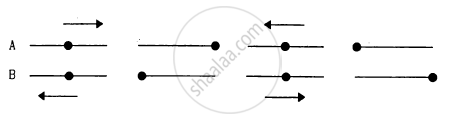
Figure represents two simple harmonic motions.
The parameter which has different values in the two motions is
A pendulum clock that keeps correct time on the earth is taken to the moon. It will run
A wall clock uses a vertical spring-mass system to measure the time. Each time the mass reaches an extreme position, the clock advances by a second. The clock gives correct time at the equator. If the clock is taken to the poles it will
A pendulum clock keeping correct time is taken to high altitudes,
A particle moves on the X-axis according to the equation x = x0 sin2 ωt. The motion is simple harmonic
Assume that a tunnel is dug across the earth (radius = R) passing through its centre. Find the time a particle takes to cover the length of the tunnel if (a) it is projected into the tunnel with a speed of \[\sqrt{gR}\] (b) it is released from a height R above the tunnel (c) it is thrown vertically upward along the length of tunnel with a speed of \[\sqrt{gR}\]
A simple pendulum of length 1 feet suspended from the ceiling of an elevator takes π/3 seconds to complete one oscillation. Find the acceleration of the elevator.
A simple pendulum fixed in a car has a time period of 4 seconds when the car is moving uniformly on a horizontal road. When the accelerator is pressed, the time period changes to 3.99 seconds. Making an approximate analysis, find the acceleration of the car.
A uniform rod of length l is suspended by an end and is made to undergo small oscillations. Find the length of the simple pendulum having the time period equal to that of the road.
A particle is subjected to two simple harmonic motions given by x1 = 2.0 sin (100π t) and x2 = 2.0 sin (120 π t + π/3), where x is in centimeter and t in second. Find the displacement of the particle at (a) t = 0.0125, (b) t = 0.025.
What is an epoch?
The displacement of a particle is represented by the equation y = sin3ωt. The motion is ______.
