Advertisements
Advertisements
प्रश्न
The angle between an incident ray and the mirror is 350.
(i) What is the angle of incidence?
(ii) What is the angle of reflection?
(iii) What is the total angle turned by the ray of light?
(iv) What is the angle between the incident and the reflected rays?
Advertisements
उत्तर
Given, angle between incident ray and mirror = 35o
(a). Angle of incidence = angle of mirror to the normal - angle between incident ray and mirror = 90 - 35 = 55o
(b). Angle of reflection = angle of incidence = 55o
(c). Total angle turned = angle of incidence + angle of reflection = 55 + 55 = 110o
(d). The angle between incident ray and reflected ray = Angle of incidence + Angle of reflection = 55 + 55 = 110o
APPEARS IN
संबंधित प्रश्न
Explain the following term:
Angle of reflection. Draw diagram/diagrams to show them.
A light ray is incident normally on a plane mirror. (a) What is its angle of incidence?
The diagram in Figure shows a point object P in front of a plane mirror MM1.
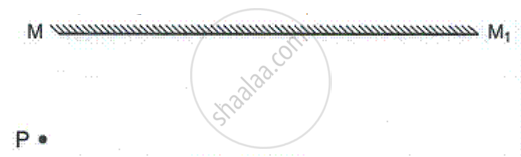
(a) Complete the diagram by taking two rays from the point P to show the formation of its image.
(b) In the diagram, mark the position of eye to see the image.
(c) Is the image formed real or virtual? Explain why?
A converging mirror, forms three times magnified virtual image when an object is placed at a distance of 8 cm from it. Calculate:
- the position of the image
- the focal length of the mirror.
The reflection of a ray of light (OA) normally incident on a plane mirror is shown below
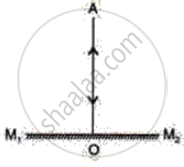
What are the angles of incidence and reflection?
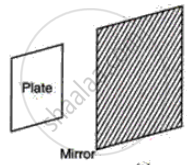
The word PLATE written on a paper is held in front of a plane mirror. Write down the letters as seen in the following case.
The paper is held parallel to the mirror.
An object is placed in front of a convex mirror of focal length 25 cm. By scale, a drawing shows the formation of image and states the nature of image.
Given that v = 10 cm.
Define reflection.
