Advertisements
Advertisements
प्रश्न
What is menstrual cycle?
Advertisements
उत्तर
The menstrual cycle is the cyclic change of the reproductive tract of a primate female. This period is marked by a characteristic event repeated almost every month (28 days with minor variation) in the form of a menstrual flow (i.e., shedding of the endometrium of the uterus with bleeding). Only during pregnancy does it temporarily cease.
APPEARS IN
संबंधित प्रश्न
The Graafian follicle, after ovulation turns into a hormone producing issue called Corpus callosum.
the Biological/technical term for Complete stoppage of menstrual cycle in females
Define the following term :
Ovulation
Explain the changes that occur in the ovary and uterus during menstrual cycle in human females. Mention the influence of pituitary and ovarian hormones in bringing these changes.
‘A proper understanding of the menstrual cycle can help immensely in family planning.’ Do you agree with the statement? Provide reasons for your answer.
Multiple choice question.
Rupturing of follicles and discharge of ova is known as _______.
Follicle stimulating hormone : Development of oocyte : : Luteinizing hormone : ____________
Explain the importance of cleanliness during the time of menstrual cycle in girls.
Find the wrongly matched pair.
Which one of the following events occurs during the secretory phase of the menstrual cycle?
In humans, the menstrual cycle is generally of ______.
Match the Columns.
| Column I | Column II | ||
| i. | Proliferative phase | a. | Breakdown of the endometrial lining |
| ii. | Secretory phase | b. | Follicular phase |
| iii. | Menstruation | c. | Luteal phase |
When does ovulatory phase occur?
Identify the INCORRECT statement.
Corpus luteum develops under the influence of ______.
The mammalian corpus luteum produces ______.
Mainly which type of hormones control the menstrual cycle in human beings?
Which one of the following is the most likely root cause why menstruation is not taking place in regularly cycling human female?
Level of which hormones are at their highest during the luteal phase (second half of the cycle) of the menstrual cycle?
A human female reaches menopause aroung the age of ______.
Distinguish between pollination and fertilisation. Mention the site and product of fertilisation in a flower.
Draw a neat, labelled diagram of a pistil showing pollen tube growth and its entry into the ovule.
A human female experiences two major changes, menarche and menopause during her life. Mention the significance of both the events.
In the figure given below, parts A and B show the level of hormones which influence the menstrual cycle. Study the figure and answer the questions that follow:
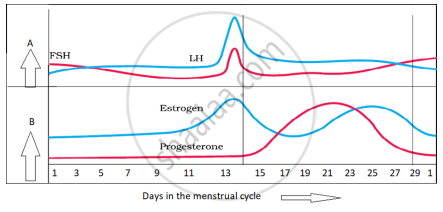
- Name the organs which secrete the hormones represented in parts A and B.
- State the impact of the hormones in part B on the uterus of the human female during 6 to 15 days of the menstrual cycle.
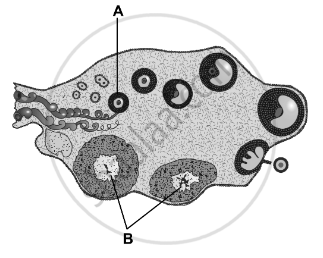
The figure show a section of human ovary. Select the option which gives the correct identification of either A or B with function/characteristic.
Give a reason for the following:
The second half of the menstrual cycle is called the luteal phase as well as the secretory phase.
The onset of menstruation in a human female is called ______.
Name these:
4 phases of the menstrual cycle.
Longest phase of menstrual cycle is ______.
At what age does menopause typically occur?
What condition can cause a temporary stop in the menstrual cycle besides pregnancy?
