Advertisements
Advertisements
प्रश्न
Identify True/False statement. Correct false statement to make it true.
Presence or absence of hymen is not a reliable indicator of virginity or sexual experience.
Advertisements
उत्तर
This statement is true.
APPEARS IN
संबंधित प्रश्न
Name the function of the following:
Fimbriae
Describe the development of a fertilized ovum upto implantation.
Put a tick mark (✓) against the correct alternative in the following statement:
Internally, the uterus opens into:
Mention the functions of Ovary.
Which part of the human body produces Ova?
What happens in a girl’s body under the influence of hormones?
In female, after how much time after fertilization, does the fertilized egg get implanted in the
uterine wall?
The following diagram represents the vertical sectional view of the human female reproductive system.
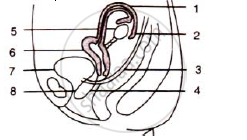
Label the parts indicated by the guidelines 1 to 8.
Give appropriate term for the following:
The onset of reproductive phase in a female.
Give appropriate term of the following:
The process of fusion of ovum and sperm.
Given here is a section of the female reproductive system of human beings.
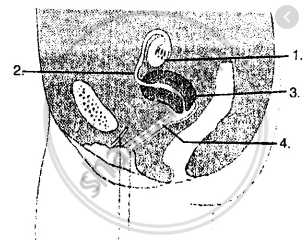
Name the part where fertilisation occurs in human beings.
Draw a sectional view of the human ovary. Label the following parts :
(ii) Secondary oocyte
(iii) Graafian follicle
(iv) Corpus luteum
Given below is a diagram of the female reproductive system of a human being

(i) Name the parts numbered 1 to 6.
(ii) Normally after how many days does an ovary release an egg?
(iii) Where are the sperms released during coitus?
(iv) What do the sperms do after being released?
(v) What is the function of the organ numbered 5?
(vi) How many days does it normally take from the fertilization of the egg up to the birth of the baby?
Write the functional activity of the following structure:
Fallopian tubes
The _______ is also called the womb.
How many lobes are generally present in each mammary gland?
During which process is the egg released from the Graafian follicle?
Which of the following is a finger like structure and lies at the upper junction of the two labia minora above the urethral opening?
Lower narrow end of uterus is called ______.
Bartholin’s glands are situated ______.
To answer the question, study the graphs below for Subjects 1 and 2 showing different levels of certain hormones.
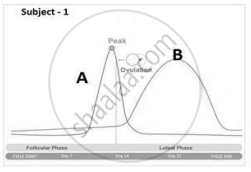
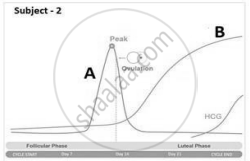
For subject 2 it is observed that the peak for hormone B has reached the plateau stage. After approximately how much time will the curve for hormone B descend?
Explain how the uterus and placenta provide necessary conditions for proper growth and development of the embryo after implantation?
The______ is also called the womb.
Write the specific location of the following:
Vagina
Complete the analogy with respect to reproductive system.
Male : Penis : : Female : ______.
What is the length of an ovary?
Which part of the fallopian tube is the wider, curved middle section and the site of fertilisation?
Which description correctly identifies the uterus?
What is formed when tubules of each mammary lobe join?
