Advertisements
Advertisements
प्रश्न
Draw a neat and well-labeled diagram showing T.S. of the ovary and describe the menstrual cycle in human females.
Advertisements
उत्तर
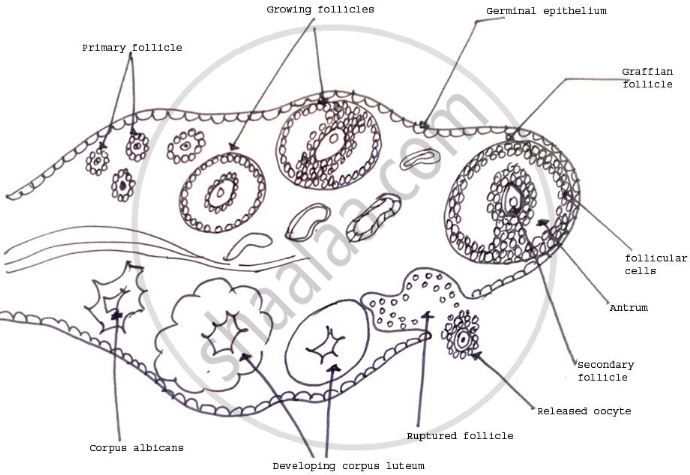
T.S. Ovary
In Human females, at the start of the puberty period, the menstruation is repeated at an average interval of about 28 / 29 days and the cycle of events starting from one mensuration till the next one is called mensuration cycle. It is a monthly flow of blood from the uterus it lasts about 25 days.

PHASES OF MENSTRUATION CYCLE
Changes during the menstrual cycle can be divided into four phases. Menstrual phase b. Proliferative phase c. Ovulatory phase d. Post ovulatory or secretory phase or luteal phase
a. Menstrual Phase (bleeding or destructive phase):
This phase extends from the 1st to the 4th day of the menstrual cycle. Menstruation occurs in the absence of fertilization. During this phase, bleeding occurs as the endometrium of the uterus is sloughed off. The menstrual flow consists of the secretion of endometrial glands, cell debris, and unfertilized ovum along with 35 to 45 ml of blood.
b. Proliferative phase: This phase extends from the 5th to the 13th day of the menstrual cycle.
Changes in the ovary: During this phase, the primordial follicle of the ovary develops into the Graafian follicle. Theca internal cells of the follicle secrete female sex hormone estrogen. Only one follicle develops in one cycle.
Changes in the uterus: Oestrogen secreted by follicular cells of ovary stimulate endometrial glands. This causes the repair of the endometrium. The endometrial cells proliferate and the thickness of endometrium grows to about 3mm to 5mm.
c. Ovulatory phase: During this phase, ovulation takes place. It usually occurs on the 14th day of the cycle. Due to LH secreted by the pituitary, the Graafian follicle bursts and releases the ovum in the abdominal cavity. It passes through the fallopian tube. On its way, if it happens to meet sperms, it is fertilized. If it remains unfertilized then ovum degenerates.
d. Secretory phase/Luteal phase: This phase extends from the 15th to the 28th day of the menstrual cycle. Changes in the ovary: After ovulation, the ruptured follicle develops into a yellow body called corpus luteum. Corpus luteum remains active till the placenta starts the secretion of HCG (Human chorionic gonadotropin). If the ovum is not fertilized, corpus luteum degenerates and transforms into a whitish scar called corpus Albicans.
Changes in Uterus: Corpus luteum formed in ovary secretes progesterone. It causes further growth of endometrial glands. If fertilization occurs, the embryo is implanted in thickened endometrium.
APPEARS IN
संबंधित प्रश्न
Uterus, Parturition, Fertilisation, Gestation, Implantation.
Read the following passage and answer the question that follows:
Rahini and her parents were watching a television program. An advertisement flashed on the screen which was promoting the use of sanitary napkins. Rahini’s parents suddenly changed the channel, but she objected to her parents and explained the need and importance of such an advertisement.
Do you think that Rahini’s objection towards her parents was correct? If so, Why?
During which phase of the menstrual cycle does the endometrium thicken up to 8-10 mm?
Secretion of progesterone by corpus luteum is initiated by ______.
At which stage of the menstrual cycle, both LH and FSH are high?
The level of progesterone is high at which phase in the menstrual cycle?
What role does pituitary gonadotropins play during follicular and ovulatory phases of menstrual cycle? Explain the shifts in steroidal secretions.
Answer the following questions by observing the diagram of menstrual cycle:

- What is the period of menstruation?
- On which day does ovulation occur during the menstrual cycle?
- In the menstrual cycle which reproductive organs undergo changes?
- Which period is said to be the period of regeneration of endometrium?
- Which period is said to be the period of secretions of glands in endometrium?
The onset of menstruation in a human female is called ______.
Name these:
4 phases of the menstrual cycle.
