Advertisements
Advertisements
प्रश्न
What is meant by homologous series?
Advertisements
उत्तर
A series of compounds of the same family in which each member has the same type of carbon skeleton and functional group and differs from the next member by a constant difference of one methylene group \[\ce{(-CH2-)}\] in its molecular and structural formula is called a homologous series.
APPEARS IN
संबंधित प्रश्न
Draw a formula for the first five members of the homologous series beginning with the given compound.
H–COOH
Draw a formula for the first five members of the homologous series beginning with the given compound.
CH3COCH3
Identify the functional group in the following compound.
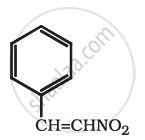
Identify primary, secondary, tertiary and quaternary carbon in the following compound.

Write the first four members of the homologous series that begins with CH3CHO. Also, write down their general molecular formula.
Describe the classification of organic compounds based on their structure.
Write a note on homologous series.
Write the molecular formula of the first six members of homologous series of nitro – alkanes.
What is the percentage of carbon in urea?
(Atomic mass C = 12, H = 1, N = 14, O = 16)
Which of the following is a hetero-aromatic benzenoid compound?
Which of the following yields only one type of monosubstituted chloroalkane upon chlorination?
Which of the following statements is INCORRECT for the organic compounds which belong to homologous series?
Which of the following is NOT a cyclic compound?
What is the molecular formula of pyran?
Identify the number of carbon atoms and number of oxygen atoms respectively present in furan molecule.

A and B are:
The correct decreasing order of priority for the functional groups of organic compounds in the IUPAC system of nomenclature is ______.
Identify primary, secondary, tertiary and quaternary carbon in the following compounds.
\[\begin{array}{cc}
\ce{CH3}\phantom{.................}\\
|\phantom{....................}\\
\ce{CH3 - C - CH - CH2 - CH2 - CH3}\\
|\phantom{.....}|\phantom{...............}\\
\ce{CH3}\phantom{..}\ce{CH3}\phantom{.............}
\end{array}\]
Identify primary, secondary, tertiary, and quaternary carbon in the following compound.
\[\begin{array}{cc}
\ce{CH3}\phantom{..................}\\
|\phantom{....................}\\
\ce{CH3 - C - CH - CH2 - CH2 - CH3}\\
|\phantom{....}|\phantom{................}\\
\ce{CH3} \ce{CH3}\phantom{..............}
\end{array}\]
Identify primary, secondary, tertiary and quaternary carbon in the following compounds.
\[\begin{array}{cc}
\ce{CH3}\phantom{.................}\\
|\phantom{...................}\\
\ce{CH3 - C - CH - CH2 - CH2 - CH3}\\
\phantom{}|\phantom{....}|\phantom{...............}\\
\phantom{}\ce{CH3}\phantom{.}\ce{CH3}\phantom{.............}
\end{array}\]
Identify primary, secondary, tertiary, and quaternary carbon in the following compounds.
\[\begin{array}{cc}
\ce{CH3}\phantom{..................}\\
|\phantom{....................}\\
\ce{CH3 - C - CH - CH2 - CH2 - CH3}\\
\phantom{}|\phantom{....}|\phantom{................}\\
\phantom{.}\ce{CH3\phantom{.}CH3}\phantom{..............}
\end{array}\]
Identify primary, secondary, tertiary, and quaternary carbons in the following compound.
\[\begin{array}{cc}
\ce{CH3\phantom{.................}}\\
|\phantom{....................}\\
\ce{CH3 - C - CH - CH2 - CH2 - CH3}\\
|\phantom{....}|\phantom{................}\\
\ce{CH3 CH3\phantom{.............}}
\end{array}\]
Identify primary, secondary, tertiary and quaternary carbon in the following compound.
\[\begin{array}{cc}
\ce{CH3}\phantom{..................}\\
|\phantom{....................}\\
\ce{CH3 - C - CH - CH2 - CH2 - CH3}\\
|\phantom{....}|\phantom{................}\\
\ce{CH3}\phantom{.}\ce{CH3}\phantom{..............}
\end{array}\]
Identify primary, secondary, tertiary and quaternary carbon in the following compound.
\begin{array}{cc}
\ce{CH3}\phantom{..................}\\
|\phantom{....................}\\
\ce{CH3 - C - CH - CH2 - CH2 - CH3}\\
|\phantom{....}|\phantom{................}\\
\ce{CH3}\ce{CH3}\phantom{..............}
\end{array}
Identify the α-carbons in the following species and give the total number of α-hydrogen.
\[\ce{CH2 = CH - CH2 - CH3}\]
Identify primary, secondary, tertiary and quaternary carbon in the following compound.
\[\begin{array}{cc}
\ce{CH3}\phantom{.................}\\
|\phantom{....................}\\
\ce{CH3 - C - CH - CH2 - CH2 - CH3}\\
|\phantom{....}|\phantom{................}\\
\ce{CH3}\phantom{.}\ce{CH3}\phantom{..............}
\end{array}\]
Identify primary, secondary, tertiary and quaternary carbon in the following compound.
\[\begin{array}{cc}
\ce{CH3}\phantom{..................}\\
|\phantom{....................}\\
\ce{CH3 - C - CH - CH2 - CH2 - CH3}\\
|\phantom{....}|\phantom{................}\\
\ce{CH3}\phantom{.}\ce{CH3}\phantom{..............}
\end{array}\]
