Advertisements
Advertisements
प्रश्न
What is the following and where do you find them in animal body?
Ciliated epithelium
Advertisements
उत्तर
Ciliated epithelium – If the columnar or cuboidal cells bear cilia on their free surface they are called ciliated epithelium. Their function is to move particles or mucus in a specific direction over the epithelium. They are mainly present in the inner surface of hollow organs like bronchioles and Fallopian tube
संबंधित प्रश्न
Describe various types of epithelial tissues with the help of labelled diagrams
Based on the following information, identify the three types of epithelial tissue in the figures given below :
| a | 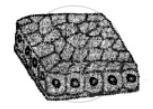 |
b | 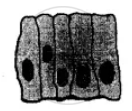 |
c | 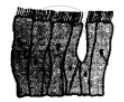 |
(1) Cuboidal epithelium: It consists of a single layer of cuboidal cells.
(2) Columnar epithelium: It is composed of tall, cylindrical cells with oval nuclei usually placed at the base of the cells.
(3) Ciliated epithelium: It consists of cells being hair-like cilia on their free surface.
Fill in the blank
Epithelial tissue is made of cells without any ...................... spaces.
Name one place in living organisms where the following tissues is located:
Squamous epithelium
Answer the following question.
What is cell junction?
Lining of small intestine is made up of ______.
State whether true or false. If false, correct the statement.
Epithelial tissue is protective tissue in animal body.
Prevention of substances from leaking across the tissue is provided by ______.
Name any four important functions of epithelial tissue and provide at least one example of a tissue that exemplifies each function.
Which is not a function of epidermis?
Write true (T) or false (F)
The lining of blood vessels, lung alveoli and kidney tubules are all made up of epithelial tissue.
Give reasons for
Meristematic cells have a prominent nucleus and dense cytoplasm but they lack vacuole.
Assertion: Materials are exchanged between epithelial and connective tissues by diffusion.
Reason: Blood vessels are absent in epithelial tissue.
Explain simple epithelium and its types.
Identify the types of cell junctions that help to stop the leakage of the substances across tissue and facilitation of communication with neighbouring cells via rapid transfer of ions and molecules.
Name the different cell junctions found in tissues.
Stratified epithelial cells have limited role in secretion. Justify their role in our skin.
How does a gap junction facilitate intercellular communication?
