Advertisements
Advertisements
प्रश्न
What is the energy of a hydrogen atom in the first excited state if the potential energy is taken to be zero in the ground state?
Advertisements
उत्तर
In ground state, the potential energy of a hydrogen atom is zero.
An electron is bound to the nucleus with an energy of 13.6 eV.
Therefore, we have to give 13.6 eV energy to move the electron from the nucleus.
Let us calculate the excitation energy required to take an atom from the ground state (n= 1) to the first excited state (n = 2).
`E = 13.6 xx(1/n_1^2 - 1/n_2^2) eV`
Therefore, the excitation energy is given by
`E =13.6xx (1/1^2 - 1/2^2) eV`
`E = 13.6 xx 3/4 eV = 10.2 eV`
Energy of 10.2 eV is needed to take an atom from the ground state to the first excited state.
∴ Total energy of an atom in the first excitation state = 13.6 eV + 10.2 eV = 23.8 eV
APPEARS IN
संबंधित प्रश्न
A 12.5 eV electron beam is used to bombard gaseous hydrogen at room temperature. What series of wavelengths will be emitted?
Find the wavelength of the electron orbiting in the first excited state in hydrogen atom.
The minimum orbital angular momentum of the electron in a hydrogen atom is
Which of the following curves may represent the speed of the electron in a hydrogen atom as a function of trincipal quantum number n?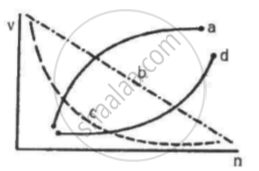
Find the binding energy of a hydrogen atom in the state n = 2.
Find the radius and energy of a He+ ion in the states (a) n = 1, (b) n = 4 and (c) n = 10.
A hydrogen atom emits ultraviolet radiation of wavelength 102.5 nm. What are the quantum numbers of the states involved in the transition?
Find the maximum Coulomb force that can act on the electron due to the nucleus in a hydrogen atom.
Whenever a photon is emitted by hydrogen in Balmer series, it is followed by another photon in Lyman series. What wavelength does this latter photon correspond to?
A gas of hydrogen-like ions is prepared in a particular excited state A. It emits photons having wavelength equal to the wavelength of the first line of the Lyman series together with photons of five other wavelengths. Identify the gas and find the principal quantum number of the state A.
Suppose, in certain conditions only those transitions are allowed to hydrogen atoms in which the principal quantum number n changes by 2. (a) Find the smallest wavelength emitted by hydrogen. (b) List the wavelength emitted by hydrogen in the visible range (380 nm to 780 nm).
The average kinetic energy of molecules in a gas at temperature T is 1.5 kT. Find the temperature at which the average kinetic energy of the molecules of hydrogen equals the binding energy of its atoms. Will hydrogen remain in molecular from at this temperature? Take k = 8.62 × 10⁻⁵ eV K−1.
Find the temperature at which the average thermal kinetic energy is equal to the energy needed to take a hydrogen atom from its ground state to n = 3 state. Hydrogen can now emit red light of wavelength 653.1 nm. Because of Maxwellian distribution of speeds, a hydrogen sample emits red light at temperatures much lower than that obtained from this problem. Assume that hydrogen molecules dissociate into atoms.
Average lifetime of a hydrogen atom excited to n = 2 state is 10−8 s. Find the number of revolutions made by the electron on the average before it jumps to the ground state.
Show that the ratio of the magnetic dipole moment to the angular momentum (l = mvr) is a universal constant for hydrogen-like atoms and ions. Find its value.
When a photon is emitted from an atom, the atom recoils. The kinetic energy of recoil and the energy of the photon come from the difference in energies between the states involved in the transition. Suppose, a hydrogen atom changes its state from n = 3 to n = 2. Calculate the fractional change in the wavelength of light emitted, due to the recoil.
In the Auger process an atom makes a transition to a lower state without emitting a photon. The excess energy is transferred to an outer electron which may be ejected by the atom. (This is called an Auger electron). Assuming the nucleus to be massive, calculate the kinetic energy of an n = 4 Auger electron emitted by Chromium by absorbing the energy from a n = 2 to n = 1 transition.
Why do only discrete frequencies appear in atomic emission spectra?
In what year was Niels Bohr awarded the Nobel Prize in Physics for his explanation of the hydrogen atom spectrum?
What is the physical significance of Planck's constant (h) in the equation \[h\nu_{if} = E_{ni} - E_{nf}\]?
