Advertisements
Advertisements
प्रश्न
Use the mirror equation to show a convex mirror always produces a virtual image independent of the location of the object ?
Advertisements
उत्तर
A convex mirror
f > 0; u < 0 (always)
Case I |u| > |f|

We know,
`v =(fu)/(u-f)`
`fu <0 and f-u<0`
`=> v>0 ` virtual image
Case `2|u|<|f|`
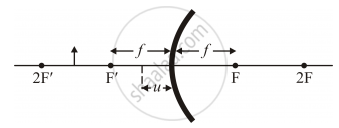
`v=(fu)/(u-f) fu<0`
`=> u> 0 u-f<0`
Hence, at all the positions convex mirror will form a virtual image.
APPEARS IN
संबंधित प्रश्न
a) Give two reasons to explain why reflecting telescopes are preferred over refracting type.
Using mirror formula, explain why does a convex mirror always produce a virtual image.
An object is kept on the principal axis of a concave mirror of focal length 10 cm. at a distance of 15
cm from its pole. The image formed by the mirror is:
(a) Virtual and magnified
(b) Virtual and diminished
(c) Real and magnified
(d) Real and diminished
Use the mirror equation to show that an object placed between f and 2f of a concave mirror forms an image beyond 2f.
Define the term 'limit of resolution'?
Mark the correct options.
A light ray is incident at an angle of 45° with the normal to a √2 cm thick plate (μ = 2.0). Find the shift in the path of the light as it emerges out from the plate.
Write any one use for each of the following mirrors :
(a) Convex
(b) Concave
For paraxial rays, show that the focal length of a spherical mirror is one-half of its radius of curvature.
A point object is placed at a distance of 30 cm from a convex mirror of a focal length of 30 cm. What is the separation between the image and the object?
