Advertisements
Advertisements
प्रश्न
Use the mirror equation to show a convex mirror always produces a virtual image independent of the location of the object ?
Advertisements
उत्तर
A convex mirror
f > 0; u < 0 (always)
Case I |u| > |f|

We know,
`v =(fu)/(u-f)`
`fu <0 and f-u<0`
`=> v>0 ` virtual image
Case `2|u|<|f|`
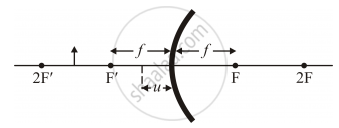
`v=(fu)/(u-f) fu<0`
`=> u> 0 u-f<0`
Hence, at all the positions convex mirror will form a virtual image.
APPEARS IN
संबंधित प्रश्न
Calculate the distance of an object of height h from a concave mirror of radius of curvature 20 cm, so as to obtain a real image of magnification 2. Find the location of the image also.
Use the mirror equation to deduce that the virtual image produced by a convex mirror is always diminished in size and is located between the focus and the pole.
An object is kept on the principal axis of a concave mirror of focal length 10 cm. at a distance of 15
cm from its pole. The image formed by the mirror is:
(a) Virtual and magnified
(b) Virtual and diminished
(c) Real and magnified
(d) Real and diminished
Can a plane mirror ever form a real image?
A point source of light is placed in front of a plane mirror.
following Figure shows two rays A and B being reflected by a mirror and going as A' and B'. The mirror
A light ray falling at an angle of 45° with the surface of a clean slab of ice of thickness 1.00 m is refracted into it at an angle of 30°. Calculate the time taken by the light rays to cross the slab. Speed of light in vacuum = 3 × 10⁸ m s−1.
A light ray is incident normally on the face AB of a right-angled prism ABC (μ = 1.50) as shown in figure. What is the largest angle ϕ for which the light ray is totally reflected at the surface AC?

The figure below shows the positions of a point object O, two lenses, a plane mirror and the final image I which coincides with the object. The focal length of the convex lens is 20 cm. Calculate the focal length of the concave lens.

The focal length f is related to the radius of curvature r of the spherical convex mirror by ______.
