Advertisements
Advertisements
प्रश्न
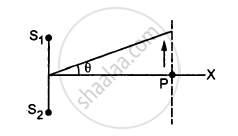
Two speakers S1 and S2, driven by the same amplifier, are placed at y = 1.0 m and y = −1.0 m(See figure). The speakers vibrate in phase at 600 Hz. A man stands at a point on the X-axis at a very large distance from the origin and starts moving parallel to the Y-axis. The speed of sound in air is 330 m s−1. (a) At what angle θ will the intensity of sound drop to a minimum for the first time? (b) At what angle will he hear a maximum of sound intensity for the first time? (c) If he continues to walk along the line, how many more can he hear?
Advertisements
उत्तर
Given :
Frequency of source f = 600 Hz
Speed of sound in air v = 330 m/s
\[v = f\lambda\]
\[\therefore \lambda = \frac{v}{f}\]=\[\frac{330}{600} = 0 . 5 \text { mm }\]
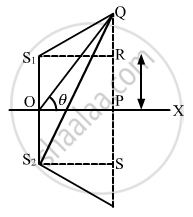
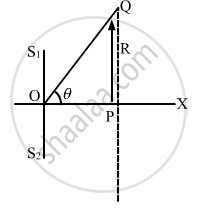
Let the man travel a distance of \[\left( y \right)\]parallel to the y-axis and let \[\left( d \right)\] be the distance between the two speakers. The man is standing at a distance of \[\left( D \right)\]from the origin.
The path difference (x) between the two sound waves reaching the man is given by :
\[x = S_2 Q - S_1 Q = \frac{yd}{D}\]
Angle made by man with the origin :
\[\theta = \frac{y}{D}\]
Given:
d = 2 m
(a) For minimum intensity:
The destructive interference of sound (minimum intensity) takes place if the path difference is an odd integral
multiple of half of the wavelength.
\[\therefore x = (2n + 1)\left( \frac{\lambda}{2} \right)\]
\[\text { For } \left( n = 0 \right)\]
\[ \therefore \frac{yd}{D} = \frac{\lambda}{2}\]
\[\left( \because \theta = \frac{y}{D} \right)\]
\[ \therefore \theta d = \frac{\lambda}{2}\]
\[ \therefore \theta = \frac{\lambda}{2d} = \frac{0 . 55}{4} = 0 . 1375 \text{ rad }\]
\[ \Rightarrow \theta = 0 . 1375 \times (57 . 1)^\circ= 7 . 9^\circ\]
(b) For maximum intensity:
The constructive interference of sound (maximum intensity) takes place if the path difference is an integral multiple of the wavelength.
\[x = n\lambda\]
\[\text { For } \left( n = 1 \right): \]
\[ \Rightarrow \frac{yd}{D} = \lambda\]
\[ \Rightarrow \theta = \frac{\lambda}{d}\]
\[ \Rightarrow \theta = \frac{0 . 55}{2} = 0 . 275 \text { rad }\]
\[ \therefore \theta = 16^\circ\]
(c) The more number of maxima is given by the path difference :
\[\frac{yd}{D} = 2\lambda, 3\lambda, 4\lambda, . . . . . \]
\[ \Rightarrow \frac{y}{D} = \theta = 32^\circ, 64^\circ, 128^\circ\]
He will hear two more maxima at 32° and 64° because the maximum value of θ may be 90°.
APPEARS IN
संबंधित प्रश्न
What is the smallest positive phase constant which is equivalent to 7⋅5 π?
When sound wave is refracted from air to water, which of the following will remain unchanged?
When two waves with same frequency and constant phase difference interfere,
The fundamental frequency of a vibrating organ pipe is 200 Hz.
(a) The first overtone is 400 Hz.
(b) The first overtone may be 400 Hz.
(c) The first overtone may be 600 Hz.
(d) 600 Hz is an overtone.
A listener is at rest with respect to the source of sound. A wind starts blowing along the line joining the source and the observer. Which of the following quantities do not change?
(a) Frequency
(b) Velocity of sound
(c) Wavelength
(d) Time period
A steel tube of length 1.00 m is struck at one end. A person with his ear closed to the other end hears the sound of the blow twice, one travelling through the body of the tube and the other through the air in the tube. Find the time gap between the two hearings. Use the table in the text for speeds of sound in various substances.
Ultrasonic waves of frequency 4.5 MHz are used to detect tumour in soft tissue. The speed of sound in tissue is 1.5 km s−1 and that in air is 340 m s−1. Find the wavelength of this ultrasonic wave in air and in tissue.
The equation of a travelling sound wave is y = 6.0 sin (600 t − 1.8 x) where y is measured in 10−5 m, t in second and x in metre. (a) Find the ratio of the displacement amplitude of the particles to the wavelength of the wave. (b) Find the ratio of the velocity amplitude of the particles to the wave speed.
At what temperature will the speed of sound be double of its value at 0°C?
A string, fixed at both ends, vibrates in a resonant mode with a separation of 2⋅0 cm between the consecutive nodes. For the next higher resonant frequency, this separation is reduced to 1⋅6 cm. Find the length of the string.
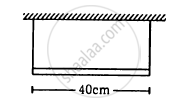
A uniform horizontal rod of length 40 cm and mass 1⋅2 kg is supported by two identical wires as shown in figure. Where should a mass of 4⋅8 kg be placed on the rod so that the same tuning fork may excite the wire on left into its fundamental vibrations and that on right into its first overtone? Take g = 10 m s−2.
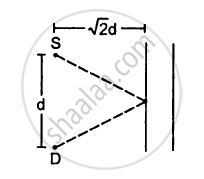
A source S and a detector D are placed at a distance d apart. A big cardboard is placed at a distance \[\sqrt{2}d\] from the source and the detector as shown in figure. The source emits a wave of wavelength = d/2 which is received by the detector after reflection from the cardboard. It is found to be in phase with the direct wave received from the source. By what minimum distance should the cardboard be shifted away so that the reflected wave becomes out of phase with the direct wave?
The two sources of sound, S1 and S2, emitting waves of equal wavelength 20.0 cm, are placed with a separation of 20.0 cm between them. A detector can be moved on a line parallel to S1 S2 and at a distance of 20.0 cm from it. Initially, the detector is equidistant from the two sources. Assuming that the waves emitted by the sources are in detector should be shifted to detect a minimum of sound.
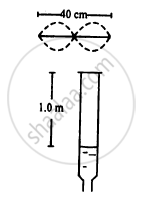
Consider the situation shown in the figure.The wire which has a mass of 4.00 g oscillates in its second harmonic and sets the air column in the tube into vibrations in its fundamental mode. Assuming that the speed of sound in air is 340 m s−1, find the tension in the wire.
A source of sound with adjustable frequency produces 2 beats per second with a tuning fork when its frequency is either 476 Hz of 480 Hz. What is the frequency of the tuning fork?
A traffic policeman standing on a road sounds a whistle emitting the main frequency of 2.00 kHz. What could be the apparent frequency heard by a scooter-driver approaching the policeman at a speed of 36.0 km h−1? Speed of sound in air = 340 m s−1.
A small source of sound oscillates in simple harmonic motion with an amplitude of 17 cm. A detector is placed along the line of motion of the source. The source emits a sound of frequency 800 Hz which travels at a speed of 340 m s−1. If the width of the frequency band detected by the detector is 8 Hz, find the time period of the source.
A sound source, fixed at the origin, is continuously emitting sound at a frequency of 660 Hz. The sound travels in air at a speed of 330 m s−1. A listener is moving along the lien x= 336 m at a constant speed of 26 m s−1. Find the frequency of the sound as observed by the listener when he is (a) at y = − 140 m, (b) at y = 0 and (c) at y = 140 m.
A train running at 108 km h−1 towards east whistles at a dominant frequency of 500 Hz. Speed of sound in air is 340 m/s. What frequency will a passenger sitting near the open window hear? (b) What frequency will a person standing near the track hear whom the train has just passed? (c) A wind starts blowing towards east at a speed of 36 km h−1. Calculate the frequencies heard by the passenger in the train and by the person standing near the track.
Figure shows a source of sound moving along X-axis at a speed of 22 m s−1continuously emitting a sound of frequency 2.0 kHz which travels in air at a speed of 330 m s−1. A listener Q stands on the Y-axis at a distance of 330 m from the origin. At t = 0, the sources crosses the origin P. (a) When does the sound emitted from the source at P reach the listener Q? (b) What will be the frequency heard by the listener at this instant? (c) Where will the source be at this instant?