Advertisements
Advertisements
प्रश्न
The absolute temperature of air in a region linearly increases from T1 to T2 in a space of width d. Find the time taken by a sound wave to go through the region in terms of T1, T2, d and the speed v of sound at 273 K. Evaluate this time for T1 = 280 K, T2 = 310 K, d = 33 m and v = 330 m s−1.
Advertisements
उत्तर
Given:
The absolute temperature of air in a region increases linearly from T1 to T2 in a space of width d.
The speed of sound at 273 K is v.
vT is the velocity of the sound at temperature T.
Let us find the temperature variation at a distance x in the region.
Temperature variation is given by:
\[T = T_1 + \frac{\left( T_2 - T_1 \right)}{d}x \]
\[ v \propto \sqrt{T}\]
\[ \Rightarrow \frac{v_T}{v} = \sqrt{\left( \frac{T}{273} \right)}\]
\[ \Rightarrow v_T = v\sqrt{\left( \frac{T}{273} \right)}\]
\[ \Rightarrow dt = \frac{dx}{v_T} = \frac{du}{v} \times \sqrt{\left( \frac{273}{T} \right)}\]
\[ \Rightarrow t = \frac{\sqrt{273}}{v} \int\limits_0^d \frac{dx}{\left[ T_1 + \frac{\left( T_2 - T_1 \right)}{d}x \right]^\frac{1}{2}}\]
\[ \Rightarrow t = \frac{\sqrt{273}}{v} \times \frac{2d}{T_2 - T_1} \left[ T_1 + \frac{\left( T_2 - T_1 \right)}{d} \right]_0^d \]
\[ \Rightarrow t = \frac{\sqrt{273}}{v} \times \frac{2d}{T_2 - T_1}\left( \sqrt{T_2} - \sqrt{T_1} \right)\]
\[ \Rightarrow t = \left( \frac{2d}{v} \right)\left( \frac{\sqrt{273}}{T_2 - T_1} \right) \times \sqrt{T_2} - \sqrt{T_1} \left( \because A^2 - B^2 = \left( A - B \right)\left( A + B \right) \right)\]
\[ \Rightarrow T = \frac{2d}{v}\frac{\sqrt{273}}{\sqrt{T_2} + \sqrt{T_1}} . . . (i)\]
Evaluating this time:
Initial temperature T1 = 280 K
Final temperature T2 = 310 K
Space width d = 33 m
v = 330 m s−1
On substituting the respective values in the above equation, we get:
\[T = \frac{2 \times 33}{330}\frac{\sqrt{273}}{\sqrt{280} + \sqrt{310}} = 96 \text { ms }\]
APPEARS IN
संबंधित प्रश्न
A string clamped at both ends vibrates in its fundamental mode. Is there any position (except the ends) on the string which can be touched without disturbing the motion? What if the string vibrates in its first overtone?
The bulk modulus and the density of water are greater than those of air. With this much of information, we can say that velocity of sound in air
Two sound waves move in the same direction in the same medium. The pressure amplitudes of the waves are equal but the wavelength of the first wave is double the second. Let the average power transmitted across a cross section by the first wave be P1 and that by the second wave be P2. Then
When two waves with same frequency and constant phase difference interfere,
An electrically maintained tuning fork vibrates with constant frequency and constant amplitude. If the temperature of the surrounding air increases but pressure remains constant, the produced will have
(a) larger wavelength
(b) larger frequency
(c) larger velocity
(d) larger time period.
A person can hear sound waves in the frequency range 20 Hz to 20 kHz. Find the minimum and the maximum wavelengths of sound that is audible to the person. The speed of sound is 360 m s−1.
At what temperature will the speed of sound be double of its value at 0°C?
A sources of sound operates at 2.0 kHz, 20 W emitting sound uniformly in all directions. The speed of sound in air is 340 m s−1 and the density of air is 1.2 kg m −3. (a) What is the intensity at a distance of 6.0 m from the source? (b) What will be the pressure amplitude at this point? (c) What will be the displacement amplitude at this point?
The noise level in a classroom in absence of the teacher is 50 dB when 50 students are present. Assuming that on the average each student output same sound energy per second, what will be the noise level if the number of students is increased to 100?
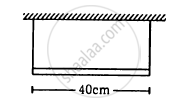
A uniform horizontal rod of length 40 cm and mass 1⋅2 kg is supported by two identical wires as shown in figure. Where should a mass of 4⋅8 kg be placed on the rod so that the same tuning fork may excite the wire on left into its fundamental vibrations and that on right into its first overtone? Take g = 10 m s−2.
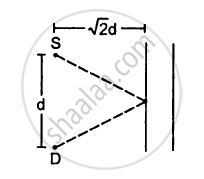
A source S and a detector D are placed at a distance d apart. A big cardboard is placed at a distance \[\sqrt{2}d\] from the source and the detector as shown in figure. The source emits a wave of wavelength = d/2 which is received by the detector after reflection from the cardboard. It is found to be in phase with the direct wave received from the source. By what minimum distance should the cardboard be shifted away so that the reflected wave becomes out of phase with the direct wave?
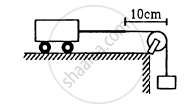
A heavy string is tied at one end to a movable support and to a light thread at the other end as shown in following figure. The thread goes over a fixed pulley and supports a weight to produce a tension. The lowest frequency with which the heavy string resonates is 120 Hz. If the movable support is pushed to the right by 10 cm so that the joint is placed on the pulley, what will be the minimum frequency at which the heavy string can resonate?
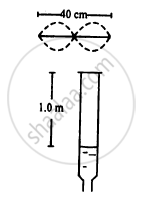
Consider the situation shown in the figure.The wire which has a mass of 4.00 g oscillates in its second harmonic and sets the air column in the tube into vibrations in its fundamental mode. Assuming that the speed of sound in air is 340 m s−1, find the tension in the wire.
The fundamental frequency of a closed pipe is 293 Hz when the air in it is a temperature of 20°C. What will be its fundamental frequency when the temperature changes to 22°C?
A tuning fork of frequency 256 Hz produces 4 beats per second with a wire of length 25 cm vibrating in its fundamental mode. The beat frequency decreases when the length is slightly shortened. What could be the minimum length by which the wire we shortened so that it produces no beats with the tuning fork?
A car moves with a speed of 54 km h−1 towards a cliff. The horn of the car emits sound of frequency 400 Hz at a speed of 335 m s−1. (a) Find the wavelength of the sound emitted by the horn in front of the car. (b) Find the wavelength of the wave reflected from the cliff. (c) What frequency does a person sitting in the car hear for the reflected sound wave? (d) How many beats does he hear in 10 seconds between the sound coming directly from the horn and that coming after the reflection?
With propagation of longitudinal waves through a medium, the quantity transmitted is ______.
A transverse wave is represented by y = 2sin (ωt - kx) cm. The value of wavelength (in cm) for which the wave velocity becomes equal to the maximum particle velocity, will be ______.
A small speaker delivers 2W of audio output. At what distance from the speaker will one detect 120 dB intensity sound?
[Given reference intensity of sound as 10-12W/m2]
