Advertisements
Advertisements
प्रश्न
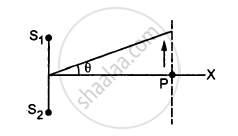
Two speakers S1 and S2, driven by the same amplifier, are placed at y = 1.0 m and y = −1.0 m(See figure). The speakers vibrate in phase at 600 Hz. A man stands at a point on the X-axis at a very large distance from the origin and starts moving parallel to the Y-axis. The speed of sound in air is 330 m s−1. (a) At what angle θ will the intensity of sound drop to a minimum for the first time? (b) At what angle will he hear a maximum of sound intensity for the first time? (c) If he continues to walk along the line, how many more can he hear?
Advertisements
उत्तर
Given :
Frequency of source f = 600 Hz
Speed of sound in air v = 330 m/s
\[v = f\lambda\]
\[\therefore \lambda = \frac{v}{f}\]=\[\frac{330}{600} = 0 . 5 \text { mm }\]
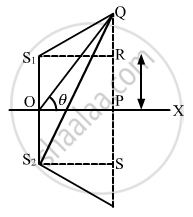
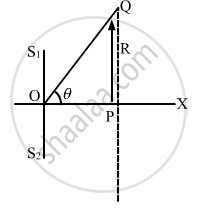
Let the man travel a distance of \[\left( y \right)\]parallel to the y-axis and let \[\left( d \right)\] be the distance between the two speakers. The man is standing at a distance of \[\left( D \right)\]from the origin.
The path difference (x) between the two sound waves reaching the man is given by :
\[x = S_2 Q - S_1 Q = \frac{yd}{D}\]
Angle made by man with the origin :
\[\theta = \frac{y}{D}\]
Given:
d = 2 m
(a) For minimum intensity:
The destructive interference of sound (minimum intensity) takes place if the path difference is an odd integral
multiple of half of the wavelength.
\[\therefore x = (2n + 1)\left( \frac{\lambda}{2} \right)\]
\[\text { For } \left( n = 0 \right)\]
\[ \therefore \frac{yd}{D} = \frac{\lambda}{2}\]
\[\left( \because \theta = \frac{y}{D} \right)\]
\[ \therefore \theta d = \frac{\lambda}{2}\]
\[ \therefore \theta = \frac{\lambda}{2d} = \frac{0 . 55}{4} = 0 . 1375 \text{ rad }\]
\[ \Rightarrow \theta = 0 . 1375 \times (57 . 1)^\circ= 7 . 9^\circ\]
(b) For maximum intensity:
The constructive interference of sound (maximum intensity) takes place if the path difference is an integral multiple of the wavelength.
\[x = n\lambda\]
\[\text { For } \left( n = 1 \right): \]
\[ \Rightarrow \frac{yd}{D} = \lambda\]
\[ \Rightarrow \theta = \frac{\lambda}{d}\]
\[ \Rightarrow \theta = \frac{0 . 55}{2} = 0 . 275 \text { rad }\]
\[ \therefore \theta = 16^\circ\]
(c) The more number of maxima is given by the path difference :
\[\frac{yd}{D} = 2\lambda, 3\lambda, 4\lambda, . . . . . \]
\[ \Rightarrow \frac{y}{D} = \theta = 32^\circ, 64^\circ, 128^\circ\]
He will hear two more maxima at 32° and 64° because the maximum value of θ may be 90°.
APPEARS IN
संबंधित प्रश्न
Explain what is Doppler effect in sound
The bulk modulus and the density of water are greater than those of air. With this much of information, we can say that velocity of sound in air
A tuning fork sends sound waves in air. If the temperature of the air increases, which of the following parameters will change?
When two waves with same frequency and constant phase difference interfere,
A source of sound moves towards an observer.
A man stands before a large wall at a distance of 50.0 m and claps his hands at regular intervals. Initially, the interval is large. He gradually reduces the interval and fixes it at a value when the echo of a clap merges every 3 seconds, find the velocity of sound in air.
Find the minimum and maximum wavelengths of sound in water that is in the audible range (20−20000 Hz) for an average human ear. Speed of sound in water = 1450 m s−1.
Sound waves from a loudspeaker spread nearly uniformly in all directions if the wavelength of the sound is much larger than the diameter of the loudspeaker. (a)Calculate the frequency for which the wavelength of sound in air is ten times the diameter of the speaker if the diameter is 20 cm. (b) Sound is essentially transmitted in the forward direction if the wavelength is much shorter than the diameter of the speaker. Calculate the frequency at which the wavelength of the sound is one tenth of the diameter of the speaker described above. Take the speed of sound to be 340 m/s.
Ultrasonic waves of frequency 4.5 MHz are used to detect tumour in soft tissue. The speed of sound in tissue is 1.5 km s−1 and that in air is 340 m s−1. Find the wavelength of this ultrasonic wave in air and in tissue.
At what temperature will the speed of sound be double of its value at 0°C?
Sound with intensity larger than 120 dB appears pain full to a person. A small speaker delivers 2.0 W of audio output. How close can the person get to the speaker without hurting his ears?
A string of length L fixed at both ends vibrates in its fundamental mode at a frequency ν and a maximum amplitude A. (a)
- Find the wavelength and the wave number k.
- Take the origin at one end of the string and the X-axis along the string. Take the Y-axis along the direction of the displacement. Take t = 0 at the instant when the middle point of the string passes through its mean position and is going towards the positive y-direction. Write the equation describing the standing wave.
In a standing wave pattern in a vibrating air column, nodes are formed at a distance of 4.0 cm. If the speed of sound in air is 328 m s−1, what is the frequency of the source?
Show that if the room temperature changes by a small amount from T to T + ∆T, the fundamental frequency of an organ pipe changes from v to v + ∆v, where \[\frac{∆ v}{v} = \frac{1}{2}\frac{∆ T}{T} .\]
A tuning fork of frequency 256 Hz produces 4 beats per second with a wire of length 25 cm vibrating in its fundamental mode. The beat frequency decreases when the length is slightly shortened. What could be the minimum length by which the wire we shortened so that it produces no beats with the tuning fork?
Two electric trains run at the same speed of 72 km h−1 along the same track and in the same direction with separation of 2.4 km between them. The two trains simultaneously sound brief whistles. A person is situated at a perpendicular distance of 500 m from the track and is equidistant from the two trains at the instant of the whistling. If both the whistles were at 500 Hz and the speed of sound in air is 340 m s−1, find the frequencies heard by the person.
A boy riding on his bike is going towards east at a speed of 4√2 m s−1. At a certain point he produces a sound pulse of frequency 1650 Hz that travels in air at a speed of 334 m s−1. A second boy stands on the ground 45° south of east from his. Find the frequency of the pulse as received by the second boy.
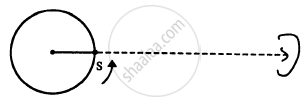
A small source of sound S of frequency 500 Hz is attached to the end of a light string and is whirled in a vertical circle of radius 1.6 m. The string just remains tight when the source is at the highest point. (a) An observer is located in the same vertical plane at a large distance and at the same height as the centre of the circle. The speed of sound in air = 330 m s−1 and g = 10 m s−2. Find the maximum frequency heard by the observer. (b) An observer is situated at a large distance vertically above the centre of the circle. Find the frequency heard by the observer corresponding to the sound emitted by the source when it is at the same height as the centre.
Which of the following statements are true for wave motion?
