Advertisements
Advertisements
प्रश्न
Three organic compounds A, B and C have the following molecular formulae: C4H10O
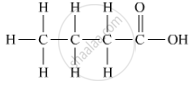
Which compound contains a carboxyl group? Write its name and structural formula.
Advertisements
उत्तर
The organic compound 'A' contains a carboxyl group. The name of the acid is butanoic acid, and its formula is C3H7COOH. Its structural formula is as follows:
APPEARS IN
संबंधित प्रश्न
Complete the following chemical equations :CH3COOH+NaOH→
When you add a few drops of acetic acid to a test-tube containing sodium bicarbonate powder, which one of the following is your observation?
(A) No reaction takes place
(B) A colourless gas with pungent smell is released with brisk effervescence
(C) A brown coloured gas is released with brisk effervescence
(D) Formation of bubbles of a colourless and odourless gas
Give a reason for Conductivity of dilute hydrochloric acid is greater than that of acetic acid
Draw the structures for the following compounds of Propanoic acid.
How would you distinguish experimentally between an alcohol and carboxylic acid on the basis of a chemical property?
What happens when ethanoic acid reacts with sodium carbonate? Write chemical equation of the reaction involved.
Consider the following organic compound:
CH3OH, C2H5OH, CH3COCH3, CH3COOH, C2H5COOH, C4H9COOC2H5, CH4, C2H6, CH3CHO, HCHO
Out of these compound:
Which compound is most likely to be sweet-smelling?
Consider the following organic compound:
CH3OH, C2H5OH, CH3COCH3, CH3COOH, C2H5COOH, C4H9COOC2H5, CH4, C2H6, CH3CHO, HCHO
Out of these compound:
Which compound is a constituent of vinegar?(e) Which compound is a constituent of vinegar?
What do you notice when acetic acid reacts with alkalies?
While studying saponification reactions, the following comments were noted down by the students :
(I) Soap is a salt of fatty acids.
(II) The reaction mixture is basic in nature.
(III) In this reaction heat is absorbed.
(IV) This reaction is not a neutralisation reaction.
Which of these are the correct comments ?
(A) I and III only
(B) I, II and III
(C) II, III and IV
(D) I and II only
On adding 2 mL acetic acid to 2 mL of water in a test tube, it was observed that
(A) a clear and transparent solution is formed
(B) a white precipitate is formed almost immediately
(C) two separate layers were formed
(D) a colourless and odourless gas is evolved
Explain the following term with example.
Reduction
Write three physical properties of acetic acid.
Fill in the blank with appropriate word/words.
Denatured alcohol is a mixture of _____ and _______
State the observation
When the gaseous product obtained by dehydration of ethyl alcohol is passed through bromine water.
Give balanced chemical equations for the following conversion :
Ethanoic acid to ethyl ethanote
Which of the following represents saponification reaction?
Give the balanced chemical equation of the following reaction:
Neutralization of NaOH with ethanoic acid.
Give the balanced chemical equation of the following reaction:
Neutralization of NaOH with ethanoic acid.
Give the balanced chemical equation of the following reaction:
Neutralization of NaOH with ethanoic acid.
