Advertisements
Advertisements
प्रश्न
Third layer of spheres is added to second layer so as to form hcp or ccp structure. What is the difference between the addition of third layer to form these hexagonal close-packed structures?
Advertisements
उत्तर
- The first one-dimensional row of a hexagonal closed-packed (hcp) structure has depressions between neighbouring atoms.
- When a second row is organised so that spheres fit in the depressions, a staggered pattern results. If row 1 is A, row 2 is B.
- When the third row is staggered and in contact with the second row, an A-type layout is created.
- Similarly, the spheres in the fourth row can be organised as a B-layer. This results in the layers being given to the ABAB type. This produces a hexagonal close packing (hcp) structure.
APPEARS IN
संबंधित प्रश्न
Choose the most correct answer.
In crystal lattice formed by bcc unit cell, the void volume is _______.
Choose the most correct answer.
A compound forms hcp structure. Number of octahedral and tetrahedral voids in 0.5 mole of substance is respectively _______.
Answer the following in one or two sentences.
Sketch a tetrahedral void.
Answer the following in brief.
How are the spheres arranged in first layer of simple cubic close-packed structures? How are the successive layers of spheres placed above this layer?
The coordination number of spheres in the hcp lattice in three dimension is ______.
The number of tetrahedral voids are formed if the number of atoms in a crystal is N/2.
The number of octahedral voids formed in 0.5 mol of a compound forming hcp structure?
In hexagonal close packed (hep) structure, ____________ layer and ____________ layer have horizontal and vertical alignment.
A metal crystallizes in bcc lattice with edge length 4.48 Å. The radius of the metal atom is ___________ Å.
The ratio of close-packed atoms to tetrahedral holes in cubic close packing is ____________.
A metallic element crystallises in simple cubic lattice. If edge length of the unit cell is 3Å, with density 8 g/cc, what is the number of unit cells in 100 g of the metal?
(Molar mass of metal = 108 g/mol)
The coordination number of each sphere in bcc lattice is ____________.
Which of the following is CORRECT for the two dimensional arrangement of spheres given below?
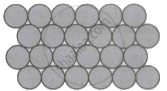
The atoms of element 'Y' form hexagonal close packing and the atoms of element X occupies `3/4` th portion of the number of tetrahedral voids. The formula of the compound formed by X and Y is ____________.
What is the coordination number of cation in ionic compound if the type of hole occupied by cation is cubic?
A metallic element crystallizes in simple cubic lattice. If edge length of the unit cell is 3Å, with density 8 g/cc, what is the number of unit cells in 108 g of the metal?
(Molar mass of metal = 100 g/mol)
Which metal crystallises in a simple cubic structure?
Which among the following metals crystallise as a simple cube?
What is the coordination number of atoms in bcc crystal lattice?
How much vacant space is present in hep crystal lattice?
Predict the type of cubic lattice of a solid element having edge length of 400 pm and density is 6.25 g/ml.
(Atomic mass of element = 60)
The number of nearest neighbours in a bcc unit cell is ______.
Calculate the volume occupied by a particle in a simple cubic unit cell if the volume of the unit cell is 5.5 × 10⁻²² cm3.
What is the minimum number of spheres required to develop an octahedral void?
