Advertisements
Advertisements
प्रश्न
Choose the most correct answer.
A compound forms hcp structure. Number of octahedral and tetrahedral voids in 0.5 mole of substance is respectively _______.
विकल्प
3.011 × 10²³, 6.022 × 10²³
6.022 × 10²³, 3.011 × 10²³
4.011 × 10²³, 2.011 × 10²³
6.011 × 10²³, 12.022 × 10²³
Advertisements
उत्तर
A compound forms hcp structure. Number of octahedral and tetrahedral voids in 0.5 mole of substance is respectively `bb(underline(3.011 xx 10^23, 6.022 xx 10^23))`.
Explanation:
No. of atoms in 0.5 mol = 0.5 × 6.022 × 1023
= 3.011 × 10²³ atoms
No. of octahedral = No. of atoms
Voids = 3.011 × 10²³
No. of tetrahedral voids = 2 × No. of atoms
= 2 × 3.011 × 1023
= 6.022 × 10²³
APPEARS IN
संबंधित प्रश्न
Choose the most correct answer.
In crystal lattice formed by bcc unit cell, the void volume is _______.
Answer the following in one or two sentences.
Sketch a tetrahedral void.
Third layer of spheres is added to second layer so as to form hcp or ccp structure. What is the difference between the addition of third layer to form these hexagonal close-packed structures?
The number of octahedral voids formed in 0.5 mol of a compound forming hcp structure?
In hexagonal close packed (hep) structure, ____________ layer and ____________ layer have horizontal and vertical alignment.
An element crystallises in a bee lattice with cell edge of 500 pm. The density of the element is 7.5 g cm-3. How many atoms are present in 300 g of metal?
The ratio of close-packed atoms to tetrahedral holes in cubic close packing is ____________.
Xenon crystallises in fcc lattice and the edge length of unit cell is 620 pm. What is the radius of Xe atom?
The coordination number of each sphere in bcc lattice is ____________.
The coordination number of Rh in the complex [Rh(NH3)3(SCN)3] is ____________.
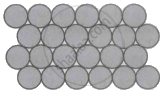
Which of the following is CORRECT for the two dimensional arrangement of spheres given below?
Zinc forms hcp structure. What is the number of tetrahedral voids formed in 0.3 mol of it?
In ABCABC type arrangement of spheres, the coordination number of any sphere is __________.
The atoms of element 'Y' form hexagonal close packing and the atoms of element X occupies `3/4` th portion of the number of tetrahedral voids. The formula of the compound formed by X and Y is ____________.
Zinc forms hcp structure. What is the number of octahedral voids formed in 0.2 mol of it?
What is the coordination number of cation in ionic compound if the type of hole occupied by cation is cubic?
A metallic element crystallizes in simple cubic lattice. If edge length of the unit cell is 3Å, with density 8 g/cc, what is the number of unit cells in 108 g of the metal?
(Molar mass of metal = 100 g/mol)
What is the coordination number of cation in ionic compound if the type of hole occupied by cation is octahedral?
Percentages of free space in cubic close-packed structure and in the body-centered packed structure are respectively ______.
Which metal crystallises in a simple cubic structure?
Which among the following metals crystallise as a simple cube?
Predict the type of cubic lattice of a solid element having edge length of 400 pm and density is 6.25 g/ml.
(Atomic mass of element = 60)
Calculate the total number of tetrahedral and octahedral voids formed in 0.6 mol of a compound if it forms hcp structure.
Calculate the volume occupied by a particle in a simple cubic unit cell if the volume of the unit cell is 5.5 × 10⁻²² cm3.
What is the minimum number of spheres required to develop an octahedral void?
