Advertisements
Advertisements
प्रश्न
Thinking about the Poem
How does the poet suggest that all people on earth are the same?
Advertisements
उत्तर
The poet suggests that all people on earth are the same as they breathe, buried, wake, sleep, hate, love and labour. The importance of the sun and air and water is equal for everyone. Everyone needs peace and suffers from starvation during wars.
संबंधित प्रश्न
What does Jerome say was Montmorency’s ambition in life? What do you think of
Montmorency and why?
Lushkoff is earning thirty five roubles a month. How is he obliged to Sergei for this?
Based on your reading of the story, answer the following question by choosing the correct options.
Private Quelch was nick-named ‘Professor’ because of ____
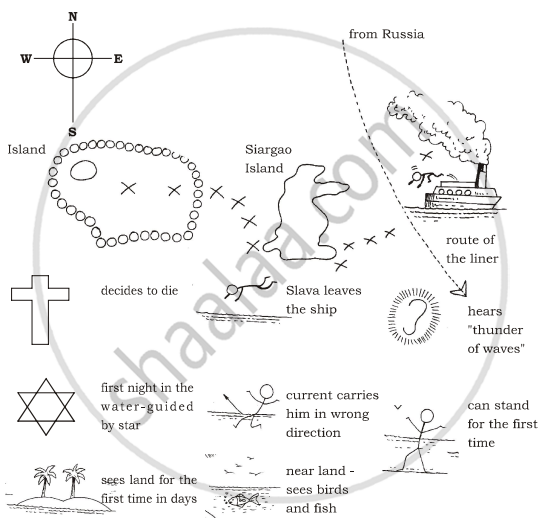
Given below is a map of the area in which Slava Kurilov faced his ordeal. You will also see the major events in the story, in mixed order, each accompanied by a symbol. After you have read ‘Ordeal in the Ocean’, draw the appropriate symbol against each x mark. (One is already drawn for you.) Draw the symbols or number the symbols, and transfer them to the map.)
Some are like fields of sunlit corn,
Meet for a bride on her bridal morn,
Some, like the flame of her marriage fire,
Or, rich with the hue of her heart's desire,
Tinkling,luminous,tender, and clear,
Like her bridal laughter and bridal tear.
Read the lines given above and answer the question that follow.
Besides visual imagery the poet also uses auditory imagery.Pick out the lines.
Some are like fields of sunlit corn,
Meet for a bride on her bridal morn,
Some, like the flame of her marriage fire,
Or, rich with the hue of her heart's desire,
Tinkling,luminous,tender, and clear,
Like her bridal laughter and bridal tear.
Read the lines given above and answer the question that follow.
Mention the colours of the bangles in this stanza. What do they represent?
"Now tell us what 'twas all about,"
Young Peterkin, he cries;
And little wilhelmine looks up
with wonder-waiting eyes;
"Now tell us all about the war,
And what they fought each other for."
"It was the English," Kaspar cried,
"Who put the French to rout;
But what they fought each other for,
I could not well make out;
But everybody said,"quoth he,
"That 'twas a famous victory.
Read the lines given above and answer the question that follow.
Did the children wonder about the reason for the war?
"Now tell us what 'twas all about,"
Young Peterkin, he cries;
And little wilhelmine looks up
with wonder-waiting eyes;
"Now tell us all about the war,
And what they fought each other for."
"It was the English," Kaspar cried,
"Who put the French to rout;
But what they fought each other for,
I could not well make out;
But everybody said,"quoth he,
"That 'twas a famous victory.
Read the lines given above and answer the question that follow.
Name the two opposing sides. Who won?
When there was a strong wind, the pine trees made sad, eerie sounds that kept most people to the main road. But Mr. Oliver was not a nervous or imaginative man. He carried a torch – and on the night I write of, its pale gleam, the batteries were running down – moved fitfully over the narrow forest path. When its flickering light fell on the figure of a boy, who was sitting alone on a rock, Mr. Oliver stopped.
Boys were not supposed to be out of school after seven P.M. and it was now well past nine. What are you doing out here, boy, asked Mr. Oliver sharply, moving closer so that he could recognize the miscreant.
Read the extract given below and answer the question that follow.
Why did Mr Oliver take the shortcut? What did he carry with him?
“Jane,” said the wheelwright, with an impressiveness of tone that greatly subdued his wife, “I read in the Bible sometimes, and find much said about little children. How the Savior rebuked the disciples who would not receive them; how he took them up in his arms, and blessed them; and how he said that ‘whosoever gave them even a cup of cold water should not go unrewarded.’ Now, it is a small thing for us to keep this poor motherless little one for a single night; to be kind to her for a single night; to make her life comfortable for a single night.”
The voice of the strong, rough man shook, and he turned his head away, so that the moisture in his eyes might not be seen. Mrs. Thompson did not answer, but a soft feeling crept into her heart.
“Look at her kindly, Jane; speak to her kindly,” said Joe. “Think of her dead mother, and the loneliness, the pain, the sorrow that must be on all her coming life.” The softness of his heart gave unwonted eloquence to his lips.
Read the extract given below and answer the question that follow.
What did Joe want to convey to his wife from his quotes from the Bible?
Ravi has a lot to say about M.P.Poonai. This shows that
Which of these statements do you agree/disagree to?
The king got angry when he was shown to be wrong ______.
What do you know about the queen ant?
Read the lines in which the following phrases occur. Then discuss with your partner the meaning of each phrase in its context.
amazing mound
What made Patrick believe that he was lucky?
How did Taro meet the demand of his father?
List out the action words in the poem.
Dive, dip, snaps, __________, __________, __________, __________, __________
Find out the meanings of these words.
The words given against the sentences below can be used both as nouns and verbs. Use them appropriately to fill in the blanks.
(i) He said he _________________________ to be invited to the party. (hope)
(ii) We gave up _______________________ of his joining the party.
- Notice the way Mr Gessler speaks English. His English is influenced by his mother tongue. He speaks English with an accent.
- When Mr Gessler speaks, p, t, k, sound like b,d,g. Can you say these words as Mr Gessler would say them?
It comes and never stops. Does it bother me? Not at all. Ask my brother, please.
Read the lines given below and answer the following question:
| Iris: Of her society Be not afraid. I met her deity Cutting the clouds towards Paphos, and her son Dove-drawn with her. |
What is meant by “dove drawn”?
