Advertisements
Advertisements
प्रश्न
The number of electrons in the outermost shell of alkali metals is ______.
विकल्प
1
2
3
7
Advertisements
उत्तर
The number of electrons in the outermost shell of alkali metals is 1.
Explanation:
Alkali metals belong to Group 1 of the periodic table, which includes elements like lithium, sodium, and potassium. They all have a valence electronic configuration of (ns1). Because they possess exactly one electron in their outermost shell, they easily lose it to form univalent positive ions (M+) and achieve a stable noble gas configuration.
APPEARS IN
संबंधित प्रश्न
Write the electronic configuration of two elements X and Y whose atomic numbers are 20 and 17 respectively. Write the molecular formula of the compound formed when element X reacts with element Y. Draw the electron-dot structure of the product and also state the nature of the bond formed between both the elements.
Why do we classify elements?
The element X forms a compound X2Y. Suggest an element that Y might be and give reasons for your choice.
An element X from group 2 of the periodic table reacts with an element Y from group 17 to form a compound.
(a) What is the nature of the compound formed?
(b) State whether the compound formed will conduct electricity or not.
(c) Give the formula of the compound formed.
(d) What is the valency of element X?
(e) How many electrons are there in the outermost shell of an atom of element Y?
The following diagram shows a part of the periodic table containing first three periods in which five elements have been represented by the letters a, b, c, d and e (which are not their chemical symbols):
-
1 18 a 2 13 14 15 16 17 b c d e
(i) Select the letter which represents an alkali metal.
(ii) Select the letter which represents a nobles gas.
(iii) Select the letter which represents a halogen.
(iv) What type of bond is formed between a and e?
(v) What type of bond is formed between d and e?
Find the neutral atom in the periodic table which has the same number of electrons as K+ and Cl−. What is this number?
Write the names and symbols of two very reactive metals belonging to group 1 of the periodic table. Explain by drawing electronic structure, how either one of the two metals reacts with a halogen. With which name is the bond formed between these elements known and what is the class of the compound so formed known? State any four physical properties of such compounds.
The molecular formula of the chloride of element X is XCl. This compound is a solid having a high melting point. Which of the following elements be present in the same group as X.
(a) How is possible valency of an element determined from the electronic configuration of its atom ?
(b) Determine the valency of an element X whose atomic number is 15.
Why was this basis of classification discarded for future classification of elements?
Elements belonging to the same group have the same valency.
Which of the following have inert gases 2 electrons in the outermost shell.
Which one of the following statements is not correct about the trends in the properties of the elements of a period on going from left to right?
An element X from group 2 of the Periodic Table reacts with Y from group 17 to form a compound. Give the formula of the compound.
An element X combines with oxygen to form an oxide XO. This oxide is electrically conducting. Write the formula of the compound formed when X reacts with chlorine.
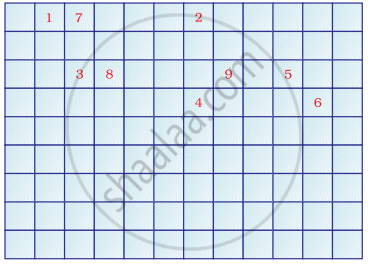
Complete the following cross word puzzle
Across:
(1) An element with atomic number 12.
(3) Metal used in making cans and member of Group 14.
(4) A lustrous non-metal which has 7 electrons in its outermost shell.
Down:
(2) Highly reactive and soft metal which imparts yellow colour when subjected to flame and is kept in kerosene.
(5) The first element of second Period
(6) An element which is used in making fluorescent bulbs and is second member of Group 18 in the Modern Periodic Table
(7) A radioactive element which is the last member of halogen family.
(8) Metal which is an important constituent of steel and forms rust when exposed to moist air.
(9) The first metalloid in Modern Periodic Table whose fibres are used in making bullet-proof vests
Relate the names of the following scientists with the statements given below.
Arranged elements in a group of seven with increasing atomic masses and eighth elements with similar properties kept below the first like eight note in an act of music.
Identify the following:
An element in Period 1 which can be placed in both Group 1 and Group 17 of the Periodic Table.
Justify. Element 'X' forms an oxide with the formula X2O3 which is a solid with a high melting point. ‘X’ would most likely be placed in the group of the Periodic Table as Al.
