Advertisements
Advertisements
प्रश्न
The angles below 180° and above 90° are called as _____________
Advertisements
उत्तर
The angles below 180° and above 90° are called as obtuse angle
APPEARS IN
संबंधित प्रश्न
State if the angle given below, write the name of the vertex, the name of the arm and the name of the angle.

Add: 29° 16′ 23″ and 8° 27′ 12″
Add: 9° 45’56” and 73° 8′ 15″
In the figure, given below name the two reflex angles.

In the given figure; PQR is a straight line. If: ∠PQS = 110°; find ∠RQS.

Find the value of ‘x’ for the following figure:

In the given figure; AB, CD and EF are straight lines. Name the pair of angles forming the straight line angles.

In the given figure; AB, CD and EF are straight lines. Name the pair of angles forming the vertically opposite angles.
Match the following:
| Measure of the angle | Type of angle |
| (1) 180° | (a) Zero angle |
| (2) 240° | (b) Straight angle |
| (3) 360° | (c) Reflex angle |
| (4) 0° | (d) Complete angle |
The measure of the angle is given below. Write the type of angle.
180°
Look at the figure below and write the type of the angle.

Look at the figure below and write the type of the angle.
Pick out the Right angle from the given figures.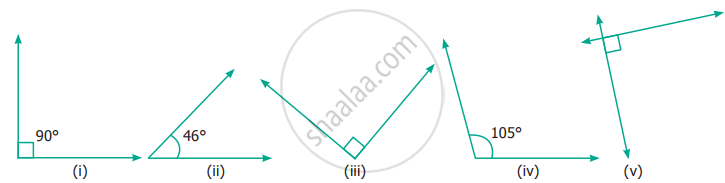
Pick out the Acute angle from the given figures.

Name the angle in the figure given below in all the possible ways
Draw and label of the angle.
∠BIG = 35°
Identify the type of angle shown by the hands of the given clock.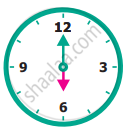
Identify the type of angle shown by the hands of the given clock.
Measure the angle of the given figure using the protractor and identify the type of angle as acute, obtuse, right or straight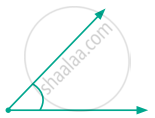
_____________ angle is formed by joining two consecutive right angles
The obtuse angle in ∆ABC is ______________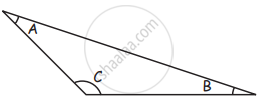
The angle formed by the nail cutter is _______________
Draw anything of your choice around the angle shown. Also, write what kind of angle it is. The first one is done.

In the picture mark angles between the two branches. Which two branches have the biggest angle?

Put 10 Math-Magic books on top of each other. Keep one book slanting to make a slide.

Now do this with six books.
- Roll a ball from the top. From which slide does the ball roll down faster?
- Which slide has the smaller angle?
How many right angles are contained within a straight angle?
