Advertisements
Advertisements
प्रश्न
_____________ angle is formed by joining two consecutive right angles
Advertisements
उत्तर
straight angle is formed by joining two consecutive right angles
APPEARS IN
संबंधित प्रश्न
State if the angle given below, write the name of the vertex, the name of the arm and the name of the angle.

State if the angle given below, write the name of the vertex, the name of the arm and the name of the angle.

Name the points in the exterior of the angle PQR.

Add: 9° 45’56” and 73° 8′ 15″
In the figure, given below name the two obtuse angles

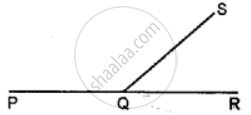
In the given figure; PQR is a straight line. If: ∠SQR = 75°; find ∠PQS.
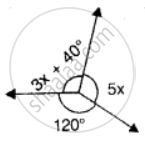
Find the value of ‘x’ for the following figure:

Find the value of ‘x’ for the following figure:
In the given figure; AB, CD and EF are straight lines. Name the pair of angles forming the straight line angles.

Find the complement of: `2/5 "of" 210^circ`
Find the supplement of: `5/7` of 154°
Find the supplement of 0.7 times of 150°
The measure of the angle is given below. Write the type of angle.
75°
Look at the figure below and write the type of the angle.

Look at the figure below and write the type of the angle.

Look at the figure below and write the type of the angle.
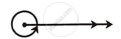
Name the angle in the figure given below in all the possible ways
Draw and label of the angle.
∠BIG = 35°
Draw and label of the angle.
∠SMC = 145°
Draw and label of the angle
∠ABC = 180°
Identify the type of angle shown by the hands of the given clock.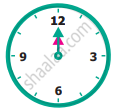
Measure the angle of the given figure using protractor and identify the type of angle as acute, obtuse, right or straight
Measure the angle of the given figure using the protractor and identify the type of angle as acute, obtuse, right or straight
The angle shown in this picture is
The angle formed by the nail cutter is _______________
Name the angles formed when the vessels are lifted by tongs in kitchen is _____________
In the picture mark angles between the two branches. Which two branches have the biggest angle?

An angle that is greater than a Straight Angle but less than a Complete Angle is called a:
