Advertisements
Advertisements
प्रश्न
The rate constant of a first order reaction increases from 2 × 10⁻² to 4 × 10⁻² when the temperature changes from 300 K to 310 K. Calculate the energy of activation (Ea).
(log 2 = 0.301, log 3 = 0.4771, log 4 = 0.6021)
Advertisements
उत्तर
According to the Arrhenius equation,
k=Ae(−Ea/RT)
From this, we get
`"log"k_2/k_1=E_a/(2.303R)((T_2-T_1)/(T_1T_2))`
We are given that
Initial temperature, T1=300 K
Final temperature, T2=310 K
Rate constant at initial temperature, k1=2×10⁻²
Rate constant at final temperature, k2=4×10⁻²
Gas constant, R=8.314 J K−1 mol−1
Substituting the values, we get
`"log"((4xx10^(-2))/(2xx10^(-2)))=E_a/(2.303xx8.314)((310-300)/(300xx310))`
`therefore " activation energy of the reaction, "E_a=(log2xx2.303xx8.314xx300xx310)/10`
`=535985.94" J mol"^(-1)`
`=535.98" kJ mol"^(-1)`
संबंधित प्रश्न
The rate constant for the first-order decomposition of H2O2 is given by the following equation:
`logk=14.2-(1.0xx10^4)/TK`
Calculate Ea for this reaction and rate constant k if its half-life period be 200 minutes.
(Given: R = 8.314 JK–1 mol–1)
The rate constant for the decomposition of hydrocarbons is 2.418 × 10⁻⁵ s−1 at 546 K. If the energy of activation is 179.9 kJ/mol, what will be the value of pre-exponential factor?
The decomposition of hydrocarbon follows the equation
k = `(4.5 xx 10^11 s^-1) e^(-28000 K//T)`
Calculate Ea.
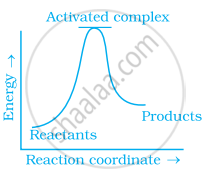
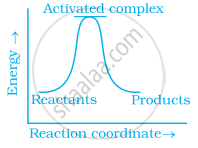
Which of the following graphs represents exothermic reaction?
(a)

(b)
(c)
The reaction between \[\ce{H2(g)}\] and \[\ce{O2(g)}\] is highly feasible yet allowing the gases to stand at room temperature in the same vessel does not lead to the formation of water. Explain.
Why does the rate of a reaction increase with rise in temperature?
Why in the redox titration of \[\ce{KMnO4}\] vs oxalic acid, we heat oxalic acid solution before starting the titration?
Total number of vibrational degrees of freedom present in CO2 molecule is
Explain how and why will the rate of reaction for a given reaction be affected when the temperature at which the reaction was taking place is decreased.
Assertion (A): A reaction can have zero activation energy.
Reason (R): The minimum extra amount of energy absorbed by reactant molecules so that their energy becomes equal to the threshold value is called activation energy.
In the light of the above statements, choose the correct answer from the options given below:
