Advertisements
Advertisements
प्रश्न
A first-order reaction is 50% completed in 40 minutes at 300 K and in 20 minutes at 320 K. Calculate the activation energy of the reaction. (Given : log 2 = 0·3010, log 4 = 0·6021, R = 8·314 JK–1 mol–1)
Advertisements
उत्तर
Given
t1/2 = 40 min at temperature (T1) = 300 K
t1/2 = 20 min at temperature (T2) = 320 K
t1/2 = 40 min, t1/2 = 20 min
`k_1 = 0.693/40`
`k_2 = 0.693/20`
According to Arrhenius equation
`log (k_2/k_1) = "E"_"a"/(2.303 " R") [1/"T"_1 - 1/"T"_2]`
`= "E"_"a"/(2.303 " R") [("T"_2 - "T"_1)/("T"_1"T"_2)]`
`log ((0.0693/20)/(0.0693/40)) = "E"_"a"/(2.303 xx 8.314) [(320 - 300)/(300 xx 320)]`
`therefore 0.3010 = "E"_"a"/19.147 [0.0002083]`
Ea = 27664 J/mol
Ea = 27.7 kJ/mol
APPEARS IN
संबंधित प्रश्न
(b) Rate constant ‘k’ of a reaction varies with temperature ‘T’ according to the equation:
`logk=logA-E_a/2.303R(1/T)`
Where Ea is the activation energy. When a graph is plotted for `logk Vs. 1/T` a straight line with a slope of −4250 K is obtained. Calculate ‘Ea’ for the reaction.(R = 8.314 JK−1 mol−1)
The rate constant for the decomposition of N2O5 at various temperatures is given below:
| T/°C | 0 | 20 | 40 | 60 | 80 |
| 105 × k/s−1 | 0.0787 | 1.70 | 25.7 | 178 | 2140 |
Draw a graph between ln k and `1/T` and calculate the values of A and Ea. Predict the rate constant at 30º and 50ºC.
The decomposition of hydrocarbon follows the equation
k = `(4.5 xx 10^11 s^-1) e^(-28000 K//T)`
Calculate Ea.
The rate of a reaction quadruples when the temperature changes from 293 K to 313 K. Calculate the energy of activation of the reaction assuming that it does not change with temperature.
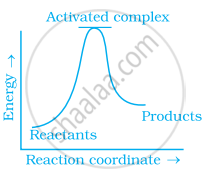
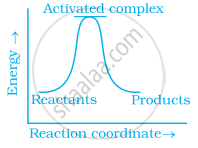
Which of the following graphs represents exothermic reaction?
(a)

(b)
(c)
Oxygen is available in plenty in air yet fuels do not burn by themselves at room temperature. Explain.
Thermodynamic feasibility of the reaction alone cannot decide the rate of the reaction. Explain with the help of one example.
The rate constant for a reaction is 1.5 × 10⁻⁷ sec–1 at 50°C. What is the value of activation energy?
The decomposition of N2O into N2 and O2 in the presence of gaseous argon follows second-order kinetics, with k = (5.0 × 10¹¹ L mol−1 s−1) `"e"^(-(29000 "K")/"T")`. Arrhenius parameters are ______ kJ mol−1.
Activation energy of any chemical reactions can be calculated if one knows the value of:
