Advertisements
Advertisements
प्रश्न
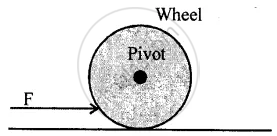
State the effect of force F in of the following diagram.
Advertisements
उत्तर १
Wheel turns about the axis of rotation i.e. about pivot on applying force.

उत्तर २
In the given diagram, the force F is applied tangentially to the wheel at its edge. The effect of this force is:
-
Rotational Motion: The force F causes the wheel to rotate about its pivot. This is due to the creation of a torque, which depends on the magnitude of the force and the distance from the pivot.
-
Translational Motion (if friction permits): The wheel may also move forward (translate) if there is sufficient friction between the wheel and the surface.
Thus, the force causes rotation and possibly translation of the wheel.
APPEARS IN
संबंधित प्रश्न
How does the magnitude of this non-contact force on the two bodies depend on the distance of separation between them?
Where can a body execute free vibrations?
A force is applied on (i) a non-rigid body and (ii) a rigid body. How does the effect of the force differ in the above two cases?
Write the expression for calculating the moment of force about a given axis.
The moment of a force about axis depends ______.
A uniform metre rule of weight 10gf is pivoted at its 0 mark.
What moment of force depresses the rule?
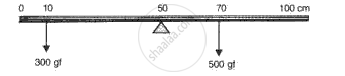
Fig. 5 shows a uniform meter scale weighing 200 gf. Provided at its centre. Two weights 300 gf and 500 gf are suspended from the ruler as shown in the diagram. Calculate the resultant torque of the ruler and hence calculate the distance from mid-point where a 100 gf should be suspended to balance the meter scale.
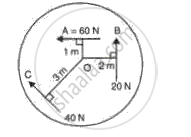
Three forces A, B and C are acting on a rigid body which can turn about O in fig.9. If all the three forces are applied simultaneously, in which direction will the body move? Explain.
In a beam balance when the beam is balanced in a horizontal position, it is in ________ equilibrium.
