Advertisements
Advertisements
प्रश्न
Solve the following problem:
Write the following number in ordinary decimal form:
14.3 × 10⁻²
Advertisements
उत्तर
14.3 × 10−2 = 0.143
APPEARS IN
संबंधित प्रश्न
To make a saturated solution, 36 g of sodium chloride is dissolved in 100 g of water at 293 K. Find its concentration at this temperature.
Calculate the amount of carbon dioxide that could be produced when 1 mole of carbon is burnt in 16 g of dioxygen.
Solve the following problem:
Find out the molar mass of the following compounds:
Mohr’s salt [FeSO4(NH4)2SO4.6H2O]
(At. mass: Cu = 63.5; S = 32; O = 16; H = 1; Na = 23; C = 12; Fe = 56; N = 14)
Solve the following problem:
Write the following number in ordinary decimal form:
3.49 × 10⁻¹¹
Solve the following problem:
Write the following number in ordinary decimal form:
43.71 × 10⁻⁴
Solve the following problem:
Write the following number in ordinary decimal form:
0.00477 × 10⁵
Solve the following problem:
Perform the following calculation. Round off your answer to two digits.
`(1.4xx10^9)/((2.77xx10^3)(3.76xx10^5))`
Solve the following problem:
Perform the following calculation. Round off your answer to three digits.
`(8.94xx10^6)/(4.35xx10^4)`
Solve the following problem:
Perform the following calculation. Round off your answer to three digits.
`((9.28xx10^9)(9.9xx10^-7))/((511)(2.98xx10^-6))`
A 1.000 mL sample of acetone, a common solvent used as a paint remover, was placed in a small bottle whose mass was known to be 38.0015 g.
The following values were obtained when the acetone-filled bottle was weighed: 38.7798 g, 38.7795 g and 38.7801 g. How would you characterise the precision and accuracy of these measurements if the actual mass of the acetone was 0.7791 g?
Solve the following problem:
Your laboratory partner was given the task of measuring the length of a box (approx 5 in) as accurately as possible, using a metre stick graduated in milimeters. He supplied you with the following measurements:
12.65 cm, 12.6 cm, 12.65 cm, 12.655 cm, 126.55 mm, 12 cm.
State which of the measurements you would accept, giving the reason.
Solve the following problem:
What weight of calcium oxide will be formed on heating 19.3 g of calcium carbonate?
(At. wt.: Ca = 40; C = 12; O = 16)
Solve the following problem:
The hourly energy requirements of an astronaut can be satisfied by the energy released when 34 grams of sucrose are “burnt” in his body. How many grams of oxygen would be needed to be carried in space capsule to meet his requirement for one day?
Name the process associated with the following
A drop of ink placed on the surface of water contained in a glass spreads throughout the water.
When light is passed through water containing a few drops of milk, it shows a bluish tinge. This is due to the ______ of light by milk and the phenomenon is called ______. This indicates that milk is a ______ solution.
Non-metals are usually poor conductors of heat and electricity. They are non-lustrous, non-sonorous, non-malleable and are coloured.
Name a lustrous non-metal.
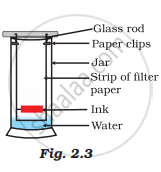
A child wanted to separate the mixture of dyes constituting a sample of ink. He marked a line by the ink on the filter paper and placed the filter paper in a glass containing water as shown in Fig.2.3. The filter paper was removed when the water moved near the top of the filter paper.
(i) What would you expect to see, if the ink contains three different coloured components?
(ii) Name the technique used by the child.
(iii) Suggest one more application of this technique.
What will be the molality of the solution containing 18.25 g of \[\ce{HCl}\] gas in 500 g of water?
Which of the following solutions have the same concentration?
(i) \[\ce{20 g of NaOH in 200 mL of solution}\]
(ii) \[\ce{0.5 mol of KCl in 200 mL of solution}\]
(iii) \[\ce{40 g of NaOH in 100 mL of solution}\]
(iv) \[\ce{20 g of KOH in 200 mL of solution}\]
The molarity of pure water is ______.
An aqueous KCl solution of density 1.20 g mL-1 has a molality of 3.30 mol kg-1. The molarity of the solution in mol L-1 is ______. (Nearest integer)
The molality of solution containing 15.20 g of urea, (molar mass = 60) dissolved in 150 g or water is ______.
Find the molality of solution if boiling point increases by 1.75 K and molal elevation constant of solvent is 5K kg mol-1.
