Advertisements
Advertisements
प्रश्न
Match the following physical quantities with units
| Physical quantity | Unit |
| (i) Molarity | (a) g mL–1 |
| (ii) Mole fraction | (b) mol |
| (iii) Mole | (c) Pascal |
| (iv) Molality | (d) Unitless |
| (v) Pressure | (e) mol L–1 |
| (vi) Luminous intensity | (f) Candela |
| (vii) Density | (g) mol kg–1 |
| (viii) Mass | (h) Nm–1 |
| (i) kg |
Advertisements
उत्तर
| Physical quantity | Unit |
| (i) Molarity | (e) mol L–1 |
| (ii) Mole fraction | (d) Unitless |
| (iii) Mole | (b) mol |
| (iv) Molality | (g) mol kg–1 |
| (v) Pressure | (c) Pascal |
| (vi) Luminous intensity | (f) Candela |
| (vii) Density | (a) g mL–1 |
| (viii) Mass | (i) kg |
Explanation:
(i) It is defined as the number of moles of solute dissolved in 1 litre of solution. So, the unit of molarity is mol L–1
(ii) Mole fraction is defined as the number of moles of a constituent divided by the total number of moles. So, it is unitless.
(iii) Mole is the unit to measure the amount of an atom or molecule in \[\ce{SI}\] system. it is symbolized as "mol".
(iv) It is defined as the number of moles of solute dissolved in 1 kg of solvent. so, the unit of morality is mol kg–1.
(v) It is defined as the force per unit area. so, the unit of pressure is Pascal.
(vi) It is the amount of visible light released per unit solid angle in unit time. so, it's unit will ve candela.
(vii) It is defined as the mass of a substance (in kg) divided by the volume of that substance (in mL). The unit of density is g mL–1.
(viii) Mass is used to measure the amount of a substance or an object. The unit of mass is kg.
APPEARS IN
संबंधित प्रश्न
Explain the term Saturated solution giving examples.
Explain the term molality
Solve the following problem:
Find out the molar mass of the following compounds:
Mohr’s salt [FeSO4(NH4)2SO4.6H2O]
(At. mass: Cu = 63.5; S = 32; O = 16; H = 1; Na = 23; C = 12; Fe = 56; N = 14)
Solve the following problem:
Write the following number in ordinary decimal form:
0.011 × 10⁻³
Solve the following problem:
Write the following number in ordinary decimal form:
0.00477 × 10⁵
Solve the following problem:
Perform the following calculation. Round off your answer to two digits.
`1/(3.40xx10^24)`
Solve the following problem:
Perform the following calculation. Round off your answer to two digits.
`33/(9.00xx10^-4)`
Solve the following problem:
Perform the following calculation. Round off your answer to two digits.
`(1.4xx10^9)/((2.77xx10^3)(3.76xx10^5))`
Perform the following calculation. Round off your answer to three digits.
(8.39 107) (4.53 109)
A 1.000 mL sample of acetone, a common solvent used as a paint remover, was placed in a small bottle whose mass was known to be 38.0015 g.
The following values were obtained when the acetone-filled bottle was weighed: 38.7798 g, 38.7795 g and 38.7801 g. How would you characterise the precision and accuracy of these measurements if the actual mass of the acetone was 0.7791 g?
Solve the following problem:
Your laboratory partner was given the task of measuring the length of a box (approx 5 in) as accurately as possible, using a metre stick graduated in milimeters. He supplied you with the following measurements:
12.65 cm, 12.6 cm, 12.65 cm, 12.655 cm, 126.55 mm, 12 cm.
Give your reason for rejecting each of the others.
Give an example of each mixture having the following characteristics. Suggest a suitable method to separate the components of this mixture
Two immiscible liquids.
Non-metals are usually poor conductors of heat and electricity. They are non-lustrous, non-sonorous, non-malleable and are coloured.
Name a lustrous non-metal.
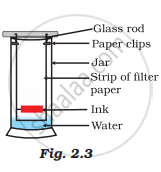
A child wanted to separate the mixture of dyes constituting a sample of ink. He marked a line by the ink on the filter paper and placed the filter paper in a glass containing water as shown in Fig.2.3. The filter paper was removed when the water moved near the top of the filter paper.
(i) What would you expect to see, if the ink contains three different coloured components?
(ii) Name the technique used by the child.
(iii) Suggest one more application of this technique.
Sulphuric acid reacts with sodium hydroxide as follows:
\[\ce{H2SO4 + 2NaOH -> Na2SO4 + 2H2O}\]
When 1 L of 0.1 M sulphuric acid solution is allowed to react with 1 L of 0.1 M sodium hydroxide solution, the amount of sodium sulphate formed and its molarity in the solution obtained is:
(i) 0.1 mol L–1
(ii) 7.10 g
(iii) 0.025 mol L–1
(iv) 3.55 g
Which of the following terms are unitless?
(i) Molality
(ii) Molarity
(iii) Mole fraction
(iv) Mass percent
If 4 g of \[\ce{NaOH}\] dissolves in 36 g of \[\ce{H2O}\], calculate the mole fraction of each component in the solution. Also, determine the molarity of solution (specific gravity of solution is 1g mL–1).
250 g solution of D-glucose in water contains 10.8% of carbon by weight. The molality of the solution is nearest to ______.
(Given: Atomic weights are H, 1u; C, 12u; O, 16u)
Molarity is ______.
