Advertisements
Advertisements
प्रश्न
Calculate the amount of carbon dioxide that could be produced when 1 mole of carbon is burnt in 16 g of dioxygen.
Advertisements
उत्तर
The balanced reaction of combustion of carbon can be written as:-
\[\ce{\underset{1 mole}{C_{(s)}} + \underset{(32 g)}{\underset{1 mole}{O_{2(g)}}} -> \underset{(44 g)}{\underset{1 mole}{CO_{2(g)}}}}\]
According to the question, only 16 g of dioxygen is available. Hence, it will react with 0.5 mole of carbon to give 22 g of carbon dioxide. Hence, it is a limiting reactant.
APPEARS IN
संबंधित प्रश्न
Explain the term mole fraction.
Solve the following problem:
Find out the molar mass of the following compounds:
Copper sulphate crystal (CuSO4.5H2O)
(At. mass: Cu = 63.5; S = 32; O = 16; H = 1; Na = 23; C = 12; Fe = 56; N = 14)
Solve the following problem:
Find out the molar mass of the following compounds:
Sodium carbonate, decahydrate (Na2CO3.10H2O)
(At. mass: Cu = 63.5; S = 32; O = 16; H = 1; Na = 23; C = 12; Fe = 56; N = 14)
Solve the following problem:
Find out the molar mass of the following compounds:
Mohr’s salt [FeSO4(NH4)2SO4.6H2O]
(At. mass: Cu = 63.5; S = 32; O = 16; H = 1; Na = 23; C = 12; Fe = 56; N = 14)
Solve the following problem:
Write the following number in ordinary decimal form:
3.49 × 10⁻¹¹
Solve the following problem:
Write the following number in ordinary decimal form:
3.75 × 10⁻¹
Solve the following problem:
Write the following number in ordinary decimal form:
0.011 × 10⁻³
Solve the following problem:
Write the following number in ordinary decimal form:
14.3 × 10⁻²
Solve the following problem:
Write the following number in ordinary decimal form:
0.00477 × 10⁵
Solve the following problem:
Write the following number in ordinary decimal form:
5.00858585
Solve the following problem:
Perform the following calculation. Round off your answer to two digits.
`1/(3.40xx10^24)`
Solve the following problem:
Perform the following calculation. Round off your answer to three digits.
`((9.28xx10^9)(9.9xx10^-7))/((511)(2.98xx10^-6))`
What are the favourable qualities given to gold when it is alloyed with copper or silver for the purpose of making ornaments?
Give an example of each mixture having the following characteristics. Suggest a suitable method to separate the components of this mixture
Two immiscible liquids.
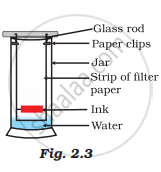
A child wanted to separate the mixture of dyes constituting a sample of ink. He marked a line by the ink on the filter paper and placed the filter paper in a glass containing water as shown in Fig.2.3. The filter paper was removed when the water moved near the top of the filter paper.
(i) What would you expect to see, if the ink contains three different coloured components?
(ii) Name the technique used by the child.
(iii) Suggest one more application of this technique.
250 g solution of D-glucose in water contains 10.8% of carbon by weight. The molality of the solution is nearest to ______.
(Given: Atomic weights are H, 1u; C, 12u; O, 16u)
The molality of solution containing 15.20 g of urea, (molar mass = 60) dissolved in 150 g or water is ______.
Molarity is ______.
